








Bio Computation

NERI OXMAN, Head of the Mediated Matter Group at MIT Media Lab
NERI OXMAN, Material Ecology
David Benjamin, Bio Computation
Interviews:
- Andrew Phillips, Bio Computation Group, Microsoft
Lectures:
- Neri Oxman at the GSAPP at Columbia University
Readings & References:
- Bio Computation at Microsoft
- Programming Cells
- Programming DNA
- Programming languages for biological processes
- Amyris
- Riffyn
- Synbiota
- Juno Therapeutics
- Calico Labs
- SynBioBeta Conference
- FastCo Article: How we will grow the next generation of buildings with bacteria
- "Why Bio is the New Digital"
- Nanopore
- Darpa Living Foundaries
- BioElectronics
This week I interviewed the head of the Bio Computation Group, Andrew Philips, at the Microsoft Research Lab in Cambridge, England. In Philips’ group, bio design is not just about “incorporating living systems into design practice,” but it is about literally designing the way the cells in living systems function and behave. His work aims to program biological systems using (1) a proprietary programming language his team has developed and (2) DNA modification techniques. The software enables a bio-programmer to program DNA circuits that
allow computation to be performed at the molecular scale, while also interfacing directly with the molecular components of living systems. They form structures that are stable inside cells, and their interactions can be precisely controlled by modifying their nucleotide sequences.
Philips’ work sits at the intersection of software design, software modeling, and biological assembly. He imagines a future where, using his software, “we will be able to reprogram the way cells work [and thus] be able to reprogram the way diseases work.”
While companies like Microsoft and Riffyn are creating biological software and programming language platforms, there are many other companies in the bio-tech space looking to capitalize on this growing field by literally reengineering life. Amyris, Juno Therapeutics, and Calico are just a few that I researched after my conversation with Philips. For example, Calico, a Google acquisition, is researching the “biology that controls lifespan,” and Juno Therapeutics “genetically engineers one’s own T-Cells” as a form of cancer treatment. These companies are attempting to redesign life at the cellular level and are reimagining what it means to be human. Is the fountain of youth and a cure for cancer possible in my lifetime? Will synthetic biology become commonplace in the next decade?
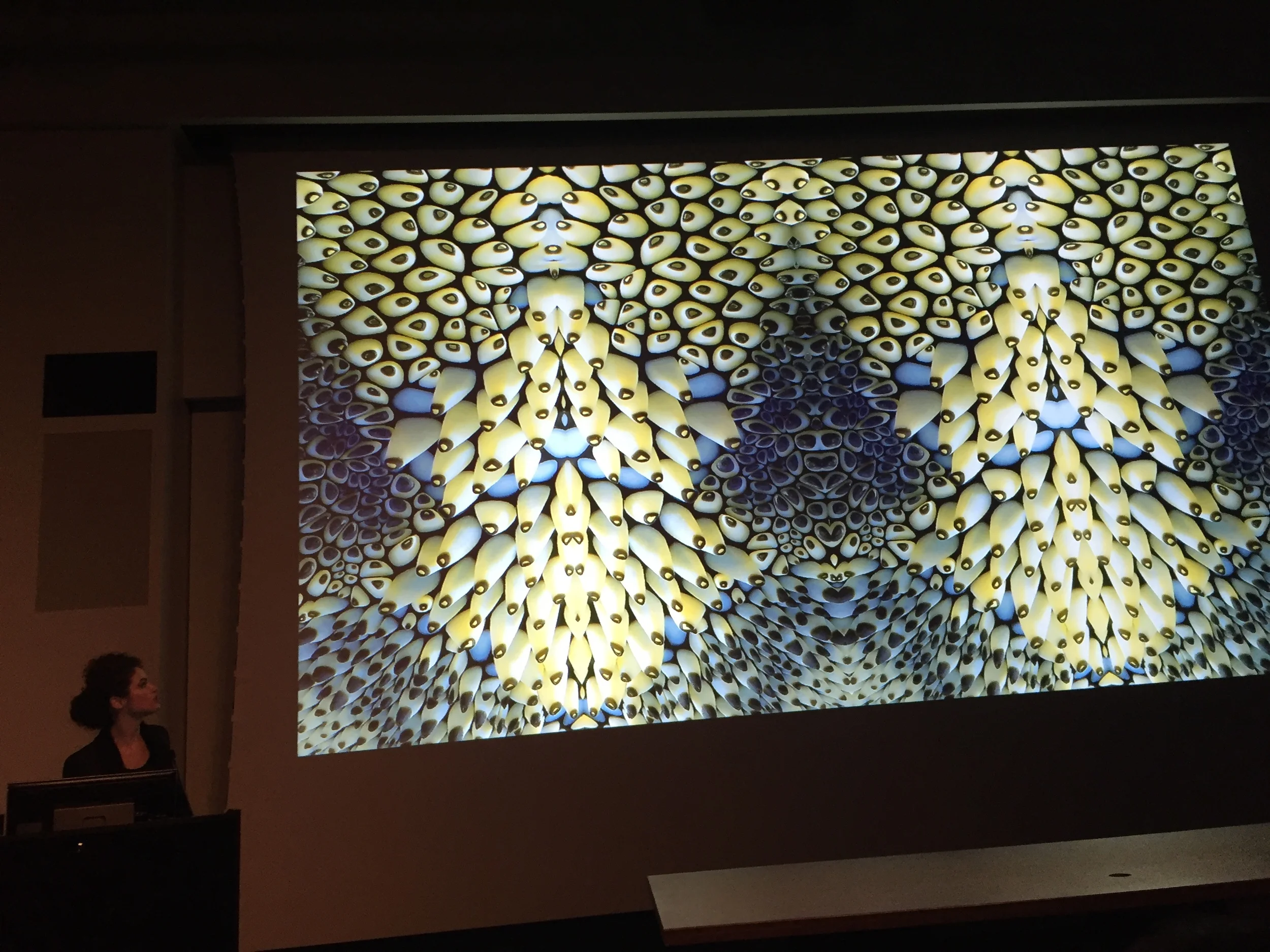
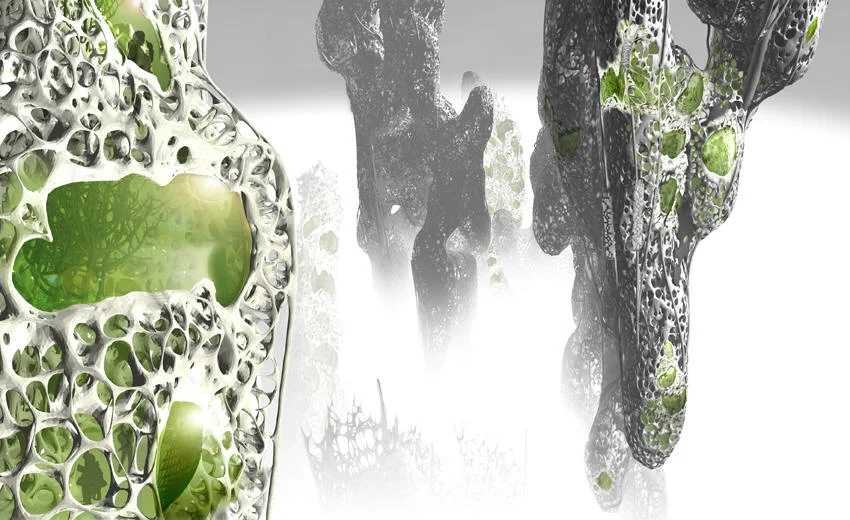
This week I also attended a lecture on Material Ecology by Neri Oxman at the GSAPP of Columbia University. Oxman, like Philips, contends that in the next 10 years, because of synthetic biology, “being human will be something very different [than it is today].” Her project, Mushtari, is a Design Futures piece that plays with themes of the human microbiome, synthetic biology, and space travel. The wearable device is comprised of:
...a single strand filled with living matter inspired by the form and function of the human gastrointestinal tract [and] is designed as an organ system for consuming and digesting biomass, absorbing nutrients and expelling waste.
Her piece serves as a prototype for a future when designers think, not just about the function and aesthetics of an object, but of how the biological systems at the cellular level might be modified to augment the object itself. Mushtari is designed “to support the flow of cyanobacteria engineered to convert daylight into consumable sucrose” for a time when humans live off-planet.
In her lecture, Oxman asked the audience of architects: “To what extent will we have to hack nature to get to the larger scale of the built environment?” “Hacking nature” to redesign the built environment has been a central theme of this course, yet today there is still no concrete, implementable solution that answers the question. However, bio-designer and architect David Benjamin imagines a future when there is a very blurred line between architect and synthetic biologist. In his project, Bio Computation, a silent short-film, he argues that we will soon be “creating new sustainable flows of energy and raw material” through the implementation of synthetic biology using bio-computation and programming (like that being done today at Microsoft) with a seamless application to bio-materials in the built environment.
Neri Oxman closed her lecture by stating that we now live in a world where we, humans, will “mother nature.” In this sense, she refers to mother as a verb, meaning to give rise to or to produce. And indeed, with synthetic biology and bio computation, biology and electronics are becoming fungible (recently proclaimed by Joi Ito, head of the MIT Media Lab, at the Solid Conference), and humans are now defining and producing nature.
I ended my conversation with Andrew Philips by asking him what he thought the dangers could be with these emerging bio-technologies. As a scientist, he spoke of protocols and ethical guidelines, and while Philips is well aware of the potential harm in bio-tech, he is one of the good guys, truly trying to build a better world by tackling disease. As a designer, I do think about those individuals who may not be so good. What are the implications when humans define what nature is? What are the bio-political implications?
Speculation:
In ten years, bio computation, the ability to program DNA, will be commonplace and nearly everyone (with access to healthcare) will have genetically engineered cells in his body to combat disease. Because biotechnology is growing faster than Moore’s Law, in 20-25 years we will be engineering biology for the built environment.
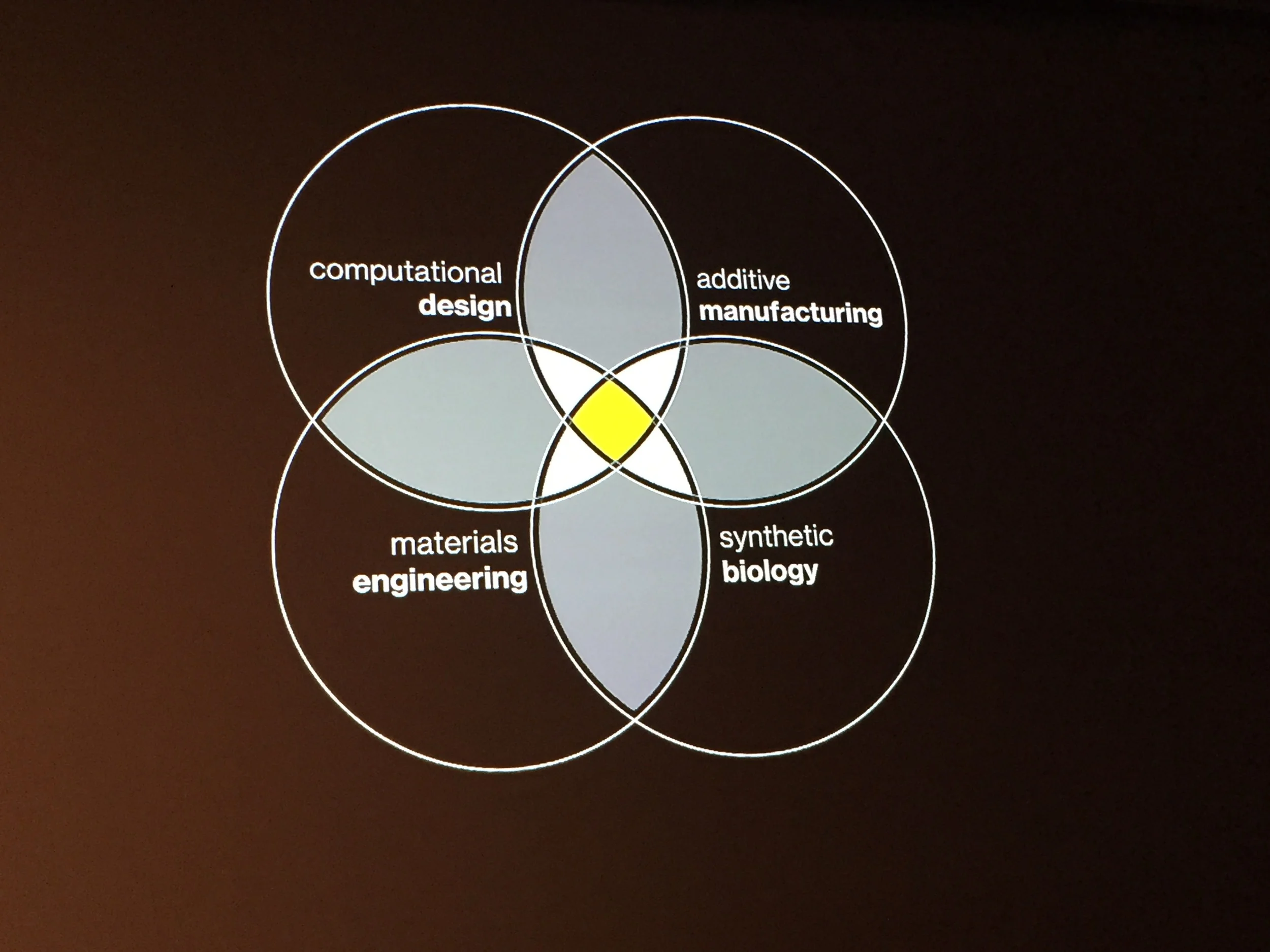
Photos from Neri Oxman's Lecture:





Thesis I Update
Progress report:
I am pursing two parallel streams of work:
- Creating data visualizations of my two data sets to form a body of work that can be bound with the final writing piece.
- Investigating the story that this data is telling (i.e what it is that I can learn from this data) to form a narrative that can be expressed through an artistically compelling web-based experience/installation. This in large, at this point in the process, is with regards to understanding the science behind the data — marrying the science, to the data, to the narrative.
I had a meeting with one of a scientist from the Cornell lab. She explained to me that, while there is preliminary evidence of health links such as obesity and depression to the microbiome, there is really not enough evidence to responsibly make that link. I think this is probably an area that I can discuss in the paper that will point to the importance and relevance of the microbiome as a topic. There are plenty of white papers that discuss the health links that can support my arguments. However, in terms of my core thesis questions, I think this is not the area that I will pursue.
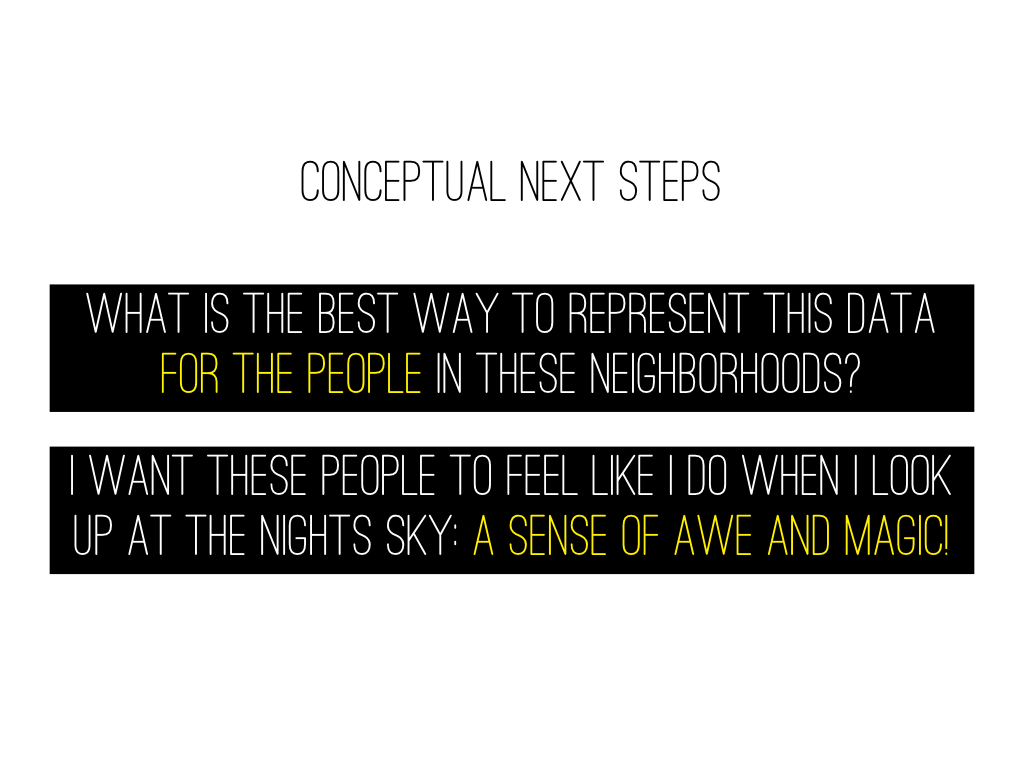
Also, I think for me personally I am not interested in pursuing the environmental angle (i.e. links to chemicals, toxins). After thinking about this more, the original impetus is Powers of Ten. I want to inspire people, not scare them. I want this work to be more focused on the positive aspects of the hidden microbial world.
So in terms of the questions that frame the making, I am exploring more spacial perception and the ways that humans perceive the world. Here are some inspiration projects I am thinking about:
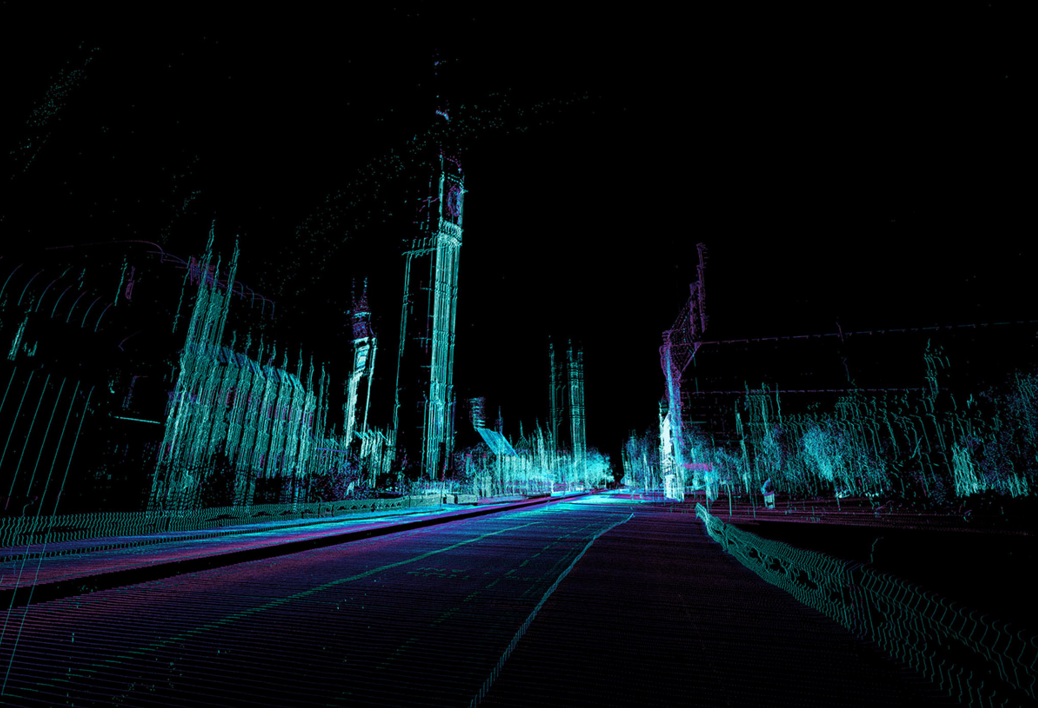
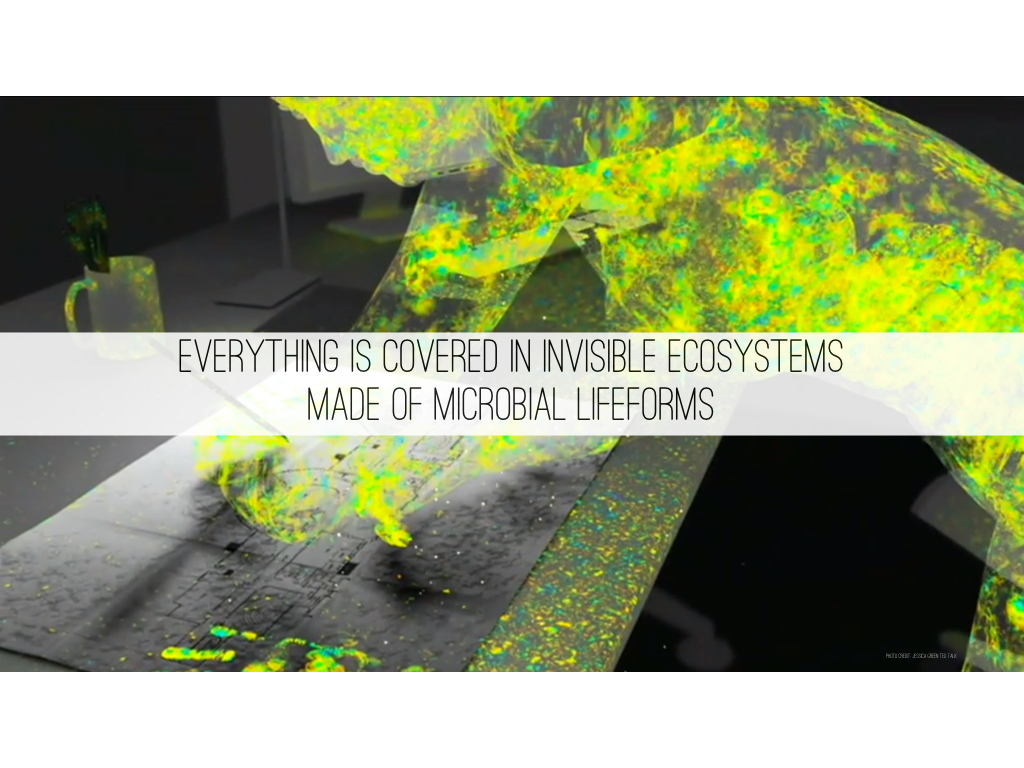
I am exploring the way that humans can visualize this invisible world.
I am asking:
- If humans could perceive the microbial world, what would that look like?
- How can we visualize the effects of the built environment on the microbial world?
- What does that distortion look like? Clouds? Shadows?
- How can we visualize the functional pathways of the microbial communities in NYC to tell a story about our relationship with microbes?
Further research into what the functional pathways are will shed light on what these microbes do. This will begin to open the narrative up to the relationship with humans. And, thus later I can start asking: how does the microbiome effect the human living there?
Technical Progress:
In total there are 2 data sets:
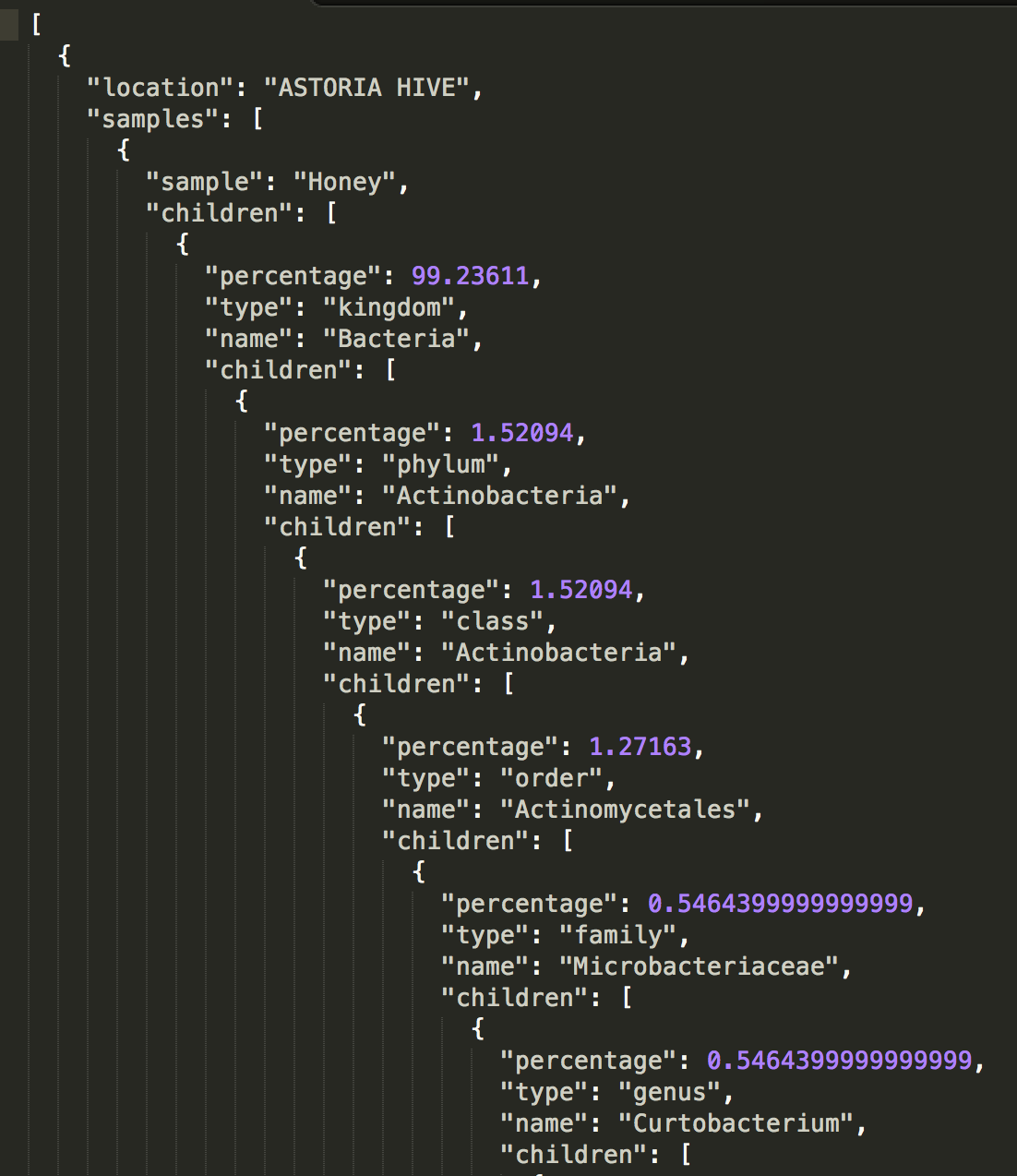
- Taxonomical (which I presented at the last presentation) which shows what bacteria are present in the hives
- Functional Analysis which shows what the different bacteria do.
Here is a link to my github with all the code parsing and tests I have been doing:
https://github.com/reginaflores/Biological_Immaterials
Taxonomical data:
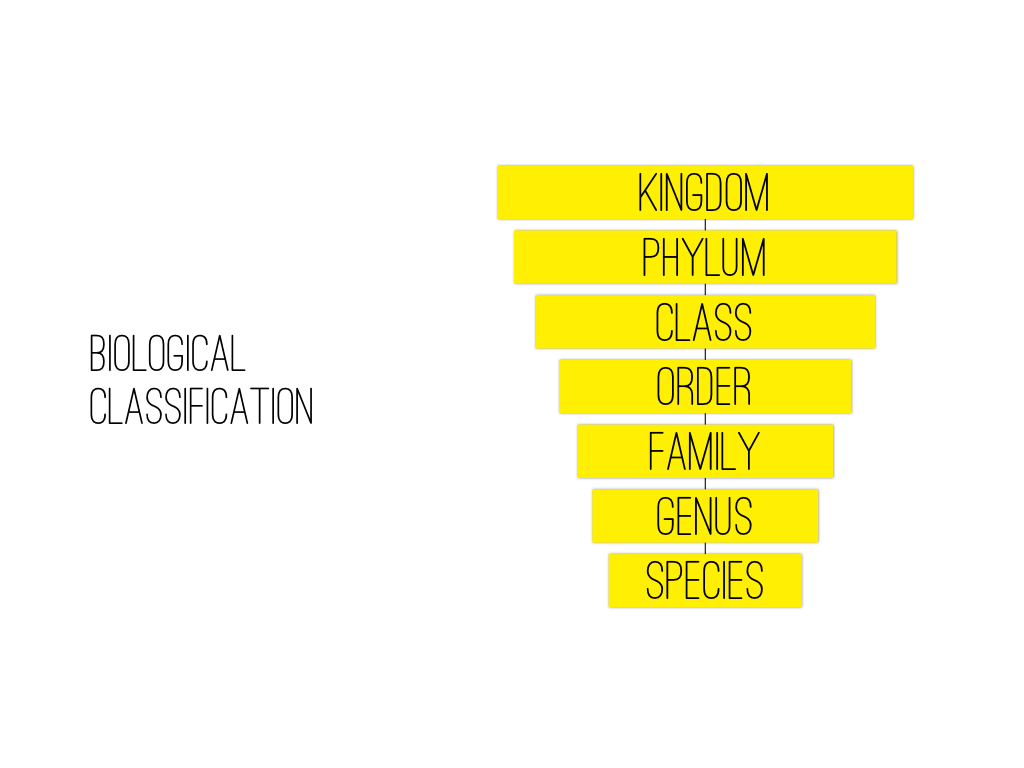
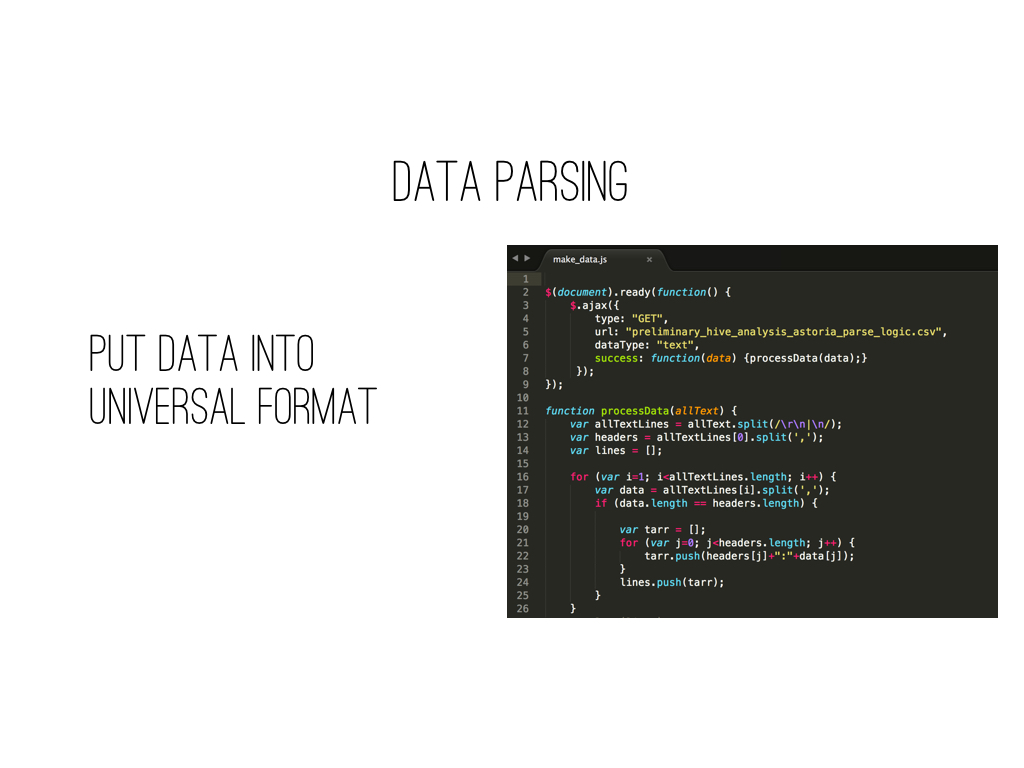
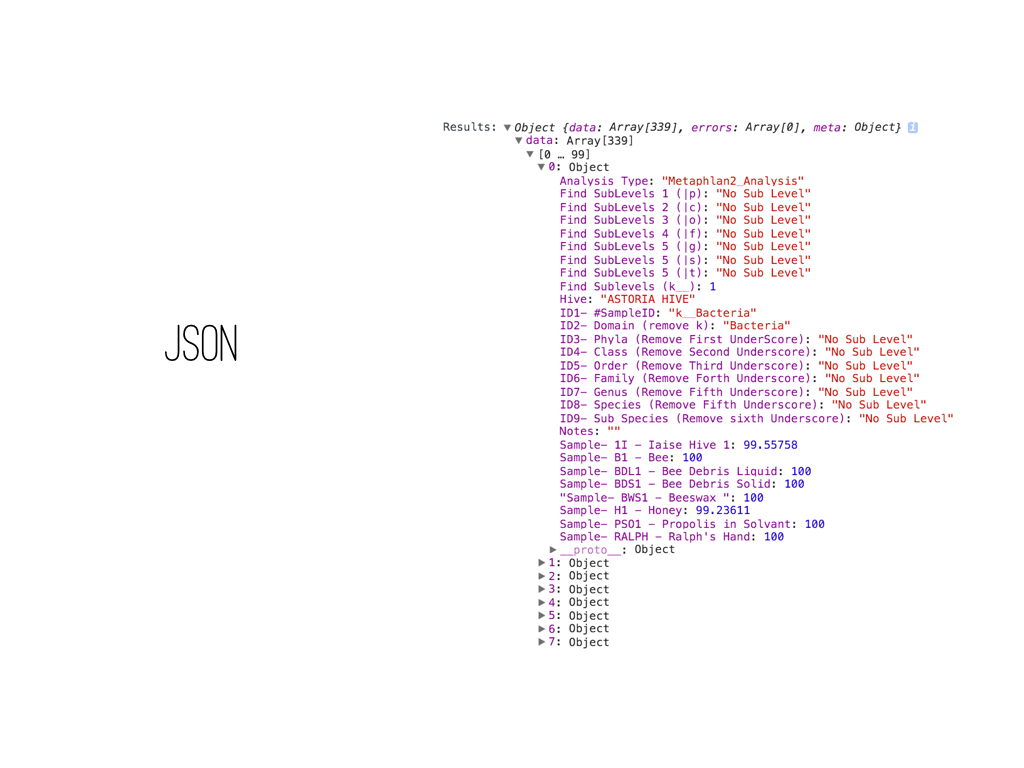
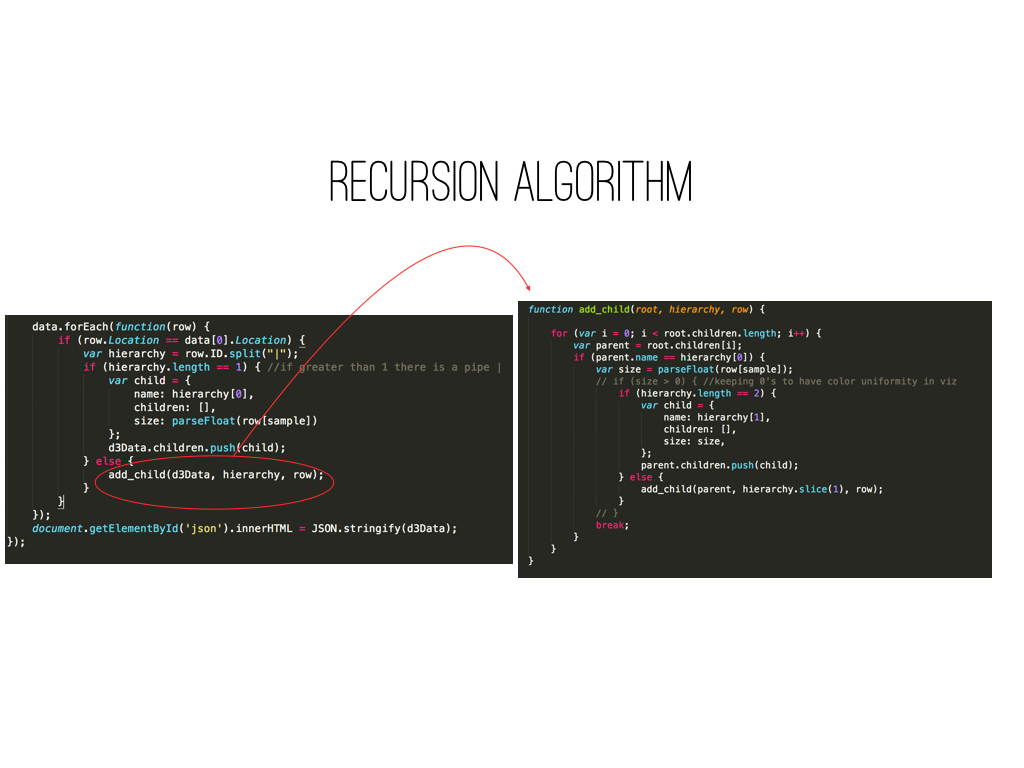
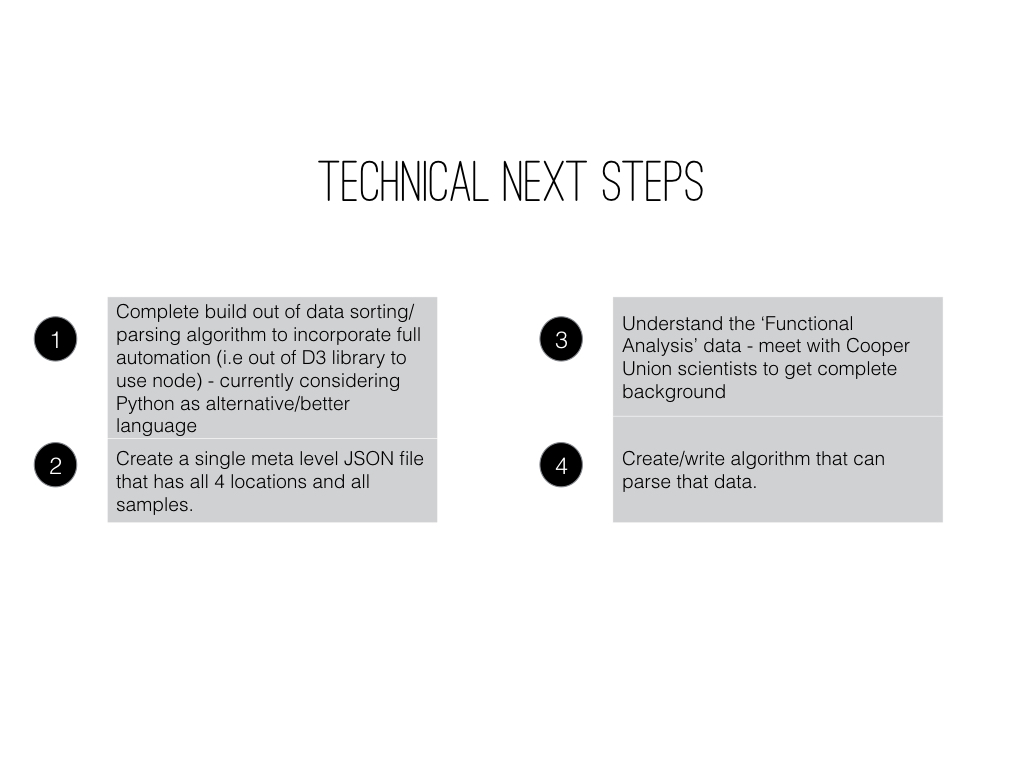
1) I spent more time parsing data into more JSON formats to be able to experiment graphically representing the data. I now have a pretty robust data suite to work with and a number of algorithms to use.
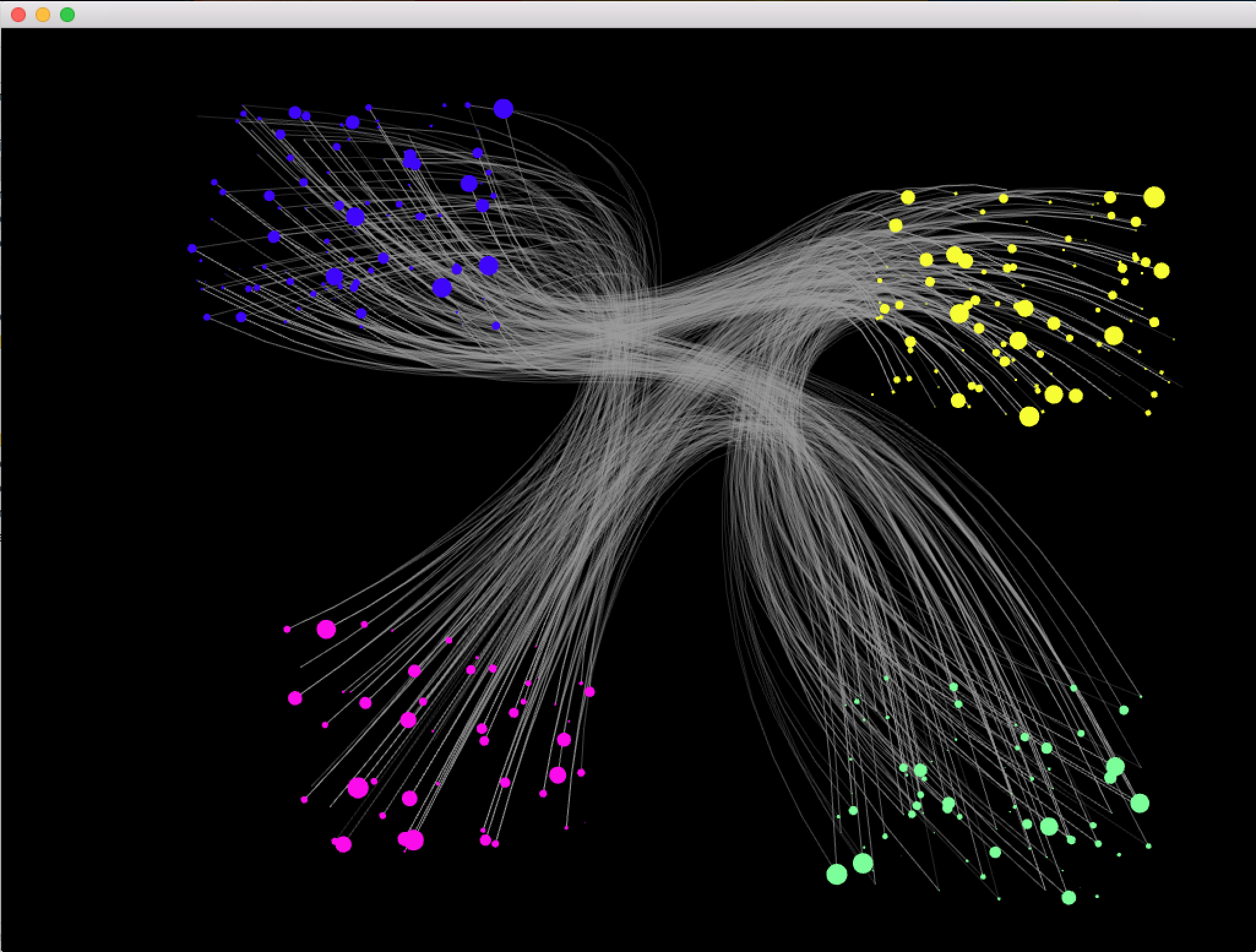
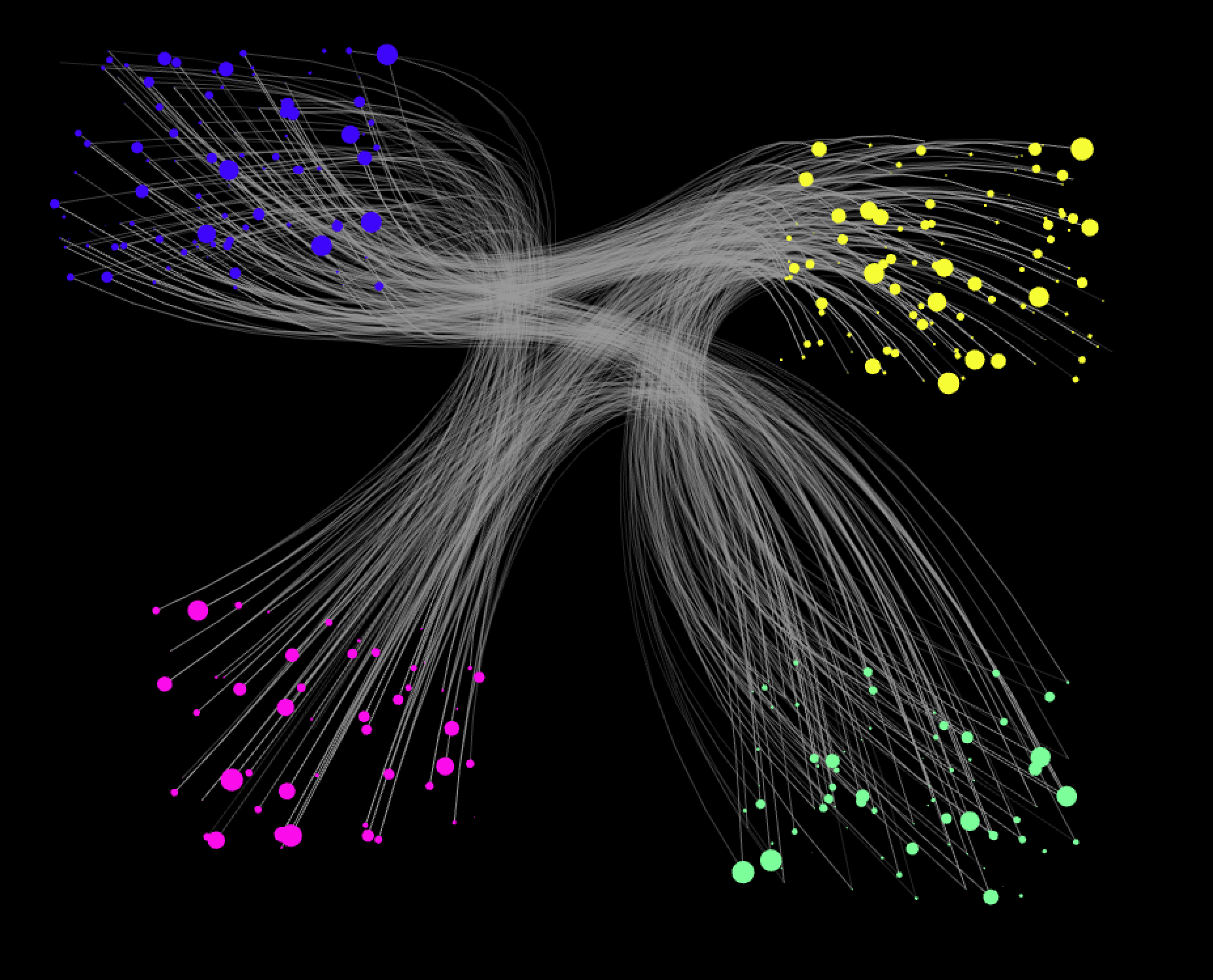
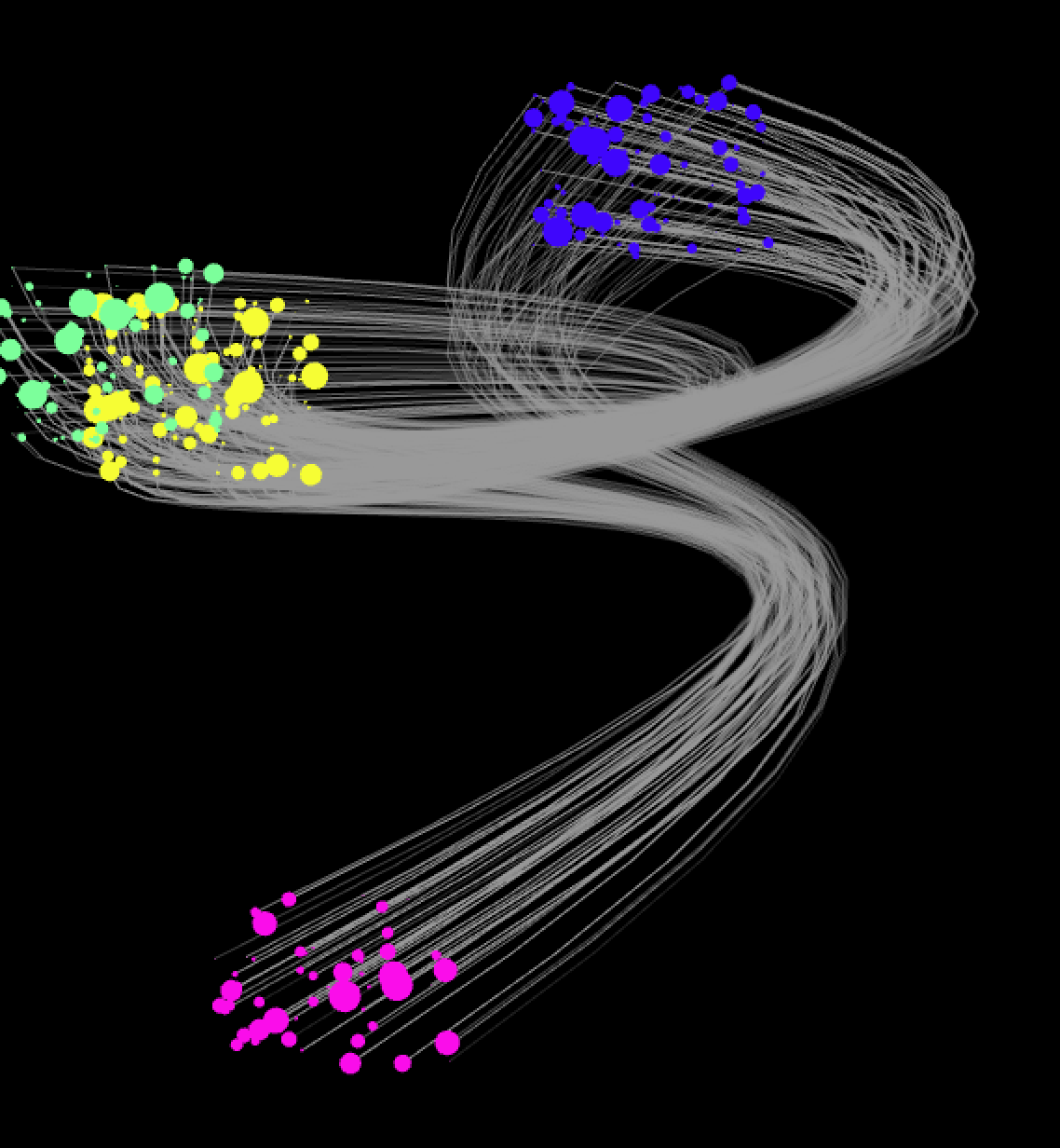
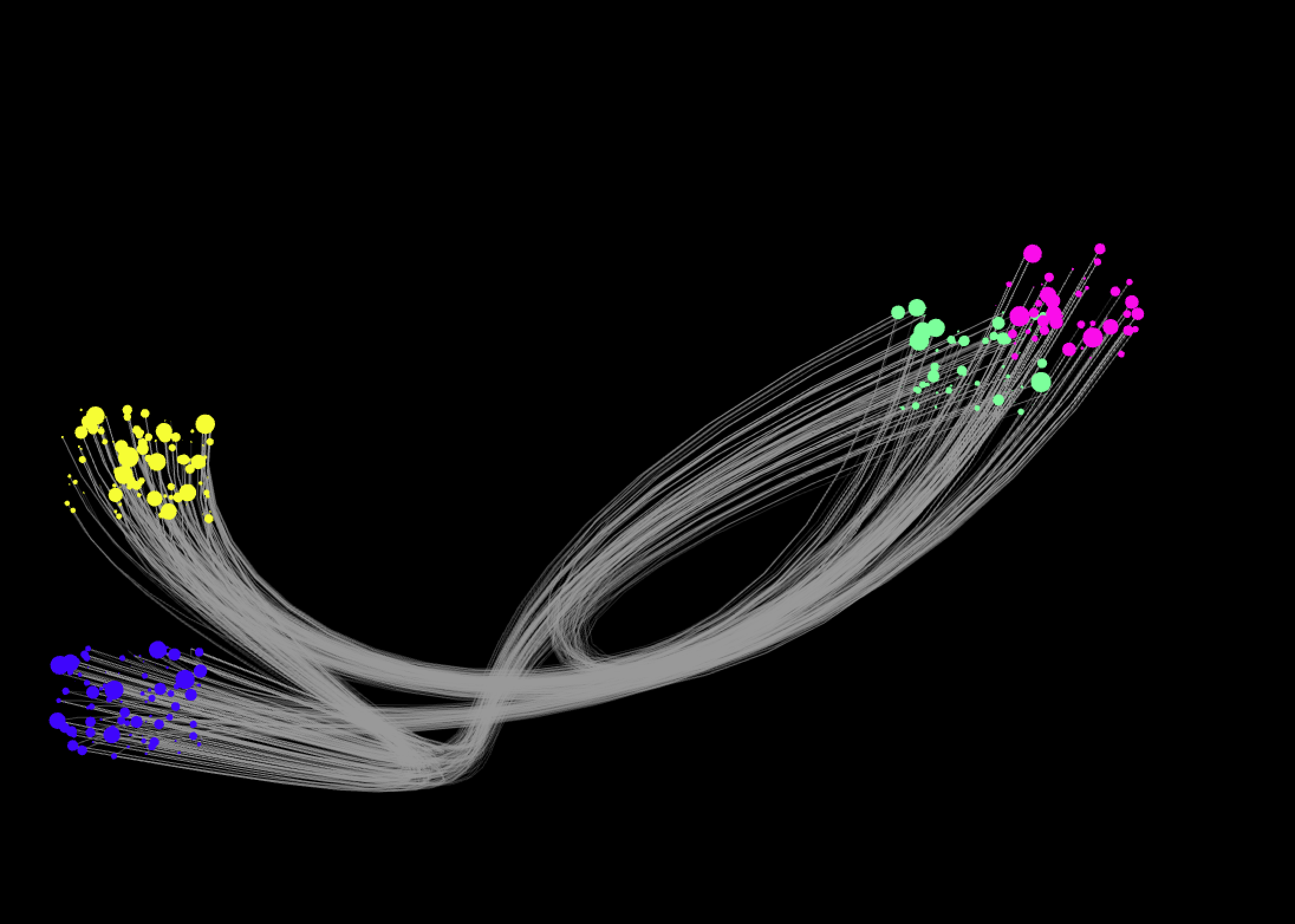
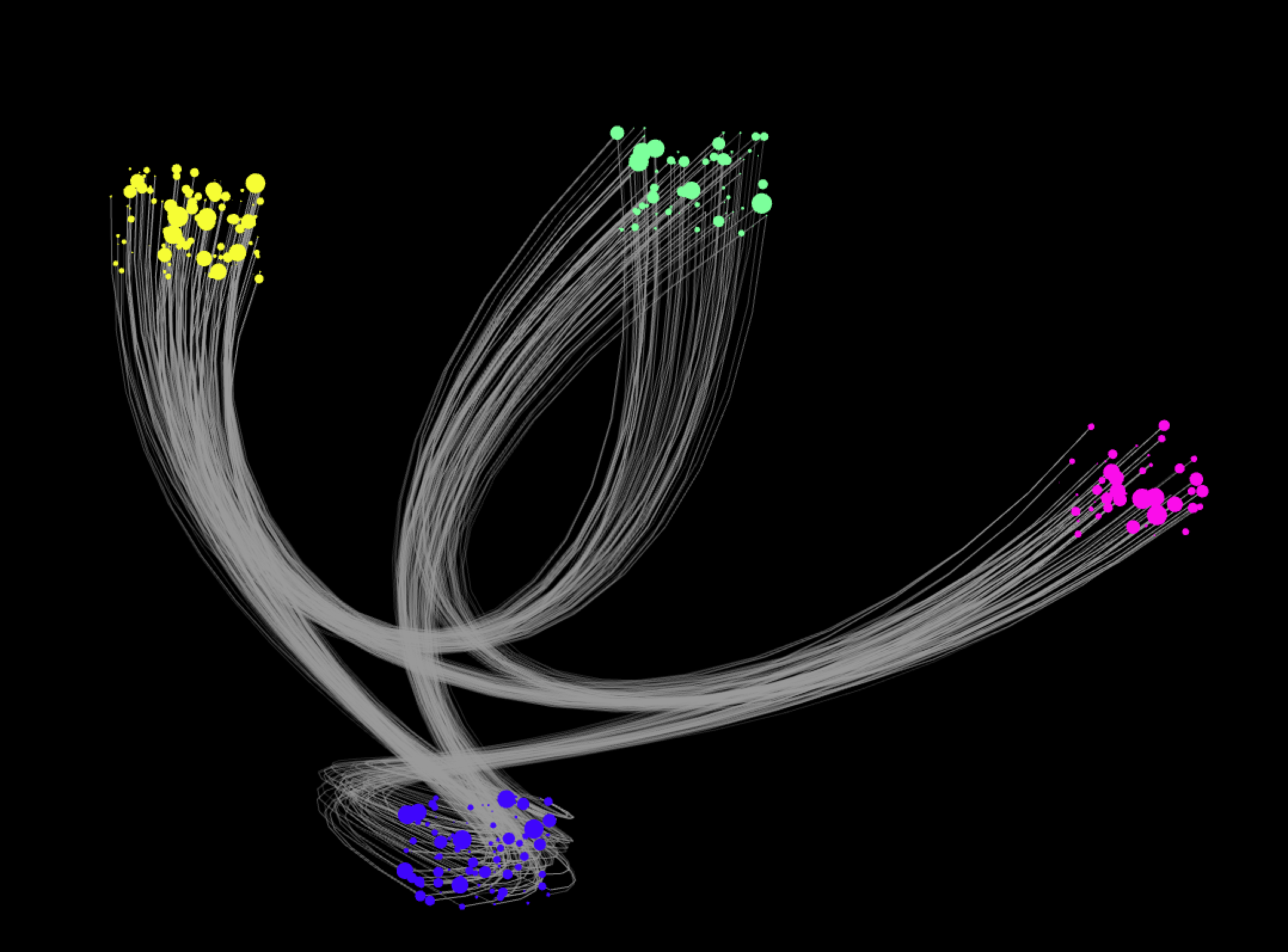
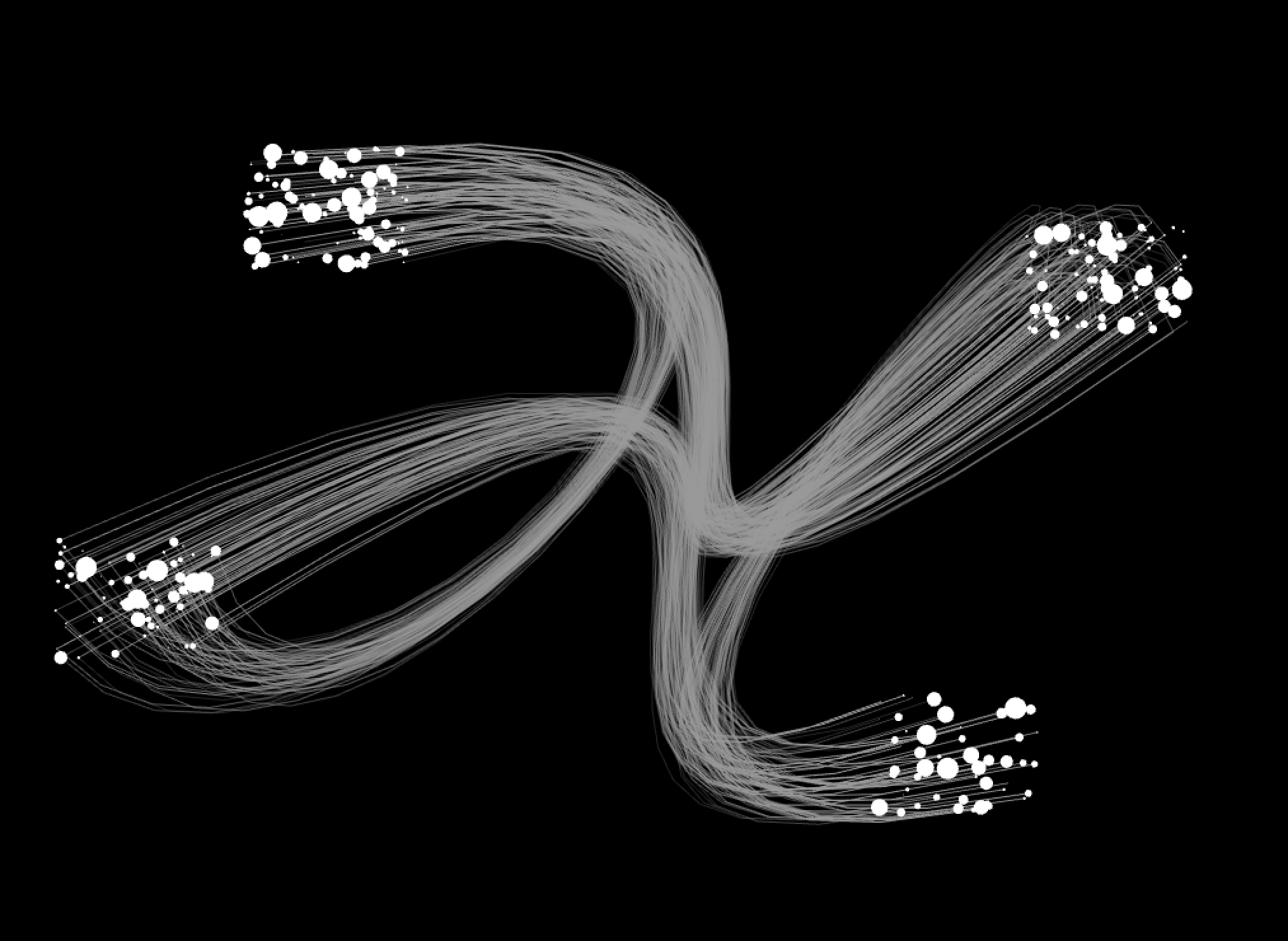
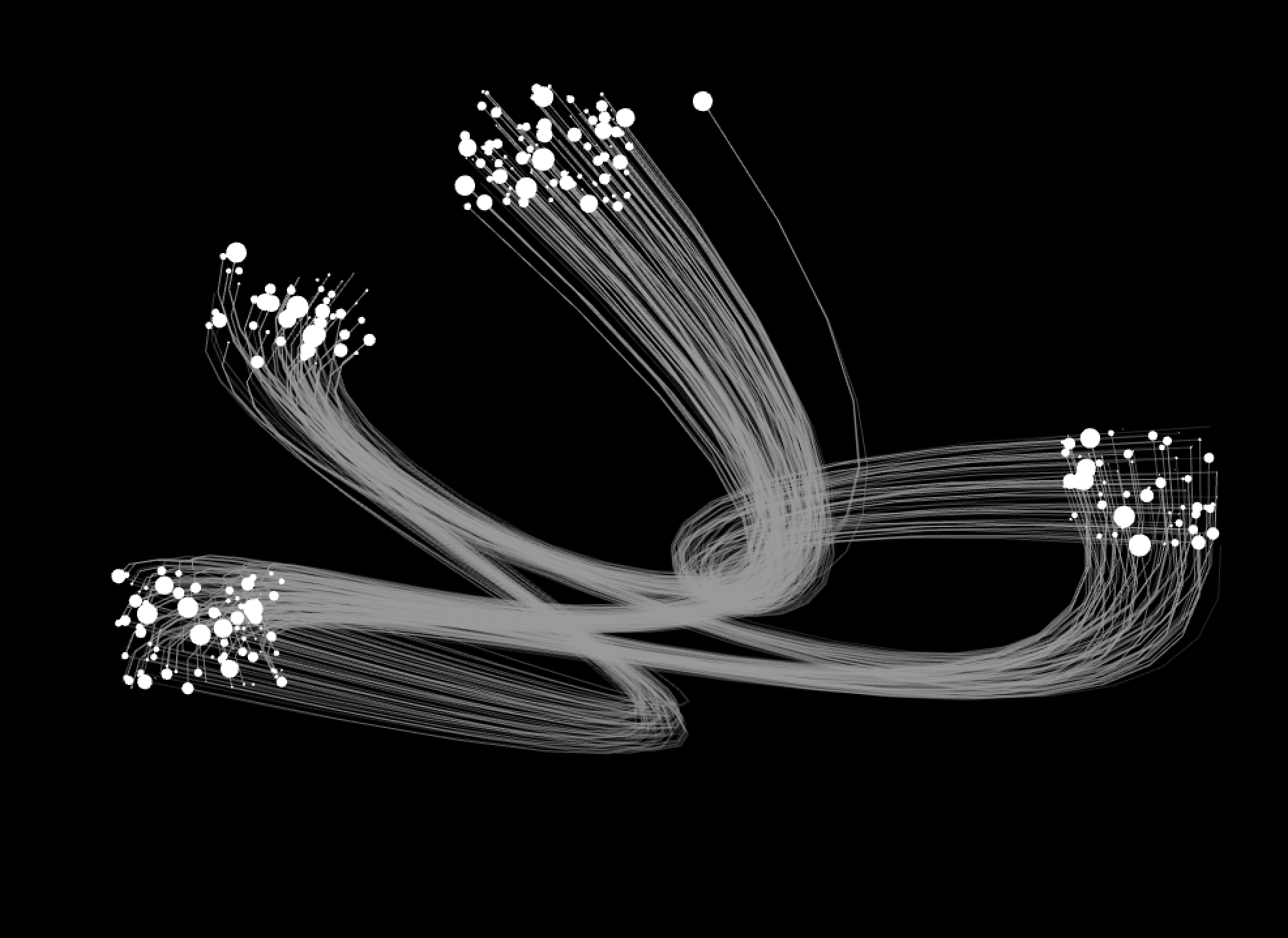
2) I spent some time looking at the taxonomical data and made a flare map that shows the species diversity in each hive and the overlap of species between hives. See the attached images. This was really an experiment to start thinking about how I could represent this data.


Functional Analysis data:
1) I spent a lot of time looking at the functional analysis data and parsed it using a few methods:
- After speaking to the Bioinformatics expert on the team, I performed some statistical analysis on the data according to her suggestions.
- First I filtered for low abundance by removing the outliers (i.e. comparing across the rows the numbers that were outside the 20th percentile - left side of the standard normal distribution).
- Second I removed low variance occurrences i.e. removing items 2 standard deviations from the mean.
2) I was then left with another robust data suite for the functional analysis. Yet, I was having a hard time thinking about how to visualize this.
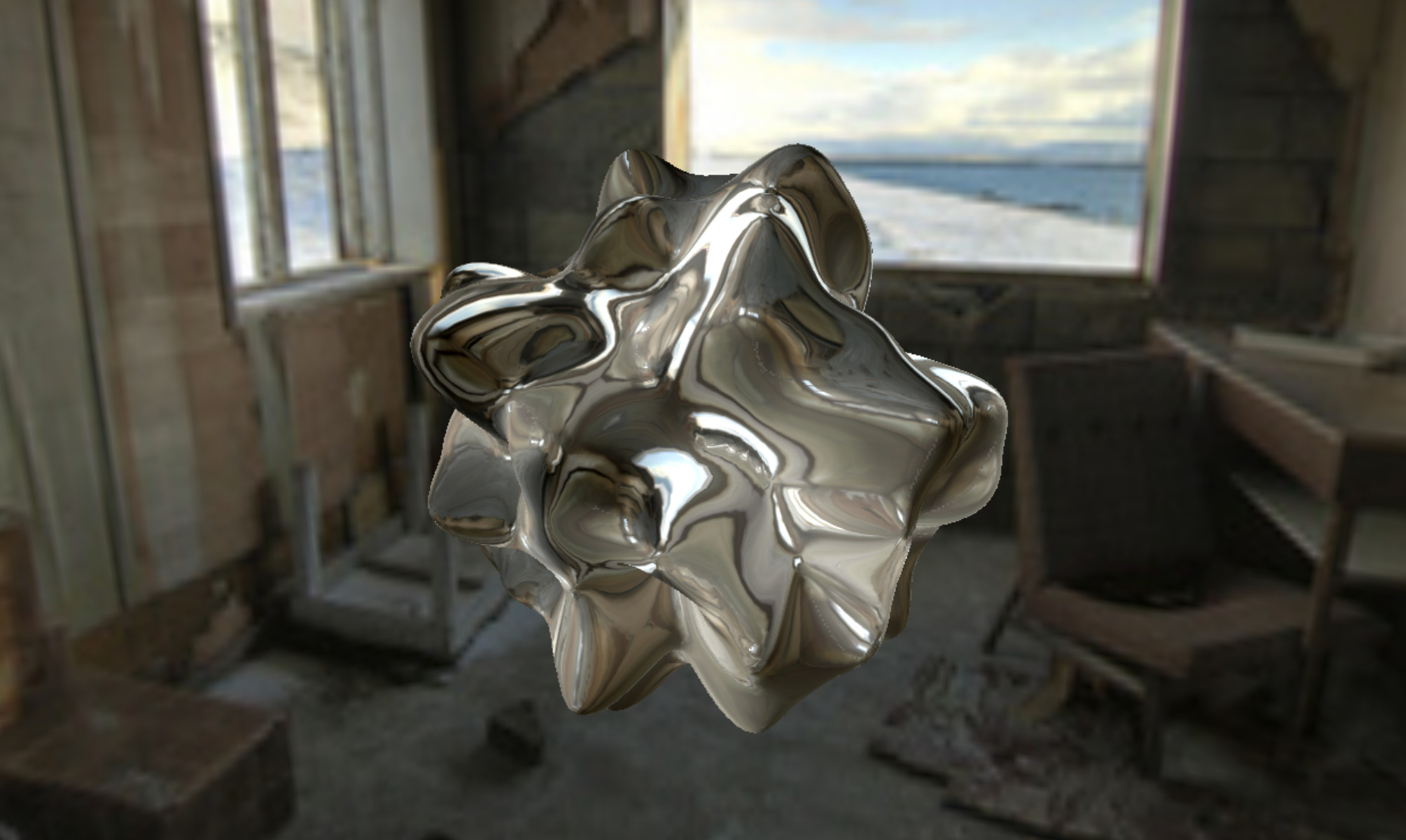
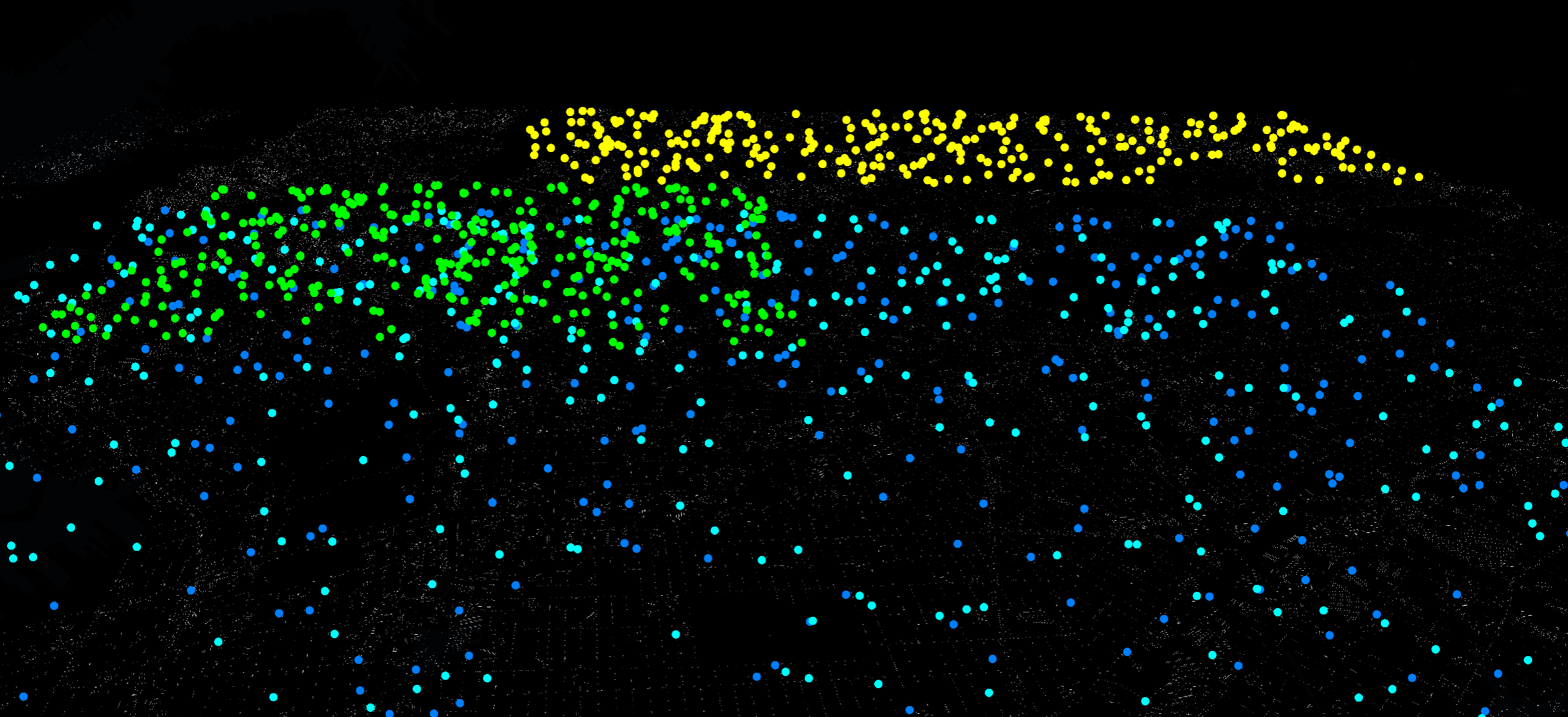
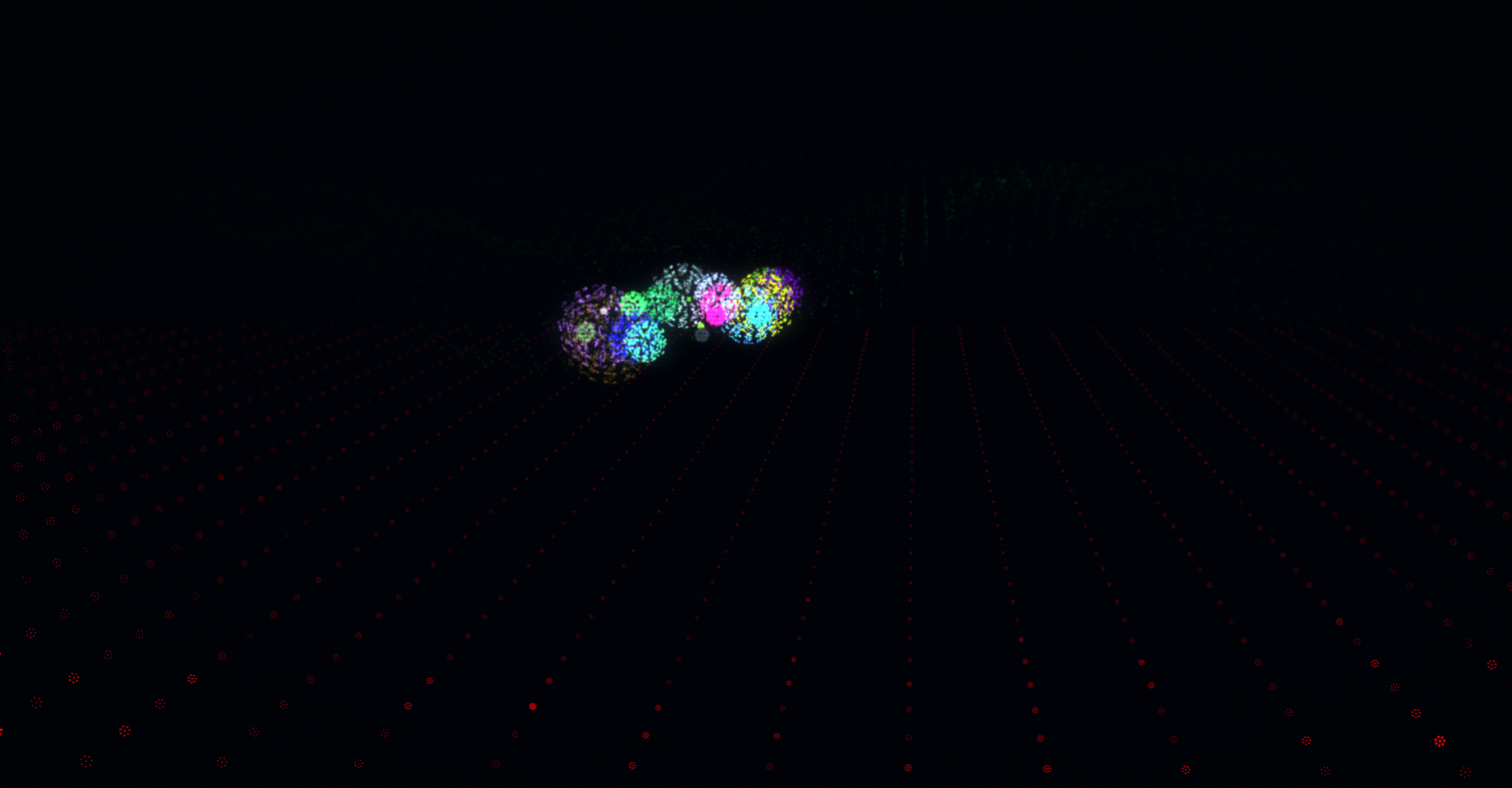
- I found some three.js examples that use 3D models in a 3D environment. I experimented making some 3D models of “bacteria” (my own artistic interpretation) and showing a randomly distributed set of “bacteria” in a 3D environment. See attached images. This data visualization experiment is not tied to the data set yet as I am still thinking how to link pathway abundance data to an interesting visual.
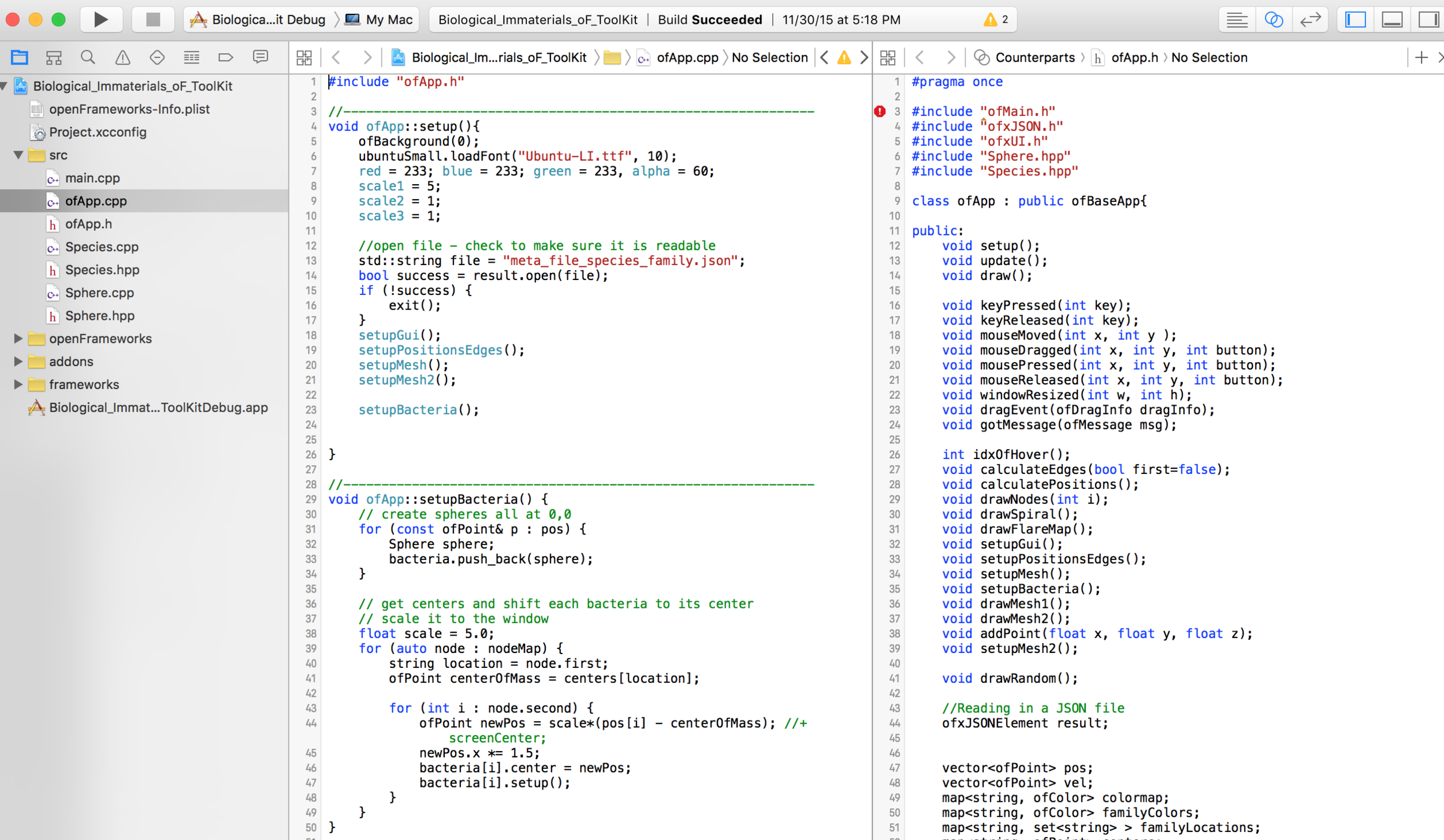
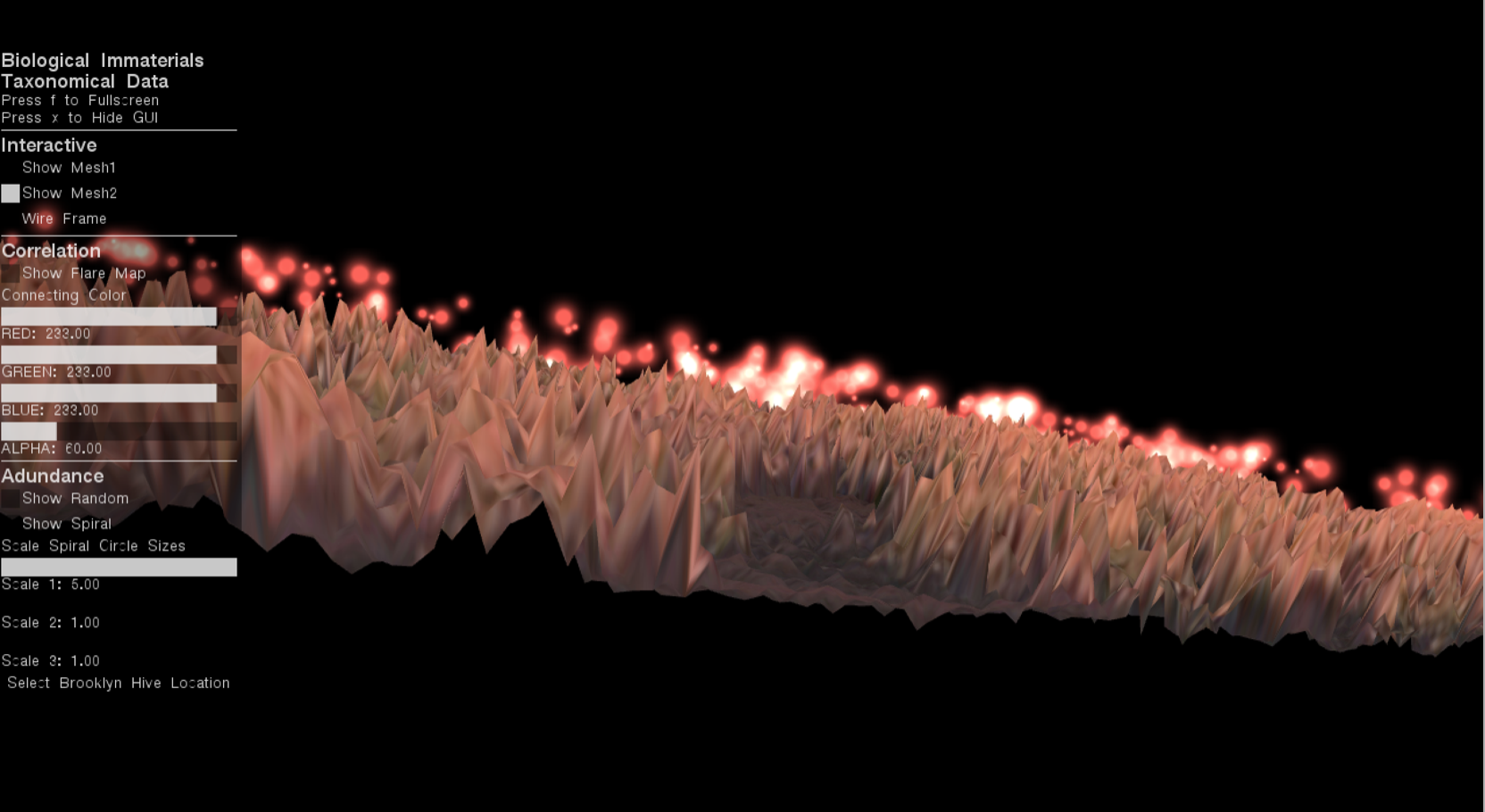
- I did another experiment looking at openFrameworks mapping a particle system to the size of the abundance in the sample (by location of hive). I am still working on this and putting the final touches.
- These later experiments are still works in progress. I will have more to show on Thursday. Note: these are interactive which gets lost in 2D images.




Final User Test:
Please describe what technical variable you are testing or experimenting with for Thursday, why, and how.
For my final prototype I am working towards making an interactive web-based experience that will enable the user to visually explore the data. Using three.js, I will use Patricio Gonzalez’s Skylines library as a basis for this work. Initially I will create a mesh terrain and wrap a custom shader (using GLSL language) to create visual effects that give the user the sense that they are flying through the built environment, but the built environment will look like clouds or shadows (i.e. not rendered). Taking inspiration from the below precedents, I will overlay a particle system on the terrain. Each particle will be mapped to a microbe from the data. The user will be able to click on a particle and see what it is or search a location and see a set of particles levitate or move in some way. Using this 3D web technology, I explore the idea of scale by allowing for rapid zooming in and out.
For Thursday, I will have a first iteration complete:
-Base terrain
-preliminary shader prototype
-basic functionality
Please also describe how this experiment underscores your overall thesis idea.
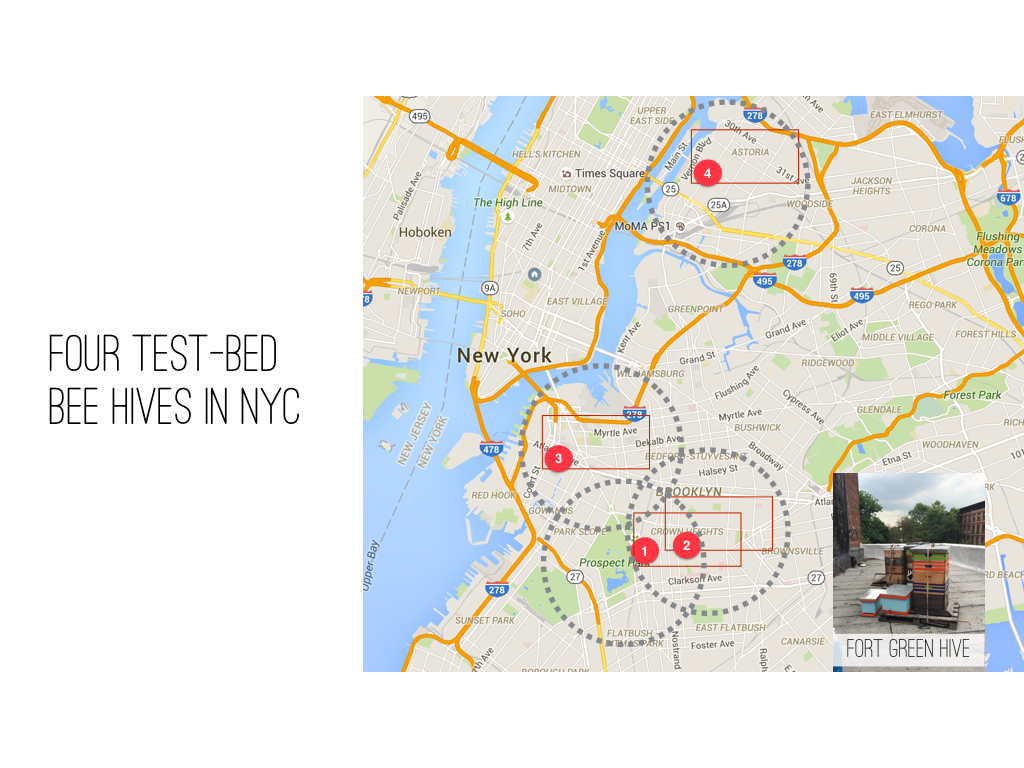
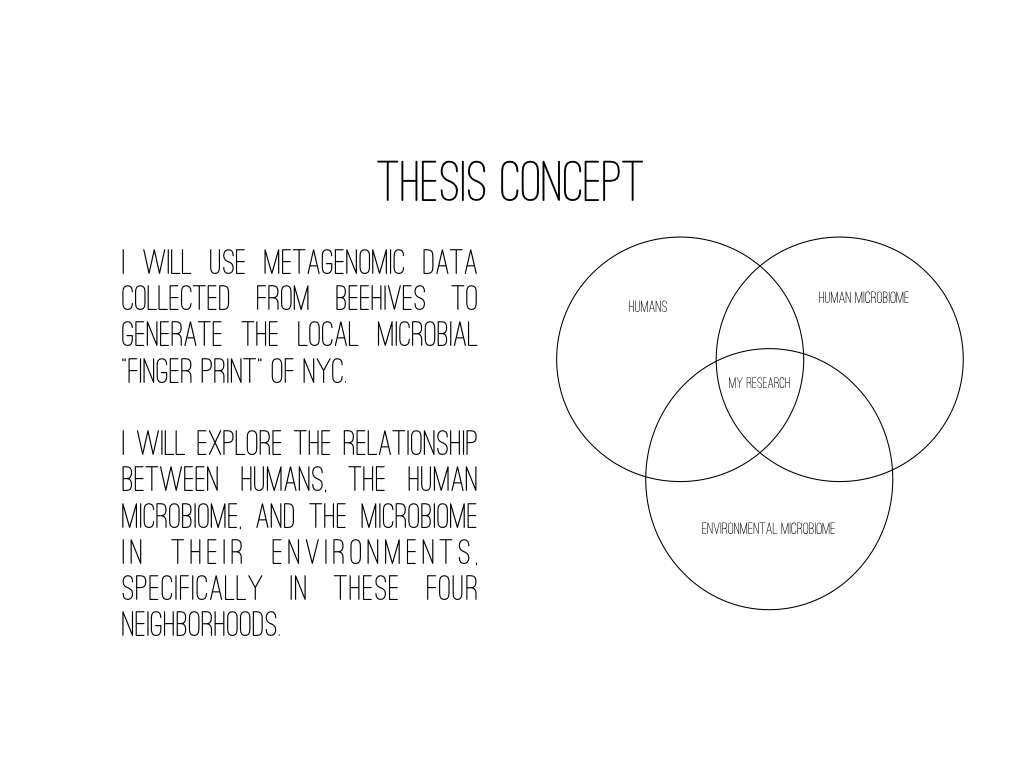
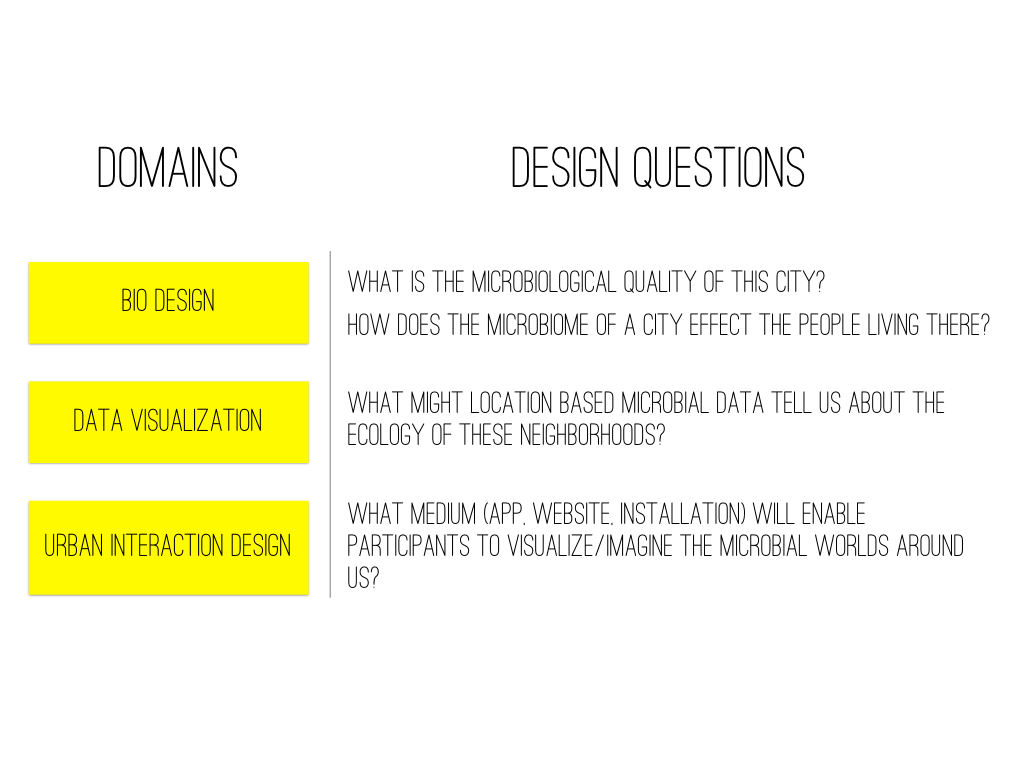
My overall thesis concept is about generating the microbial “finger print” of New York City and exploring the relationship between humans, the human microbiome, and the microbiome in the environment (specifically in the four neighborhoods where that serve as the test-beds for the science experiment).
One of the core question I am asking is: how can we visualize the microbial world around us? While I am still researching the implication of this data (i.e. what can we learn about the humans living in this neighborhood by understanding the microbes present?), this final prototype is the basis for the visualizations that will allow the user to imagine this world.
Precedent Images:




Proposal Towards a Reimagined Built Environment
For the past two months I have been researching the realm of Bio Design and exploring how humans might imagine a near (5-10 years) future when living systems can be seamlessly integrated into design practice—an integration that would fundamentally enhance the integrity of the design system not just its aesthetics. This research was based heavily on the premise that in the Age of the Anthropocene—at the precipice of devastation from climate change—our civilization simply cannot afford to continue the current trajectory. Something must change. I believe that change should be, in part, to establish a symbiotic relationship[1] with nature and the environment. Specifically, my interest has centered around the built environment (buildings and cities), perhaps because, in spite of the technological revolution over the last generation, our built environments have remained virtually unchanged for the past 100 years. Our buildings, both new and old, are relics of a bygone era; they linger in our cities, constant reminders of an epoch in human history born from steel and oil. Thus, I sought to understand if it was possible for our built environments to be dynamic, living systems. Could we live in symbiosis with the natural environment? What if we could grow our cities instead of build them?
Moving towards true biological systems integration into our architecture to literally grow our cities will become a reality, and many top scientists and designers are working towards implementation of these projects—at least in the longer term. Yet, in the near term, I think what is most important is a public consciousness shift. As part of my research into Bio Design, I have met with luminaries who span the spectrum of the field from architects to synthetic biologists[2], I have attended the Biofabrication conference that showcases the latest advancements in Bio Design and Bio Technology, and I have read and viewed countless source materials. While there is a part of me that remains optimistic about the future of Bio Design, the unfortunate reality is that the work being done in this field today remains largely aesthetic and speculative. To create real impact, considerable technological growth is required, and, perhaps even more importantly, to create penetration into the consumer and commercial markets, there needs to be larger economic incentives or subsidies from local and federal governments.[3] Is there another direction, perhaps a smaller step we could take towards integrating biological systems into our society in a more publically palpable way? Can we step away from the aisle-dividing climate change topic towards a public health argument to create government support for Bio Designs integrated into our cities?
The Human Microbiome
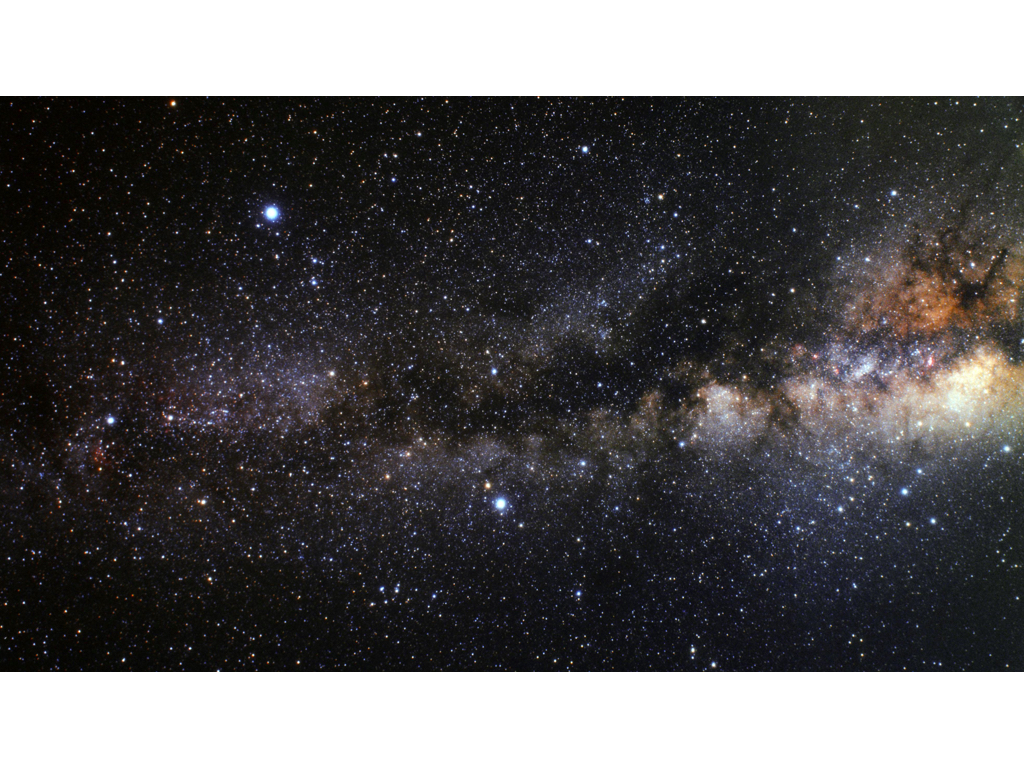
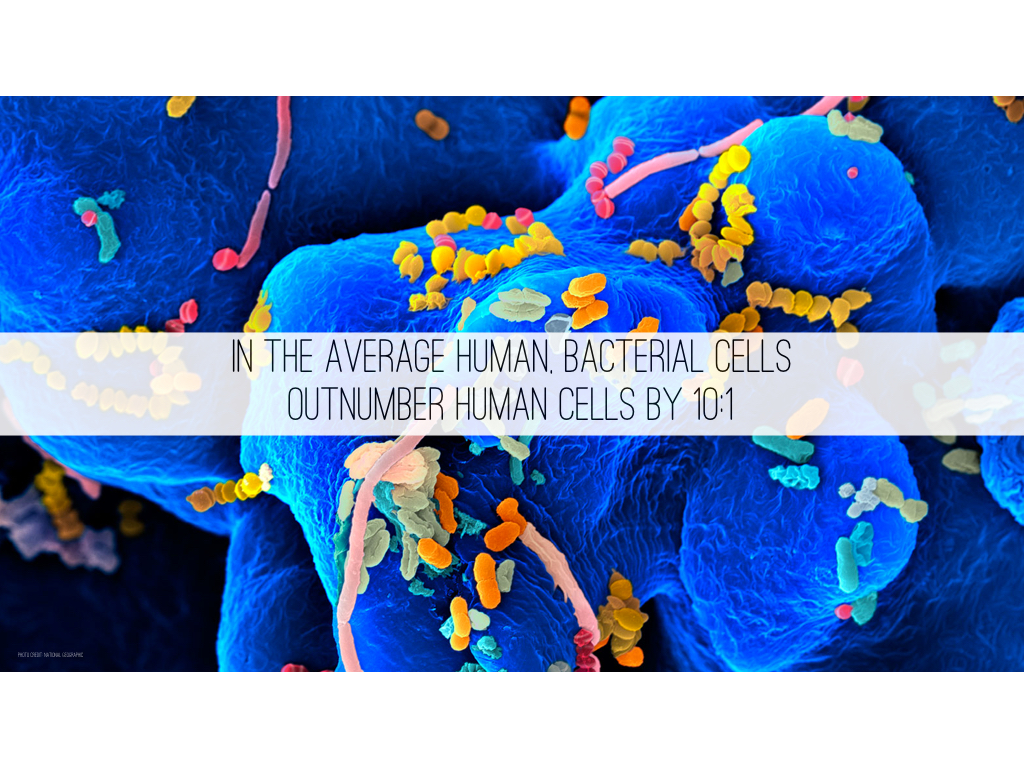
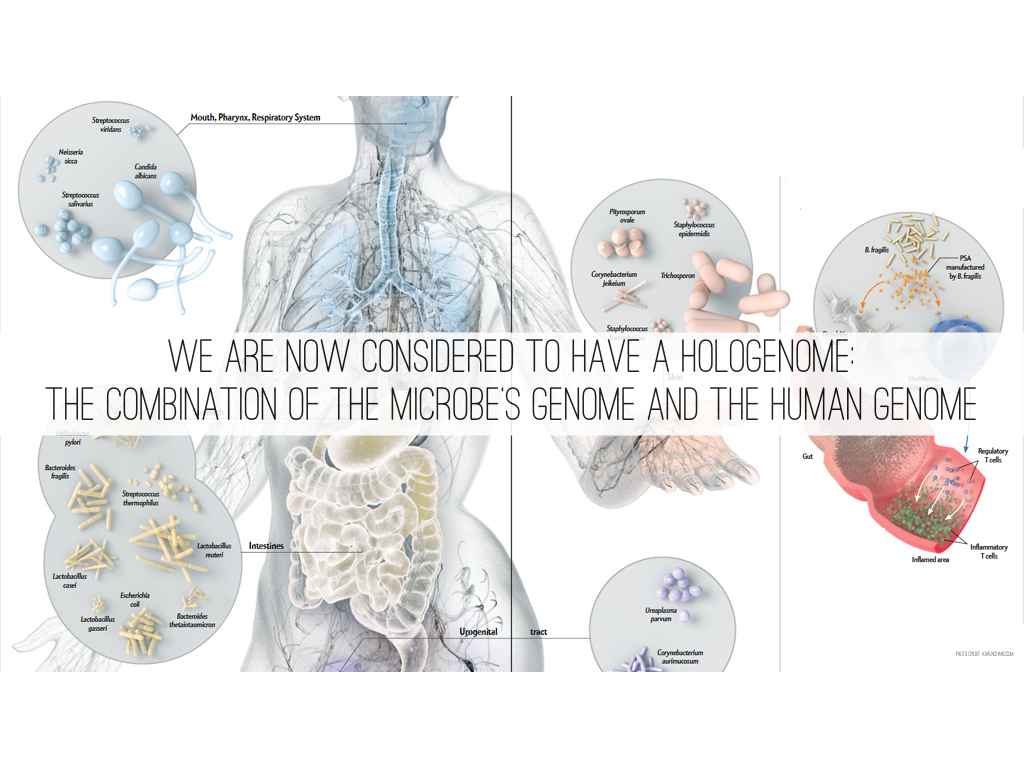
The emerging field of the human microbiome is beginning to radically shift our understanding of both ourselves and our relationship to the environment. For example, we now know that in the average human, microbial cells out-number human cells 10:1,[4] which means that 90% of the cells in our bodies are not human. In fact, it is believed that there are more bacteria in the human body than there are stars in the Milky Way Galaxy.[5] A paper published in August, 2015, argues that:
Animals and plants are no longer heralded as autonomous entities but rather as biomolecular networks composed of the host plus its associated microbes, i.e., "holobionts." As such, their collective genomes forge a "hologenome.”[6]
Microbiologists are increasingly finding links between our health and the microbes that live in our bodies. Obesity,[7] depression,[8] and brain functionality, such as memory,[9] are a few of the health risks being linked to an unhealthy microbiome. And while there are many contributing factors to a healthy microbiome, some research suggests that many of these health concerns are modern phenomenon caused by humans living in cities (i.e., away from nature).
[D]isease issues [in the West] of the 20th and 21st century… have to do with nutrition and autoimmune processes…We don’t have a definitive cause yet, but as we look at the new science being done, we see a lot of connections to the microbiome and [microbial imbalance].[10]
Could there be a connection between human health, the microbiome, and the built environment? Could the fact that in modern life humans are so removed from nature be a cause of much of our modern disease? And if so, can we begin to design with the microbiome in mind to optimize human health and create a symbiotic relationship with our bodies and our built environments?
Proposal
This past summer I worked as a Research Fellow at Terreform One, a New York City architecture, urban and ecological design firm. My work there focused on the Urban Farm Pod—“a ‘living’ cabin for individuals and urban nuclear families to grow and provide for their daily vegetable needs[11]” (see Figure 1). Part of my research was to design, test, and implement a system for food production. Using the Red Hook Housing Project, a “food desert,” as a test-bed, we sought to understand the economic, legal/political, and technological[12] implications of using the pods as food sources for the community.


But what if the pods have other uses? Could they be used as microbiome charging stations for the inhabitants of the city? The pods, in the current iteration, are designed so that approximately three adults can fit inside of them. I imagine that they could be placed in densely urban areas, inner cities, or in urban public spaces (where there is littler to no access to nature) and covered, not in food, but in organic material that is specific to reenergizing the human microbiome. What if the pods were placed inside of our homes and we could customize the organic material to meet the specific signature of our personal microbiome? Further, what if these pods could be used to create scientific case-studies to monitor the before and after effects of a person’s (or community’s) microbiome to concretely contribute to scientific understanding of the microbiome?
Unifying Bio Design with the Built Environment
As urban dwellers, we lack a connection to nature, a connection so fundamental to our being that it is ingrained in our hologenome. Bio Design, specifically as it pertains to the built environment and public health, can begin to change public perception about the importance of that connection. Projects such as the Microbiome Charging Station can not only begin to make our cities more livable, but can facilitate Bio Design thinking. And perhaps soon, the integration of living systems into design will become a reality and we will grow our cities from the ground up.
[1] See Design in the 21st Century final paper: http://www.reginafloresmir.com/blog/2015/1/20/ecological-synergies-a-model-for-a-better-world-final-paper-in-design-for-the-21st-century
[2] See Bio Design Blog: http://www.reginafloresmir.com/blog?category=Bio+Design
[3] On a small scale, Ecovative is an example of a company already producing Bio Design products. In an informal interview with their Chief Science Officer, I was told that it is challenging to compete with traditional companies because they are heavily subsidized by the local and federal government.
[4] Mason et al.
[5] American Museum of Natural History. November 2015 Exhibit: The Secret World Inside You.
[6] Bordenstein, Seth R., and Kevin R. Theis. “Host Biology in Light of the Microbiome: Ten Principles of Holobionts and Hologenomes.” PLoS Biol 13, no. 8 (August 18, 2015): e1002226. doi:10.1371/journal.pbio.1002226.
[7] Turnbaugh, Peter J., Ruth E. Ley, Michael A. Mahowald, Vincent Magrini, Elaine R. Mardis, and Jeffrey I. Gordon. “An Obesity-Associated Gut Microbiome with Increased Capacity for Energy Harvest.” Nature 444, no. 7122 (December 21, 2006): 1027–1131. doi:10.1038/nature05414.
[8] http://www.medscape.com/viewarticle/836260
[9] Galland, Leo. “The Gut Microbiome and the Brain.” Journal of Medicinal Food 17, no. 12 (December 2014): 1261–72. doi:10.1089/jmf.2014.7000.
[10] http://genomemag.com/change-your-microbiome-change-yourself/#.VkTVd66rSHo
[11] http://www.terreform.org/projects_habitat_Plug_In_Ecology.html
[12] http://www.terreform.org/projects_habitat_Smart_Spirulina_System.html
Hive Plots
Experiments in Data Visualization


void ofApp::calculatePositions(){
//Note: Using Flocking Algorithm

//PART 1 - Calculate Center of Mass
string location = result[thingIGrabbed]["location"].asString();
ofPoint center;
int numberOfPoints = 0;
for (int i : nodeMap[location]) {
    center += pos[i];
    numberOfPoints++;
}
center = center / numberOfPoints;
ofPoint cohesion_velocity = (center - pos[thingIGrabbed])/1.0f;


//Part 2 - Calculate Distance between each node and itself
ofPoint displacement;
for (int i : nodeMap[location]) {
    if (i != thingIGrabbed) {
        float dist = ofDist(pos[i].x, pos[i].y, mouseX, mouseY);

        if(dist < 10.0){
            displacement = displacement - (pos[i] - ofPoint(mouseX, mouseY));
        }
    }
}

ofPoint separation_velocity;
separation_velocity = displacement;


//Part 3 - Add Velocity
ofPoint alignment_velocity;
if (previousGrabbedPosition.x != 0 || previousGrabbedPosition.y != 0) {
    // v = (x2 - x1)/t ==> but we assign time = 1
    vel[thingIGrabbed] = ofPoint(mouseX, mouseY) - previousGrabbedPosition;

    ofPoint avgVel;
    for (int i : nodeMap[location]) {
        avgVel += vel[i];
    }
    alignment_velocity = avgVel / (numberOfPoints + 1) / 1.0f;
}
previousGrabbedPosition = ofPoint(mouseX, mouseY);

ofPoint swarmV = -cohesion_velocity + separation_velocity + alignment_velocity;


for (int i : nodeMap[location]) {
    pos[i] += swarmV;
}
}
Shader Studio

Proof of Concept Prototype Presentation







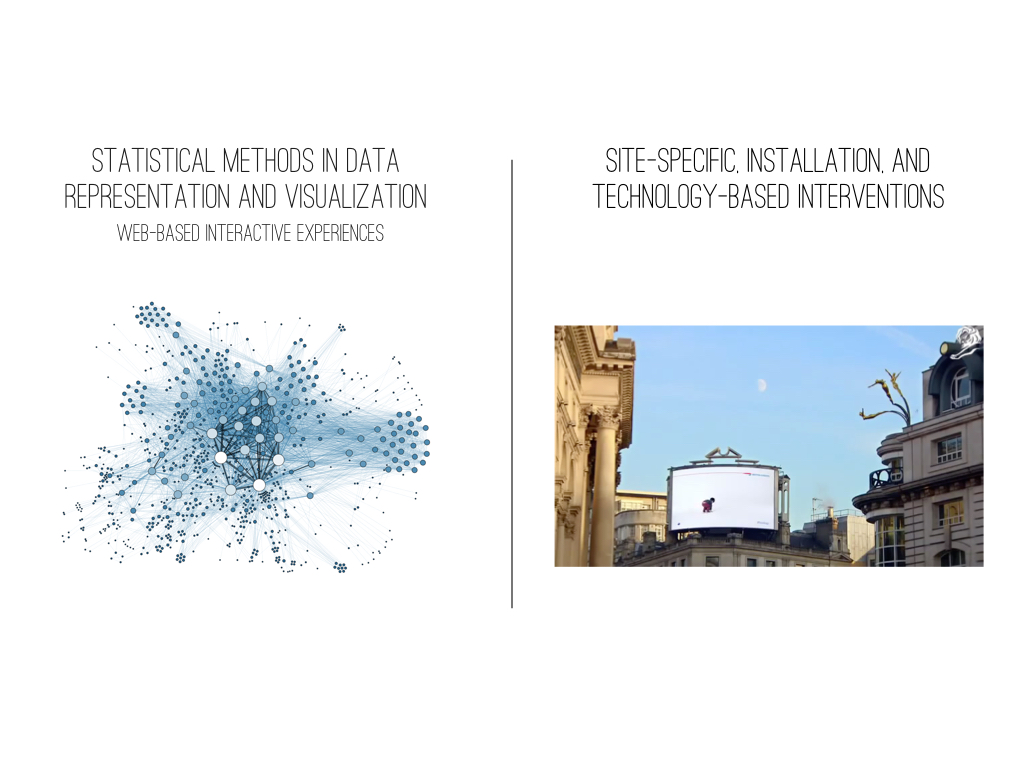
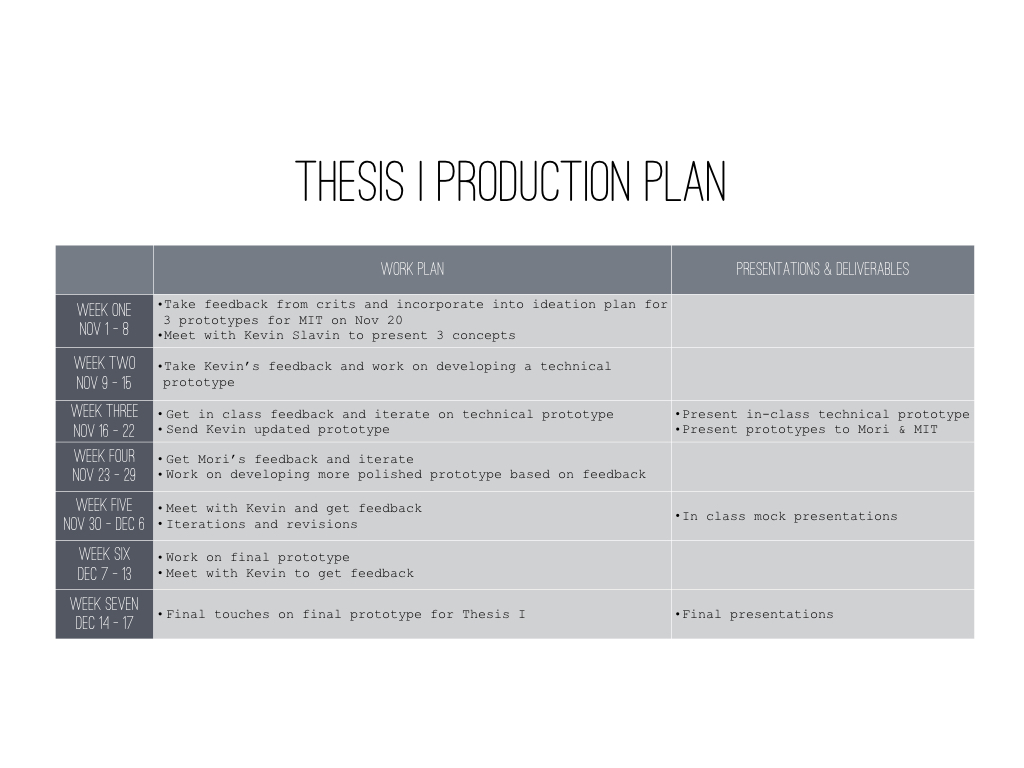

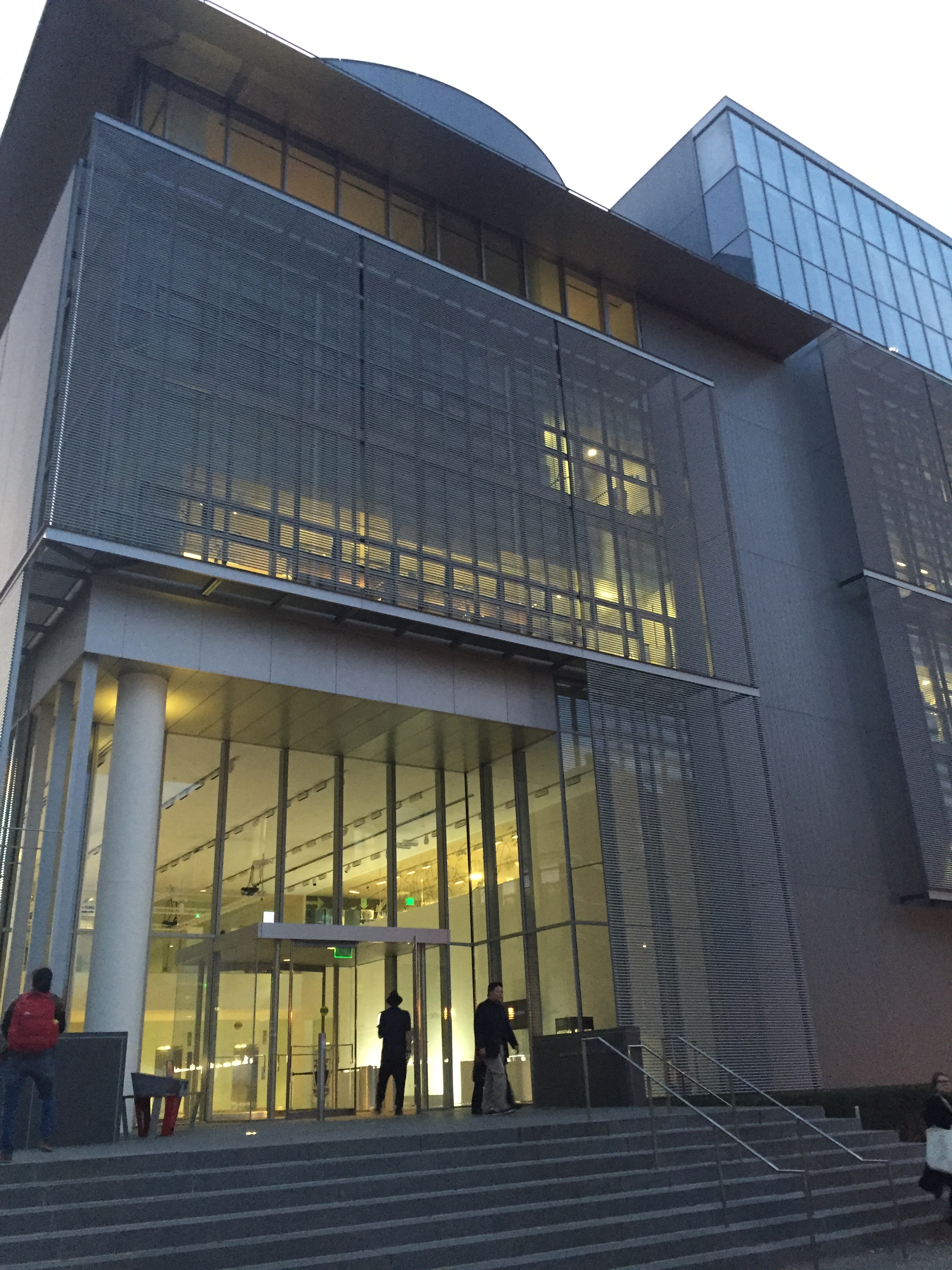
Visiting the MIT Media Lab
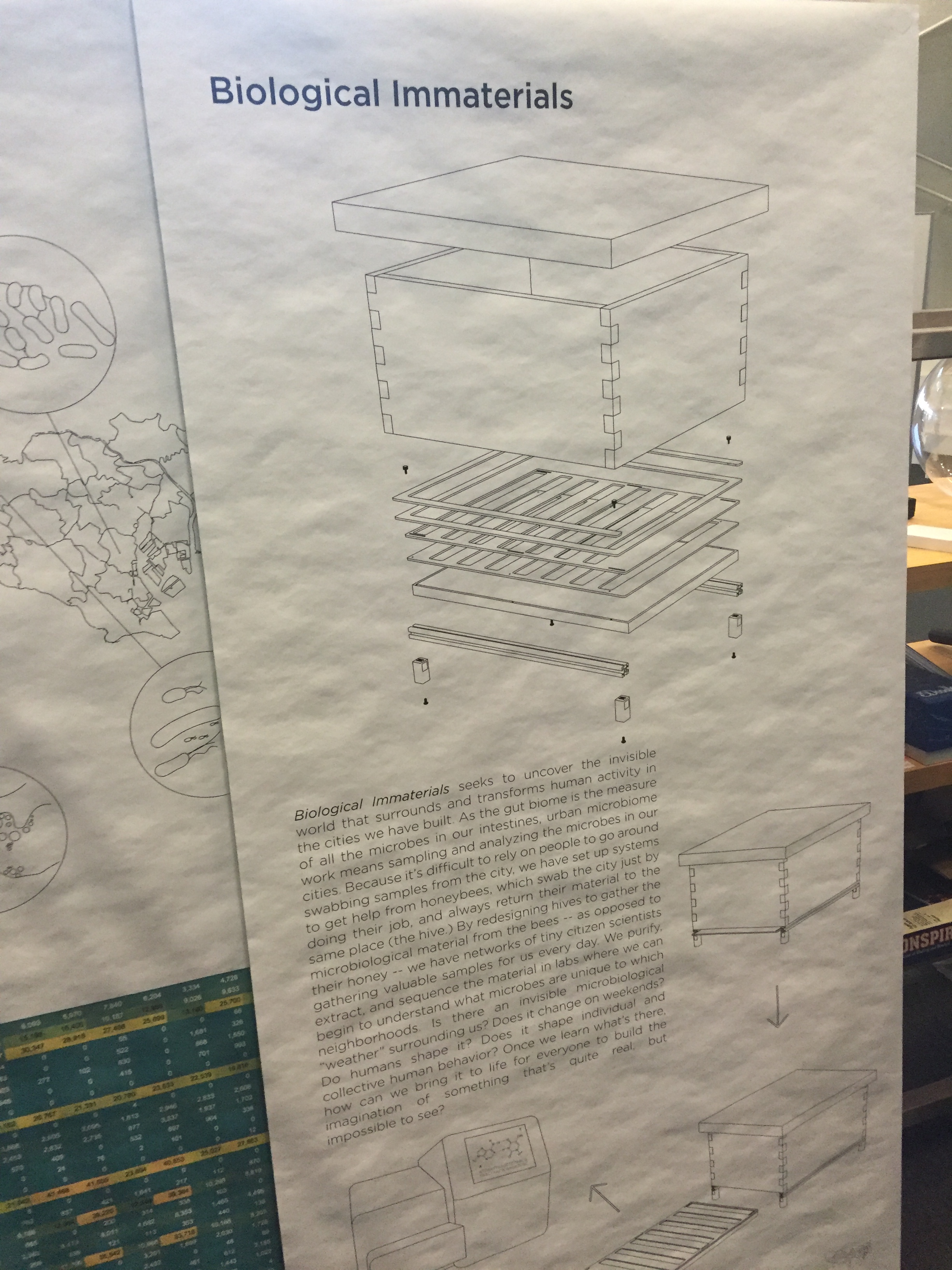
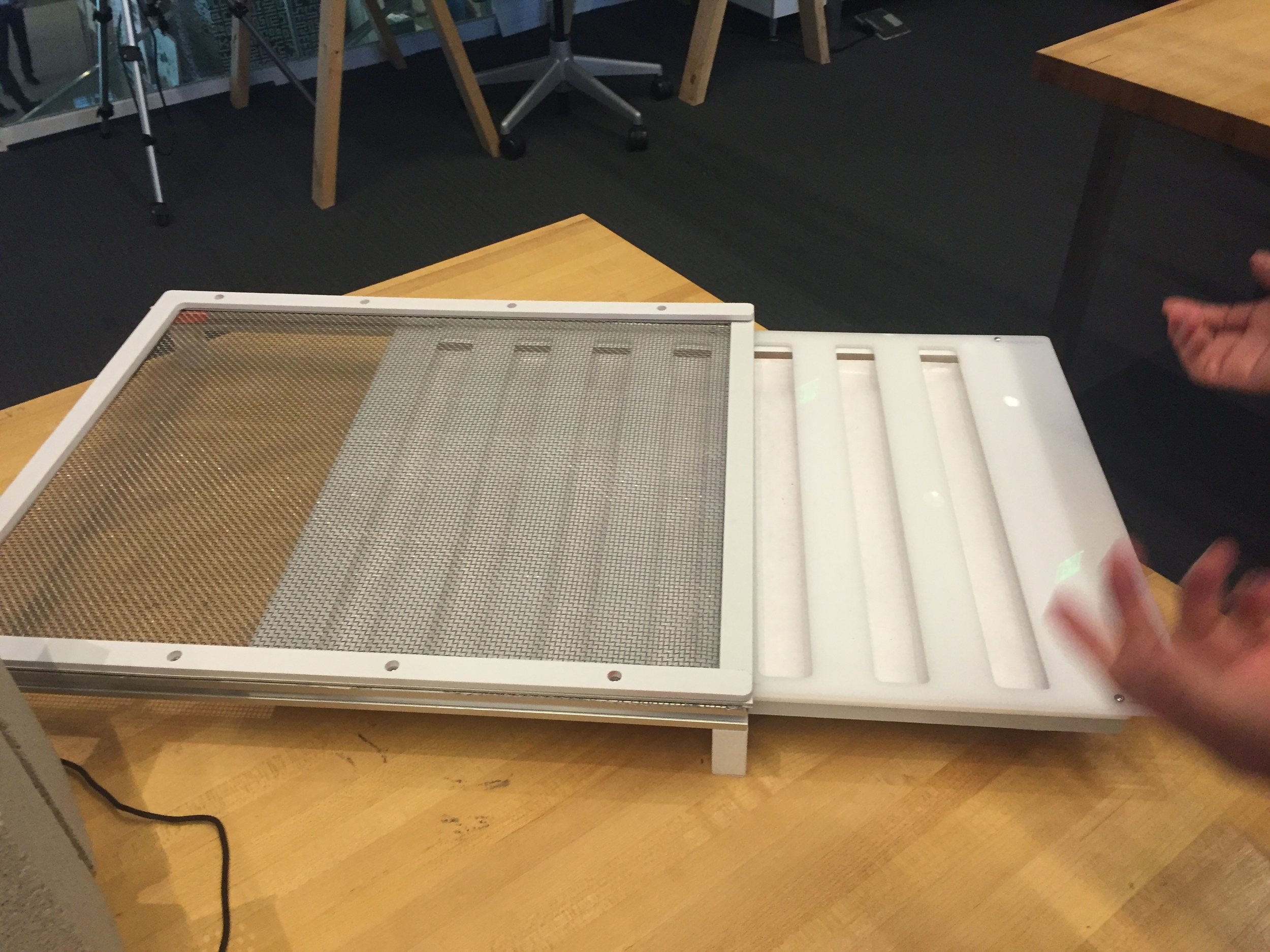
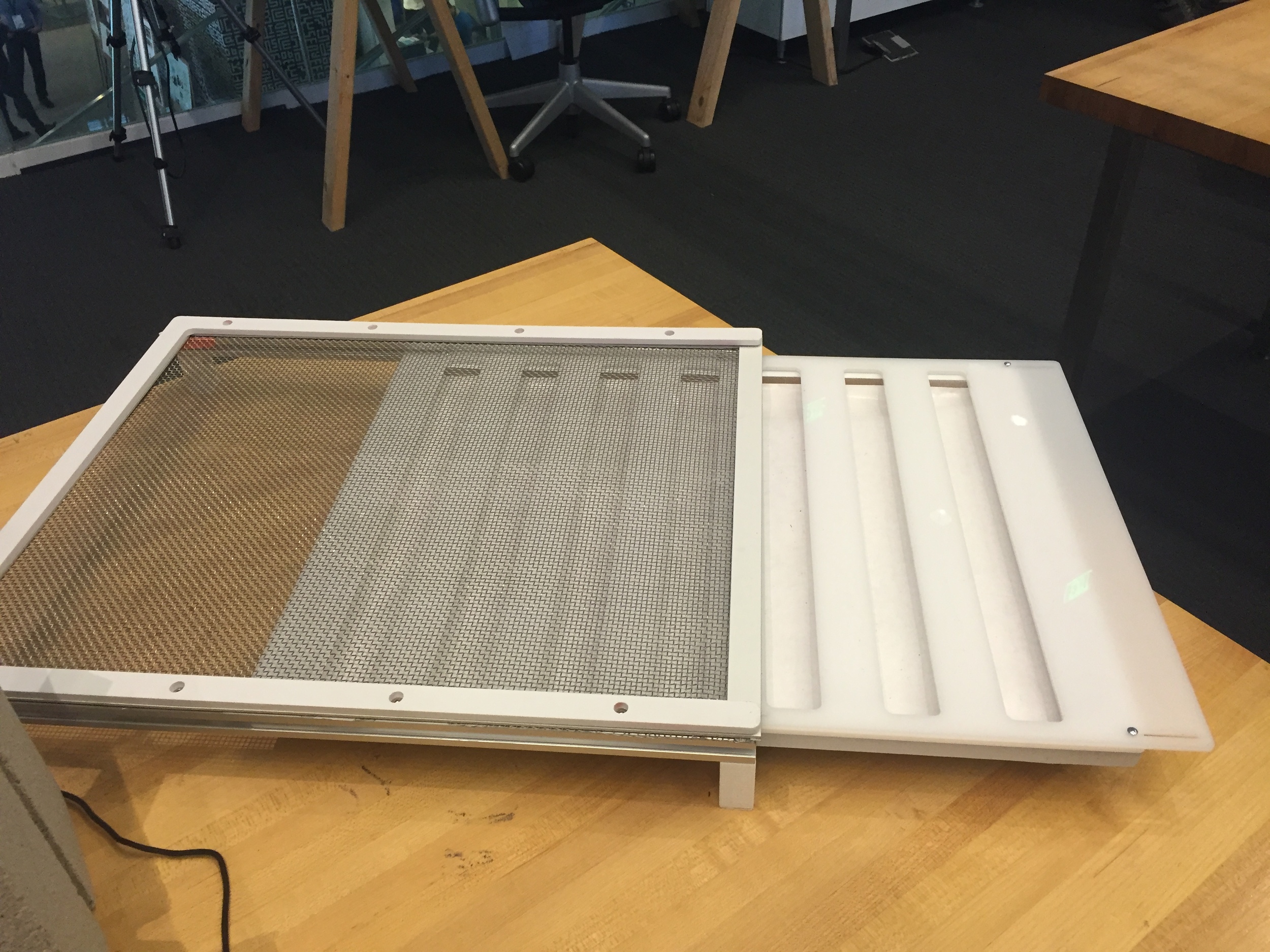
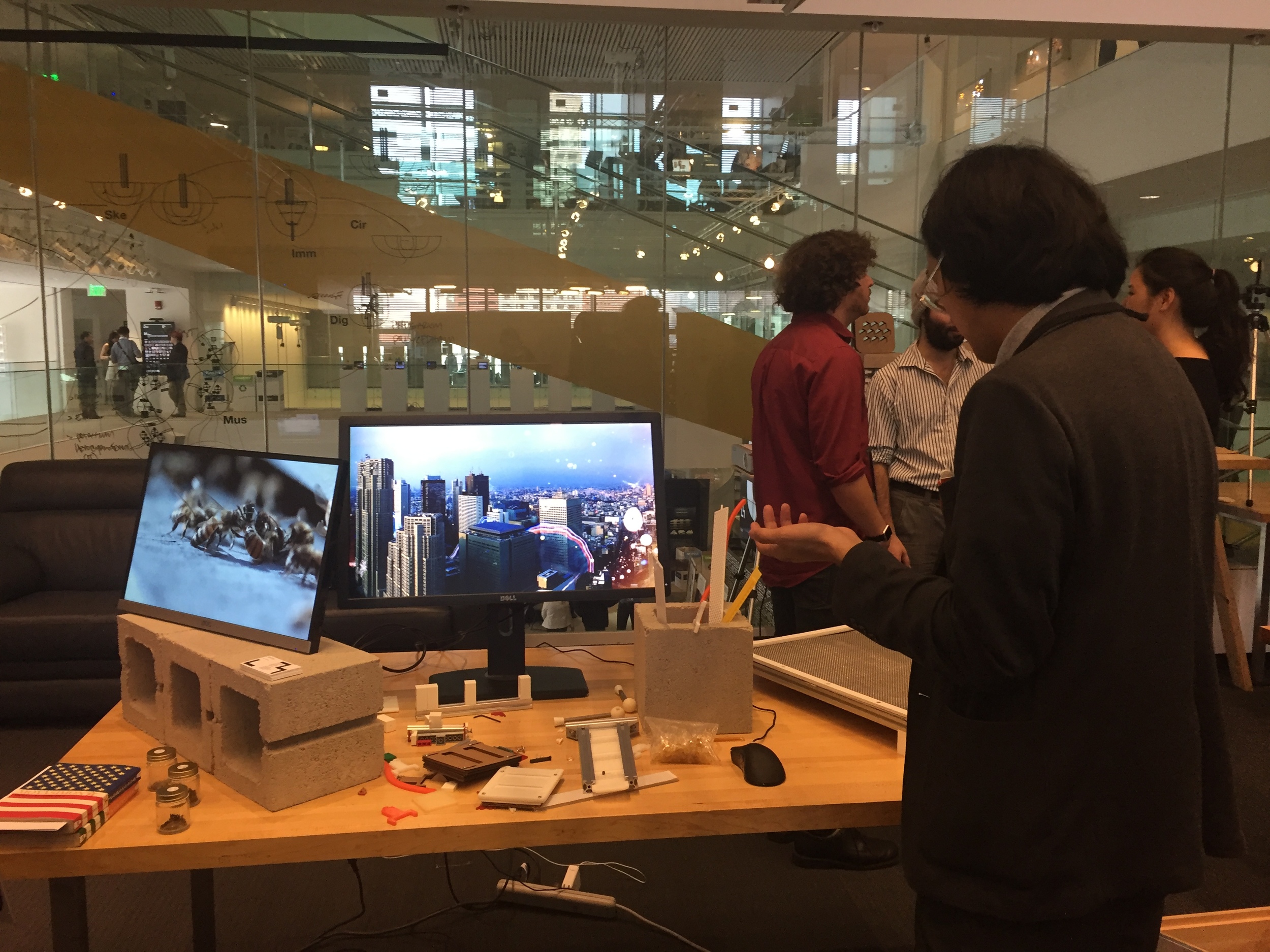
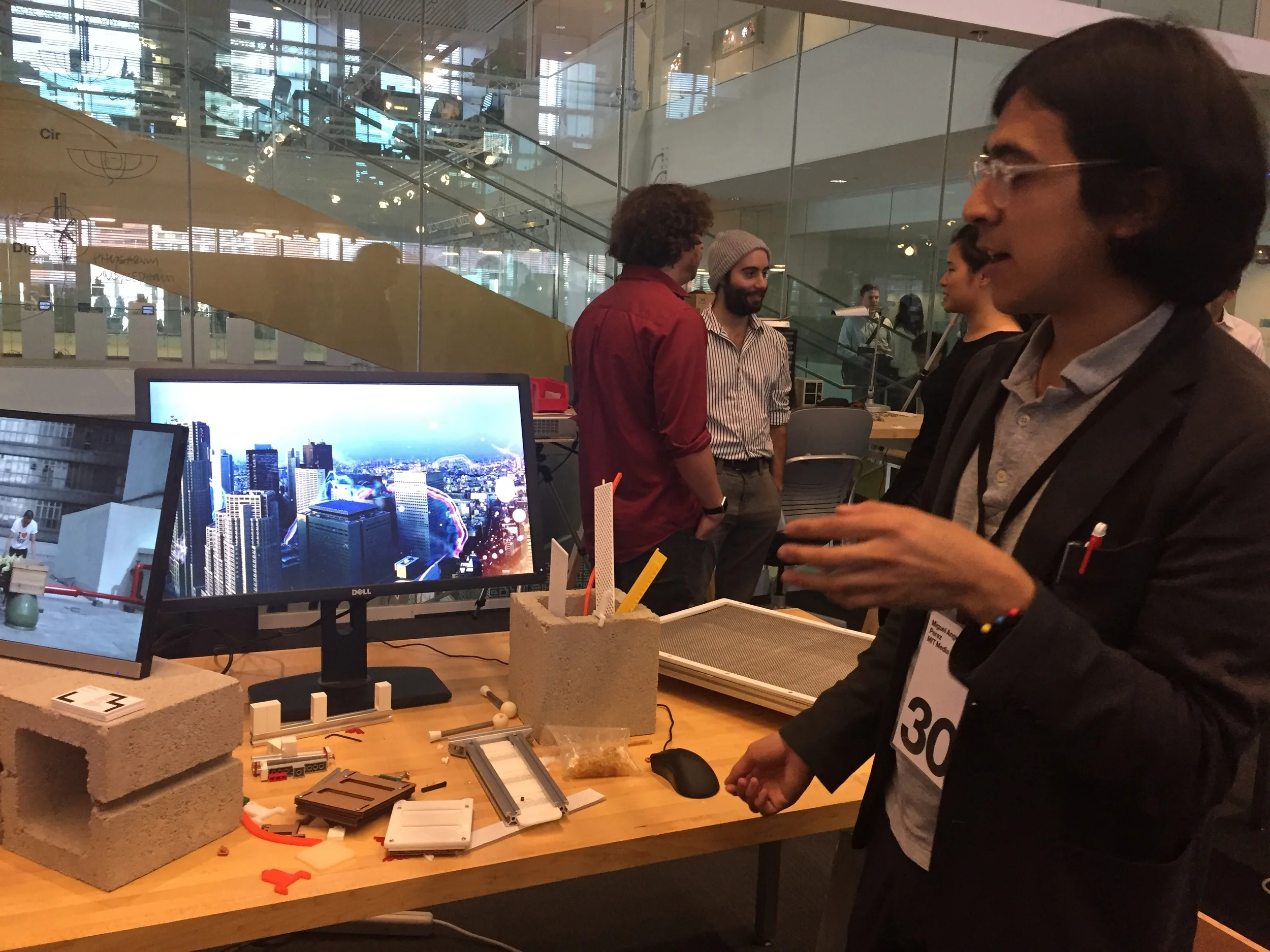
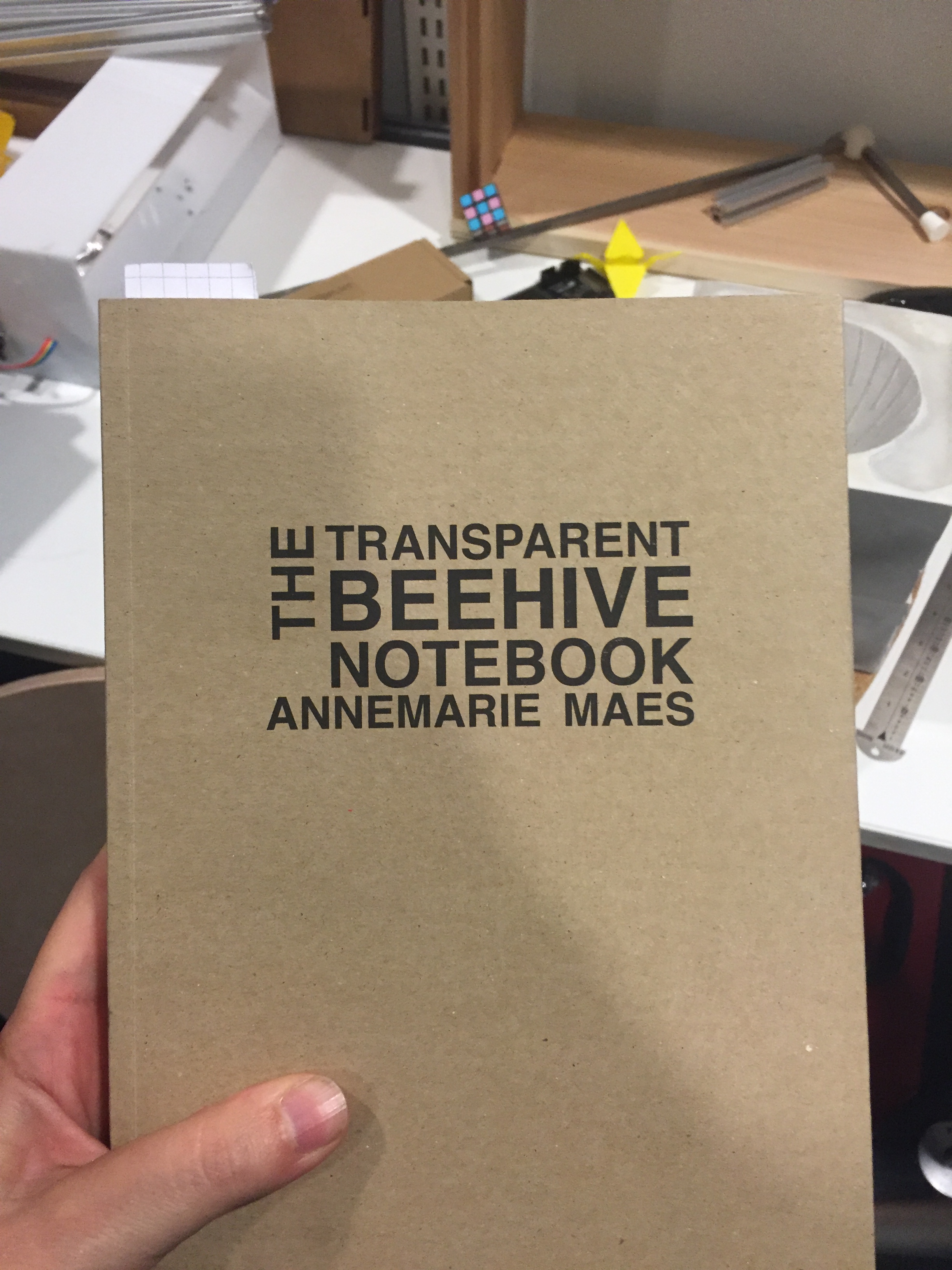
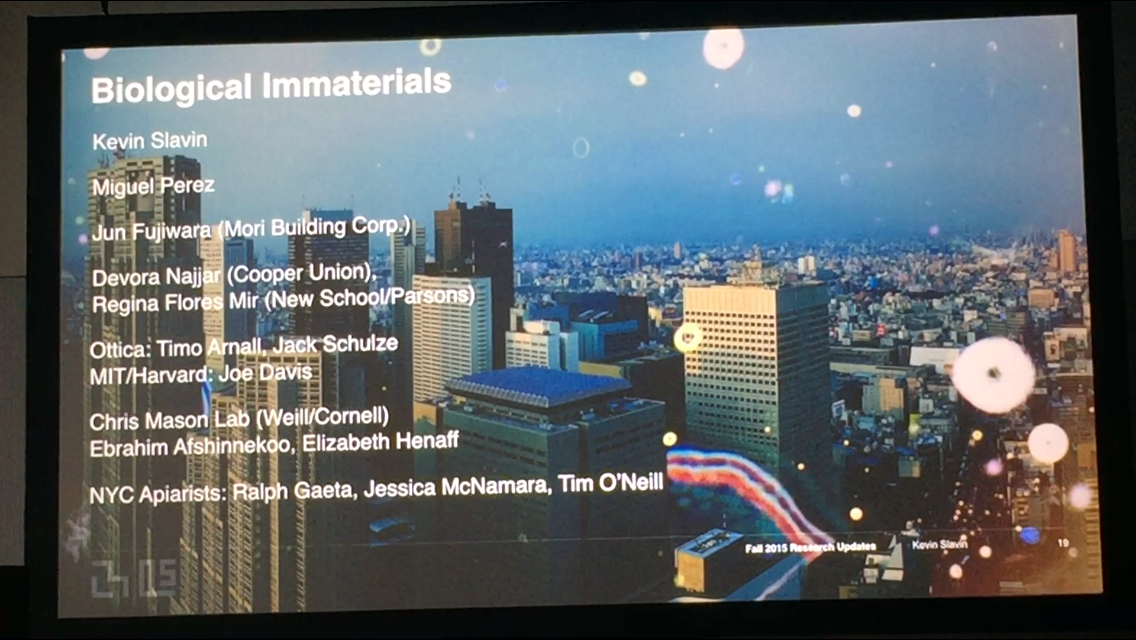

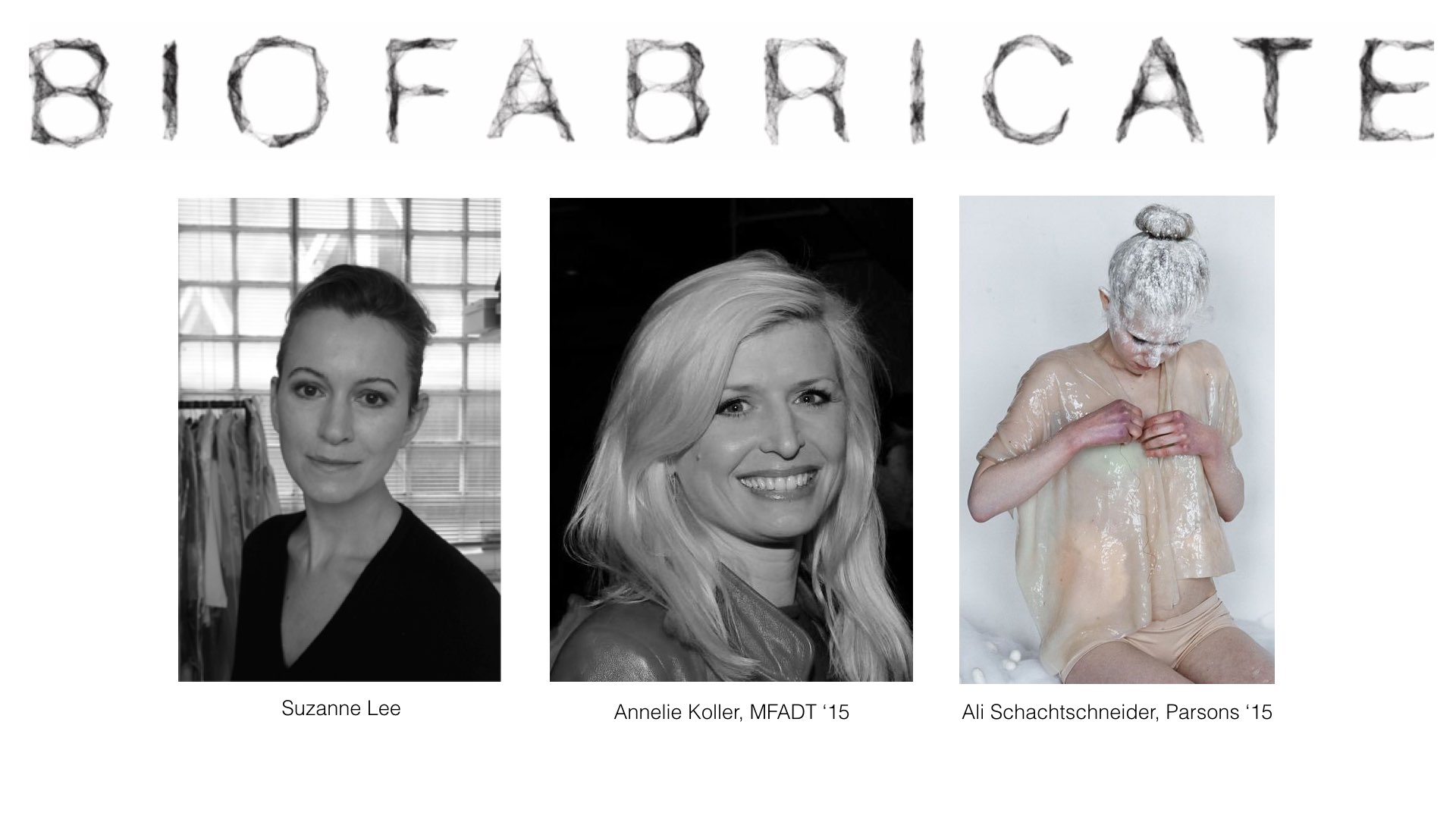
2015 Biofabricate Conference

Ecovative Myco Flex
References From Speakers:
Microbial Machines

David Kong, MIT
- Rob Carlson,
- Jasnima Aganovic, Mother Dirt, AO Biome
- Tal Danino
- Thomas Landrain, Pili.Bio
- Miranda Wang
- Christina Agapakis, Ginko BioWorks
Culturing Innovation
- Rodrigo Martinez
- Dan Grushkin, biodesignchallenge.org
- Ellen Jorgensen, GenSpace
- Ellenore Pauwels, Wilson Center
- David Kong
3D, 4D, 5D - Printing Life
- Rodrigo Cruz
- Eric Klarenbeek
- Christophe Guberan
- Danny Cabrera, Bio Bots
Reflection:
"What I cannot create I do not understand" -Richard Feynman
The Biofabricate conference was exciting and inspiring! I met many new people and learned about new and cutting-edge projects in the Bio Design industry. It was a great opportunity to be able to be in the same room with people who are also working in the same space and learn about different perspectives and implications. The attendees spanned the entire spectrum from politics, policy, synthetic biology, manufacturing, critical design, consumer products, venture capital, and beyond. All those different people, from diverse points of view, discussing the same topic, allowed for lively panel discussions and helped frame the conversations in a new light.
I thought the presentation from IDEO was particularly interesting because they showed an alternate future scenario/critical design project. This is out of the ordinary coming from a product design firm. And the format was unique among all the presentations at the conference.
The work from AO Biome was also fascinating. For the first time we are seeing consumer products designed to work in tandem with the microbiome: to enhance it rather than "disinfect" it. Mother Dirt is a skin care line that "restores your skins natural microbiome".
I was excited to see Ecovative and have the opportunity to chat with the team. They are launching a new product called Myco Flex. I think they are one of the most innovative companies out there who are truly making a difference in the Biofabrication space.
Bio Bots, a 3D printer that uses living tissue, was also at the conference. This seems like a potentially interesting product. Although I am not sure the technology today is advanced enough to make this product revolutionary, it certainly is a fascinating thought exercise to think about a desk-top product that allows consumers to print their own tissue.
In general the mood at the conference was positive and felt like a pep-rally. I personally had a great time. But, the same questions I had from the last blog post linger. Where is the real impact today of these technologies? I believe that we have the power to change our world by incorporating biology into our making and manufacturing. But in order for real, scalable change we need to get government (Big Money) on board. There have to be economic incentives. As William Meyers said, we have to "follow the money".


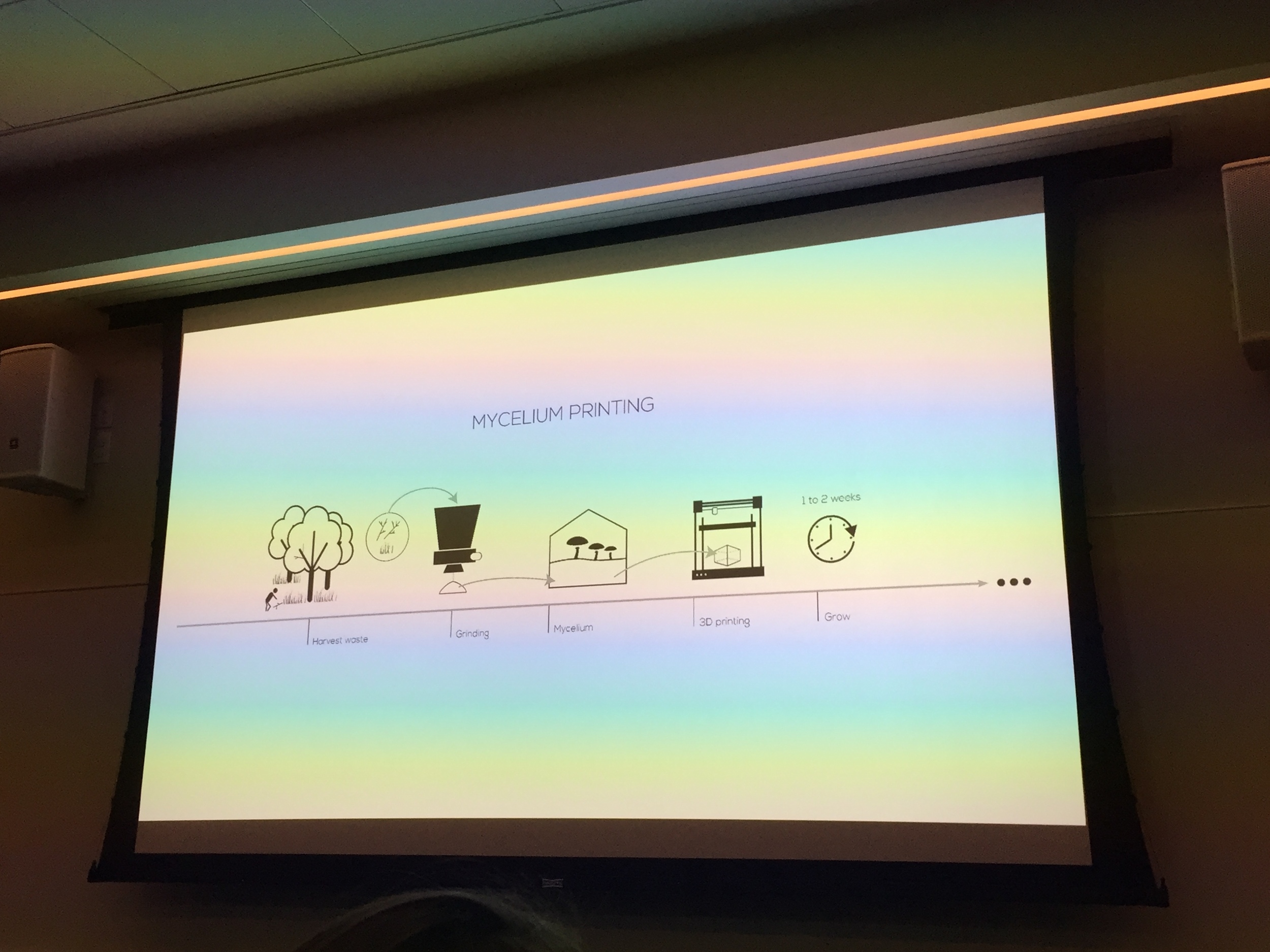


Bio Fabrication

Marin Sawa Algaerium Bioprinter

Terreform One Fab Tree Hab
Readings and References:
Interview with William Meyers
Question: Your books BioDesign: Nature + Science + Creativity and BioArt: Altered Realities play an important role in helping designers and artists think about the possibilities of their work and have helped redefine an entire genre of design/art practice. A common thread in both books is the role that critical design plays when thinking about the intersection of nature and the artifice. What do you think are some ideas/topics with respect to biotechnology that we should be most critical of? Or are there any new or important projects that you think are speaking to the current social/cultural implications of biotechnology?
"I think we should be wary of where biotechnology is going. We need to ask questions like what is driving it and who is it benefiting? Too many projects only celebrate, speculate, or experiment with these new technologies and not enough look at them skeptically. Critical art and design, like that of Daisy Ginsberg and Spela Petric should proliferate. A project to look at which is in development is the MSA by Emma Conley."
Question: We are now living in the Age of the Anthropocene, what do you see as the biggest threat or concern for the near future? What do you think Bio Designers should be thinking most about? Are there any projects that are speaking directly to these particular issues?
"A major concern or goal as I see it is to link economic growth to ecosystem protection and enhancement. In other words, identify how certain economic activity builds and supports ecosystems (example would be oyster farms), and then reward or incentivize organizations to do these activities. To a limited extent we already do this, but it must be vastly expanded to begin to counteract the destructive momentum of current systems."
Question: If we looking ahead to your next book it could be called BioManufacturing. Do you think that the DIY manufacturing movements (OpenSource Hardware/Arduino, 3D Printing/Makerbot) will soon make using biomaterials a common practice? Are we headed towards an open source biomaterials world where we will be 3D printing organic material? If yes, what are your thoughts on this? What might your BioManufacturing book look like? Where do you see the most promise at the intersection of Biology and Manufacturing?
"Yes, I think by necessity DIY practitioners as well as large companies will turn to biomaterials and harnessing bio processes for more production. This is a logical outcome or reaction to the pressures building as a result of climate change, and the regulatory environment which is continually getting better and spotting what/where harm is done. Not sure what a book on this would look like....but it would be a pleasure to write it if I had the support structure to do it (museum, university, etc)."
Question: I am very interested in the intersection of architecture and biotechnology — grown environments rather than built environments. And in particular I am looking at how we can incorporate living systems either directly as Terreform has in Fab Tree Hab or indirectly where biological material serves as a model like the Bio City Map. I am beginning to think more computationally about how to marry mathematical modeling with living matter like the Silk Pavillion. (I am also very inspired aesthetically by architects like Ezio Blasetti, Alisa Andrasek and Francois Roche.) What do you think is the most promising technology in reimagining our built environments? Are there actual (that can be implemented now or in the near future) architecture projects that can disrupt the status quo and harness Bio Design to actually grow environments? If this work resonates with you, are there projects that you think are interesting or inspiring in this space?
"You're definitely on the right track, and I really admire your optimism and energy. With designers and thinkers like you it will only be a matter of time before we achieve the kind of healthy hybridization of built and grown environments that we need! You site solid examples, and I like your question about what's most promising. Instead of citing something like algae bio reactors in buildings or some other specific tech, I think what is most promising is the techniques and tools under development in the fields of ecology and evolutionary biology that are allowing us to measure the changes in ecosystems over time. Such measures, I think and hope, will be the tool for designing policies like I describe in the answers above. Reliable measurement will allow us to assign value and then protect environments. Some would call this fatalistic or cynical, but I really think that harnessing capitalism itself to undue its previous impact on the global environment is the most promising way to do it quickly. As Jenny Holzer said "use what is dominant in a culture to change it quickly." Let's use money."
Previously recorded interviews with Mitch Joachim:
A critical note:
What is biofabrication? Is this a word designers made up? Is an ant hill biofabrication? What about a bee hive? What does it mean to fabricate with biological material? Fabricate implies assembling parts or inventing a process, but does nature assemble? Is growing nature's fabrication?
I think that we we have yet to see biofabrication come to life. Perhaps there are some examples in the biomedical field (3D printing bone or hearts), but in the design and architecture community the work being shown at the intersection of technology, biology, and architecture leaves much to the imagination. While luminaries such as Mitch Joachim, Neri Oxman, and David Benjamin are all doing work that is aesthetically pleasing and certainly creating a buzz around Bio Design, I find the work lacking a bit of substance. Is their work making real change in the way we actually build today? No! I am skeptical about the real impact to change the way we live in the Age of the Anthropocene. Are these people just making more beautiful things to be displayed in galleries and museums? Why are there no implementation plans in place for this work? Why do we not see grown environments all around us? I think as William Meyers said above, the real impact here needs to come from economics and policy changes. I am not really sure how making another critical design piece for an art gallery can add to the conversation about Bio Fabrication.
Bio-Architecture and Material Ecology

Silk Pavilion, MIT Mediated Matter Group
Kevin Slavin, MIT Media Lab
Francois Roche, I've Heard About
Interviews:
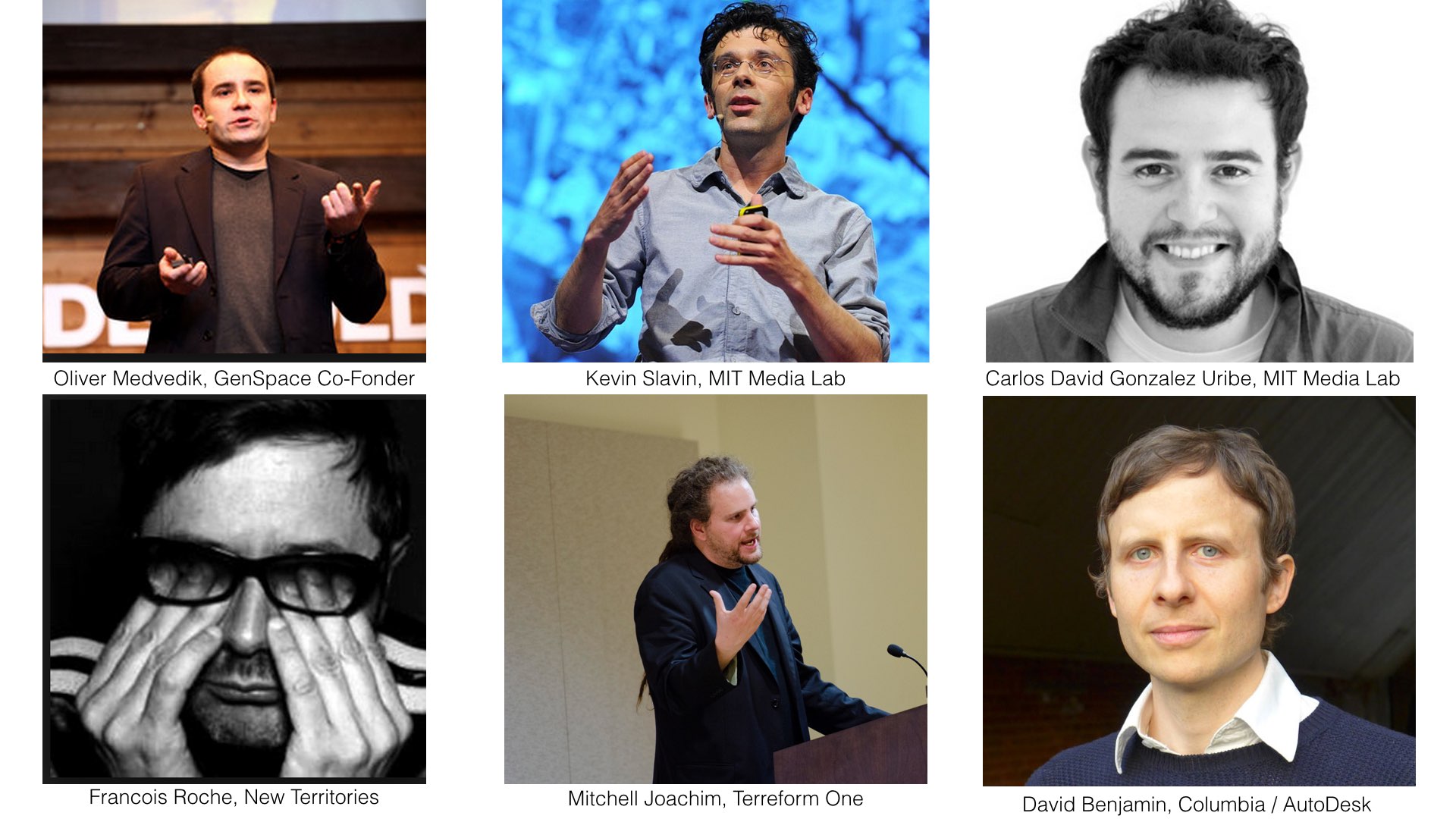
Carlos David Gonzales Uribe, MIT Media Lab, Mediated Matter Group
Kevin Slavin, MIT Media Lab, Playful Systems
Francois Roche, New Territories
Readings:
- Self Repairing Architecture
- Design as Future Making. Clive Dilnot's Essay Reasons to be Cheerful 1, 2, 3...* (Or why the artificial may yet save us)
- Neri Oxman. Material Ecology
- Next Nature
References:
- Acadia Conference 2015 Website
- Francois Roche: New Territories
- http://syndebio.com/
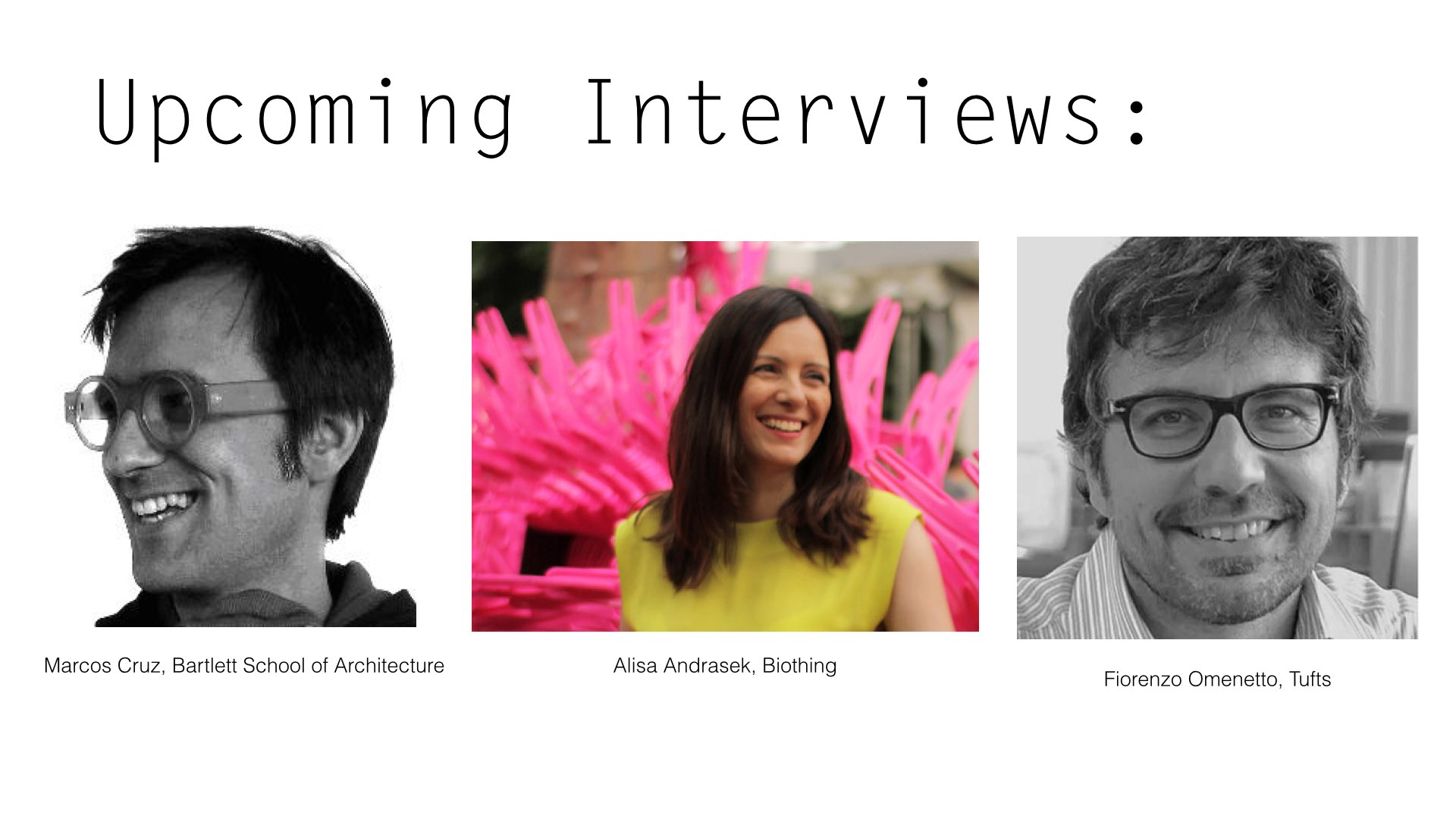
- Marcos Cruz Blog (Bartlett School of Architecture)
- The work of Alisa Andrasek at Biothing
- Neri Oxman's TedTalk March 2015
Terms:
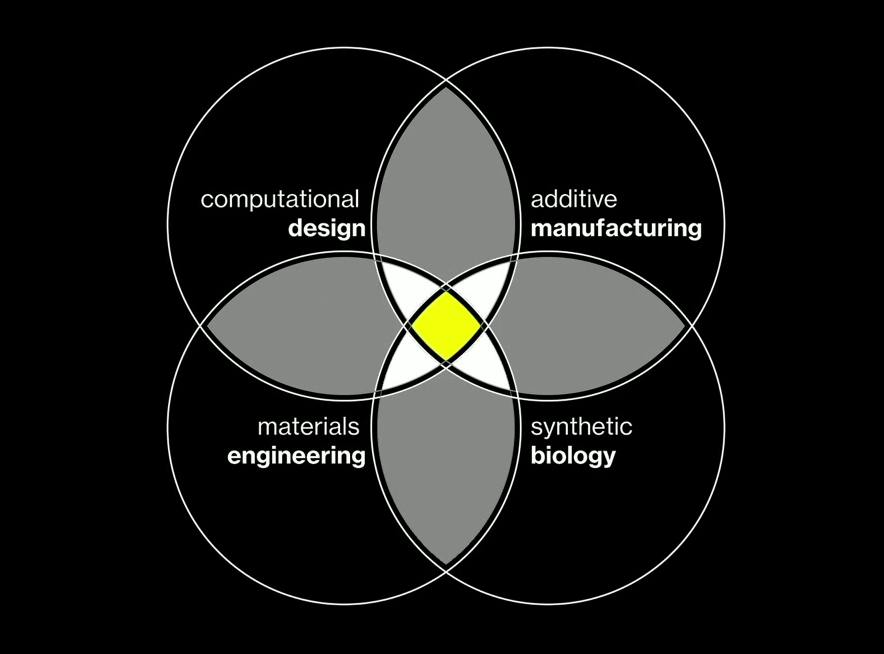
Material Ecology: "Material Ecology is an emerging field in design denoting informed relations between products, buildings, systems, and their environment (Oxman, 2010). Defined as the study and design of products and processes integrating environmentally aware computational form-generation and digital fabrication, the field operates at the intersection of Biology, Materials Science & Engineering, and Computer Science with emphasis on environmentally informed digital design and fabrication. With the advent of digital fabrication techniques and technologies, digital material representations such as voxels (3-D pixels) and maxels (a portmanteau of the words 'material' and 'voxel') have come to represent material ingredients, for instance in the context of additive manufacturing processes." (Ref)
Age of the Anthropocene: "The slice of Earth's history during which people have become a major geological force. Through mining activities alone, humans move more sediment than all the world's rivers combined. Homo sapiens has also warmed the planet, raised sea levels, eroded the ozone layer and acidified the oceans. Given the magnitude of these changes, many researchers propose that the Anthropocene represents a new division of geological time." (Ref)
Last year I wrote a Design Manifesto essay where I wrote:
In his paper, Reasons to be Cheerful, Clive Dilnot outlines human history as it relates to the artificial, and breaks it into three distinct epochs. Most notably is the “Age of the Artificial,” the period that we are currently living in, that Dilnot describes as the time when “the artificial and not nature is now the horizon, medium and determining condition of the world” (Dilnot). He describes climate change, namely global warming, as one of the “destructive historical markers” of the “Age of the Artificial” and suggests that we are now defined by the Anthropocene Age—the era where humans begin to impact the environment to such a degree that even the Earth’s geology is forever altered. This idea that our increasing dependency on and obsession with the artifice has directly resulted in a fundamental change of our planet’s ecosystem must dictate the direction that humanity moves toward into the 21st century. Thus, the primary axiom in the guiding principles of my design ideology is that, above all else, the ecology of the planet must be protected and sustained.
I argued in a subsequent essay that if humanity is to survive the environmental destruction that our current social and economic models are based upon, the only way forward is to make a radical change toward an “ecologically synergistic” social model.
Over the past year my focus on where best to implement the Ecological Synergy became centered on the built environment. Why? Because the practices (factories, pollution, mass production) of the industrial revolution have what has largely contributed to climate change. And steel—the symbol of the 20th century industrial revolution, — is the foundation upon which the world’s largest cities are based. And perhaps because it is architects — who are using alternative materials and innovative design approaches — who are the most prominent figures today to rethink our “Artificial” world. One must only look at the 2015 Acadia (Association for Computer-Aided Design in Architecture) Conference description to see that the future of architecture is heavily rooted in reimagining the built environment:
Until recently, architecture’s proximity to environmental issues has been dominated principally by “sustainability” or “green” discourse, which not unlike the “functionalism” rhetoric of twentieth century modernism, privileges an arguably deterministic and thus parochial view of the discipline. The ACADIA 2015 conference, titled Computational Ecologies: Design in the Anthropocene, seeks to expand the topic of environmental discourse beyond purely practical issues of “performance” as a general means of engaging experimental contemporary design that explores aesthetic, conceptual, and even philosophical levels as well. In the context of such work, the discipline of architecture, conceived as both a technological and a cultural endeavor, becomes immersed in a much broader geophilosophical debate regarding the future of society and by extension the built environment in the age of the Anthropocene.
The “future of society” is indeed what is at risk here if we neglect to identify alternative modes of living and designing. We simply can’t afford any other avenue.
Neri Oxman is the head of the Mediated Matter group at the MIT Media Lab. In her 2015 TedTalk, Oxman says that we must now look not to “nature inspired design” but “design inspired nature.” Further she argues that we are now in a time when we, humans, must “mother nature.” In the context of Dilnot’s assertion that we are now fully immersed in the “Age of the Artificial,” Oxman’s call to “mother nature” feels like the right approach. Is it not our responisibility to care for that which we have destroyed? The on-line blog turned book, Next Nature offers a subtly different argument saying that in the Age of the Anthropocene we humans must “radically” shift our view of nature, which has historically been naïve. Next Nature argue that we must leverage our technology to become “catalysts of evolution.” Rather than mothering nature perhaps we must partner with nature, as I have suggested, toward a Synergistic Ecology. How can our impetus to design our world serve as a launching point to create a better future?
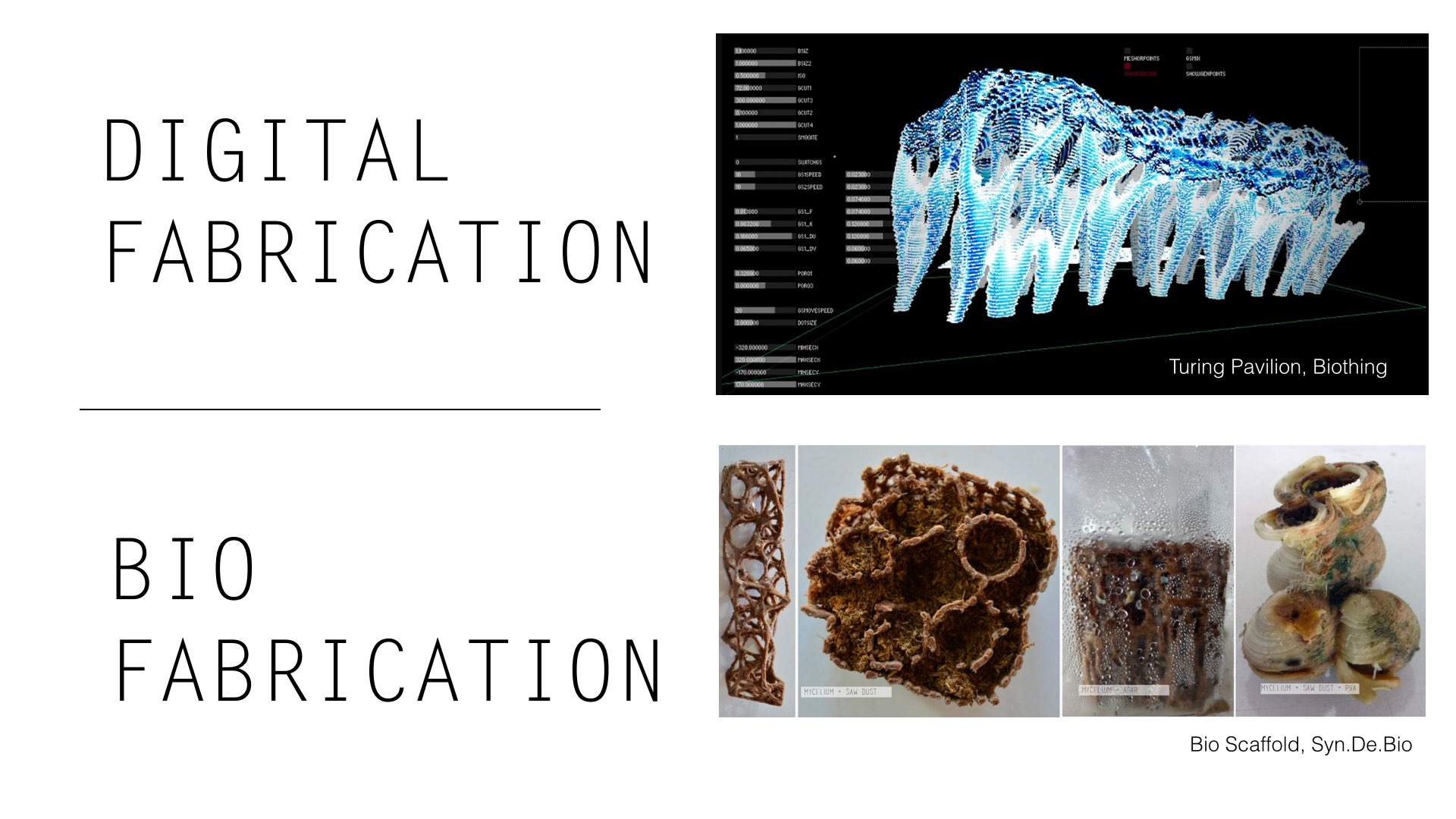
Oxman’s answer is through Material Ecology — which is “an emerging field in design denoting informed relations between products, buildings, systems, and their environment. Defined as the study and design of products and processes integrating environmentally aware computational form-generation and digital fabrication…” I find Oxman’s work undeniably interesting. I see her Silk Pavilion, for example, as an important precedent in merging biological fabrication and digital fabrication to create impressive architectural models of the future of the built environment. Her designs are both aesthetically beautiful and evocative of a wondrous future. But is her Material Ecology enough? Can this research make real change, now?
Francois Roche is another contemporary architect and could be described as “fringe” or “punk-rock.” His ideas about the field of architecture and the implications for society border on that of an activist as he “seeks to articulate the contradictions of architecture” (Wikipedia). In I’ve Heard About he writes “the urban form no longer depends on the arbitrary decisions or control over its emergence exercised by a few, but rather the ensemble of its individual contingencies. It simultaneously subsumes premises, consequences and the ensemble of induced perturbations, in a ceaseless interaction. Its laws are consubstantial with the place itself, with no work of memory.”
In my conversations with him this week, he urged me to think more broadly about what all of this work is really for. He asked that I consider the dichotomy of making work to be shown at an architecture conference where hundreds of people will get on planes, adding to the CO2 levels in the atmosphere, where they will be wearing Prada suits to sit in an ivory-tower and discuss the meaning and potential impact of a project? How can we “force the territories of discourse to move” to “offend the status quo”? How can we reveal the “vulgarity” of society, the “ugly parts” that we don’t want to see, that get swept away from our eyes?
Which leads me the question: is the ecology movement in design and architecture too focused on aesthetics? Is it not the role of architecture, by design, to make things beautiful? And will more beautiful objects, even if made using innovative techniques in bio-engineering/fabrication/design, create the social discourse that is required to create long-lasting, radical change? If the point of all of this research is to deliver humanity safely from the Age of the Anthropocene, then, to be emotionally moved to take action do we need to look at our own detritus?
I also spoke this week with Kevin Slavin who runs the Playful Systems lab at the MIT Media Lab. While Slavin’s world-view is also deeply rooted in the realities of the Age of the Anthropocene, he is distinctly more optimistic than Roche. His current research focuses on the microbiome and looks toward revealing the impact that the micro world has on the macro world, especially as it relates to the built environment. He seeks to answer the question: How do the microbes that live in our city impact human behavior, disease, and even the social order?
At the start of this blog post I referenced my Design Manifesto, which demands, primarily, Ecology Above All Else. However, also in my manifesto is the notion of Design to Inspire. While I agree with Roche that it is important that my work question the status quo and “disrupt,” I don’t believe that fear is the way to move humanity, rather I believe it is inspiration that will. Slavin’s research offers promising insight into the connections between the micro and macro—the fractal nature of our universe. This, in my view, could inspire people. We, humans and microbes, are all on this “spaceship earth” together. Only by working together will we survive.
Speculation:
Understanding the relationship between the microbiome and the built environment will give us a deeper understanding of human behavior. How does the microbiome in a large, industrial city differ from that of a rural environment?
Thesis Concept Presentation
Click here for the PDF.








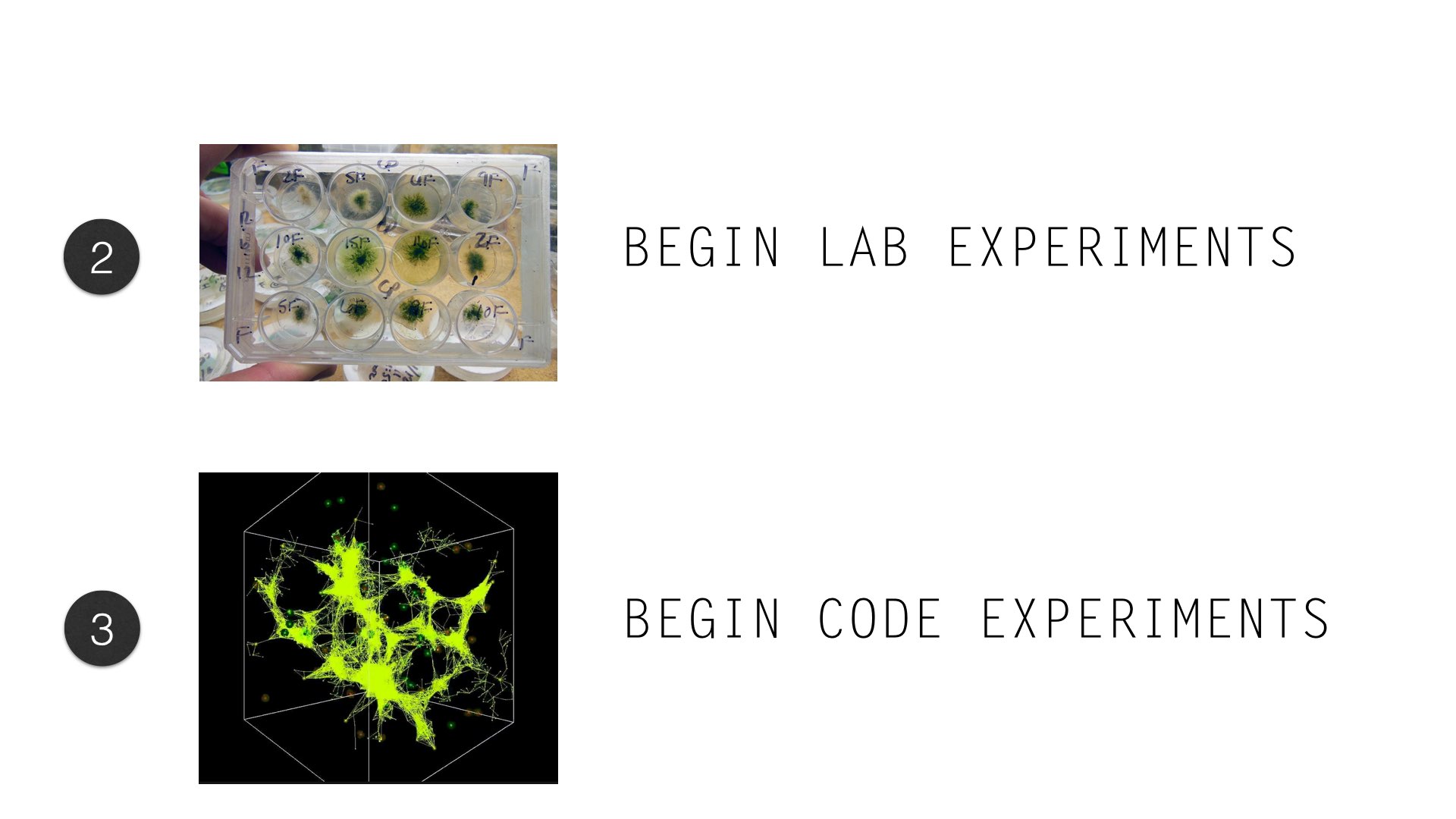

3D Printed Self
More experiments in 3D printing and Rhyno.


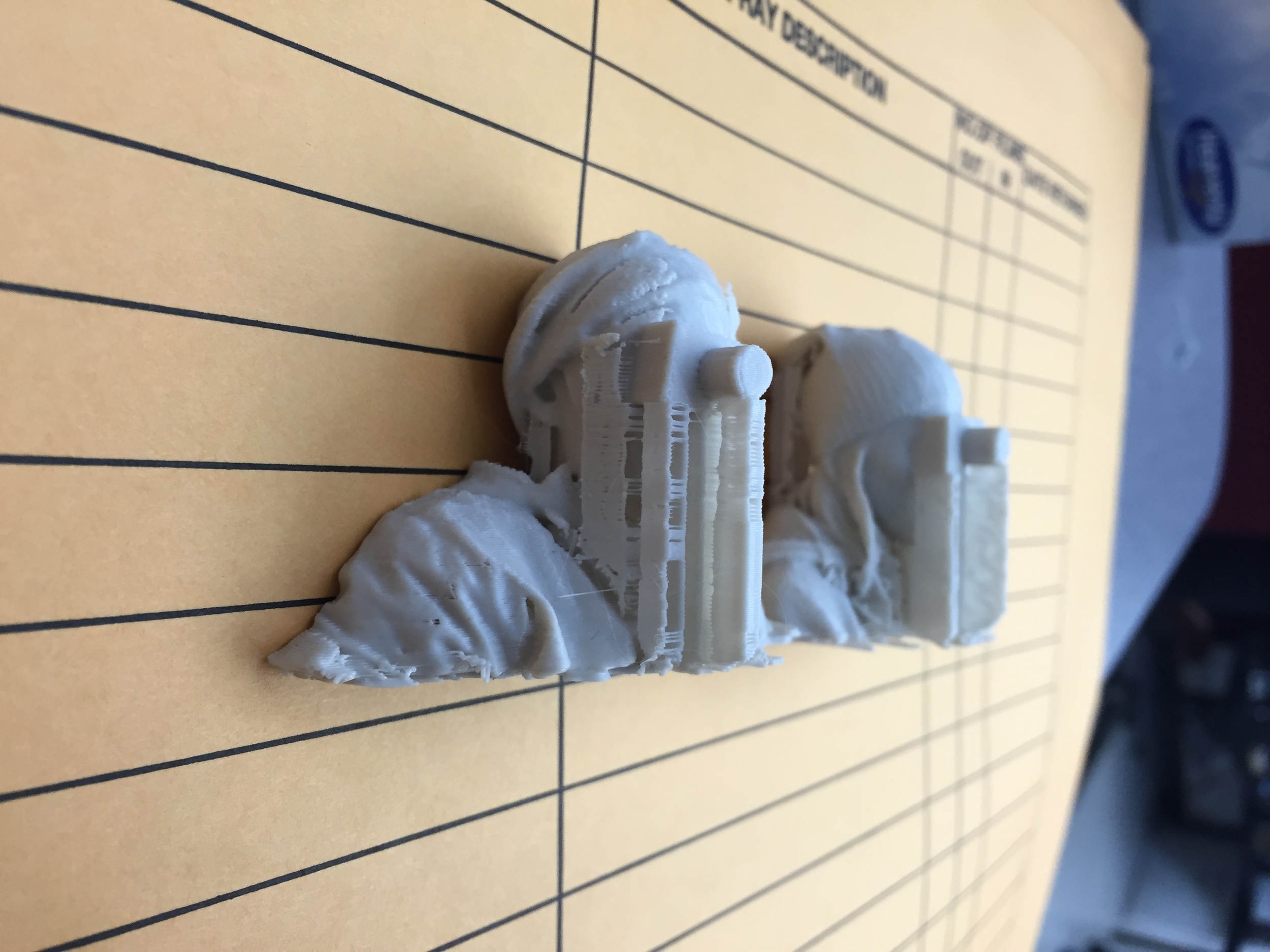

Prototype III: Aesthetics
For the third prototype we are asked to investigate the aesthetics (material, form, color, texture) or methodological (process) aspects of the work.
Current Working Concept Statement:
I am studying digital and biological fabrication because I want to find out how to build a sculpture at the architectural scale using alternative materials and computational and mathematical modeling methods in order to broaden the social conception of the built environment in the age of the anthropocene.
Process:
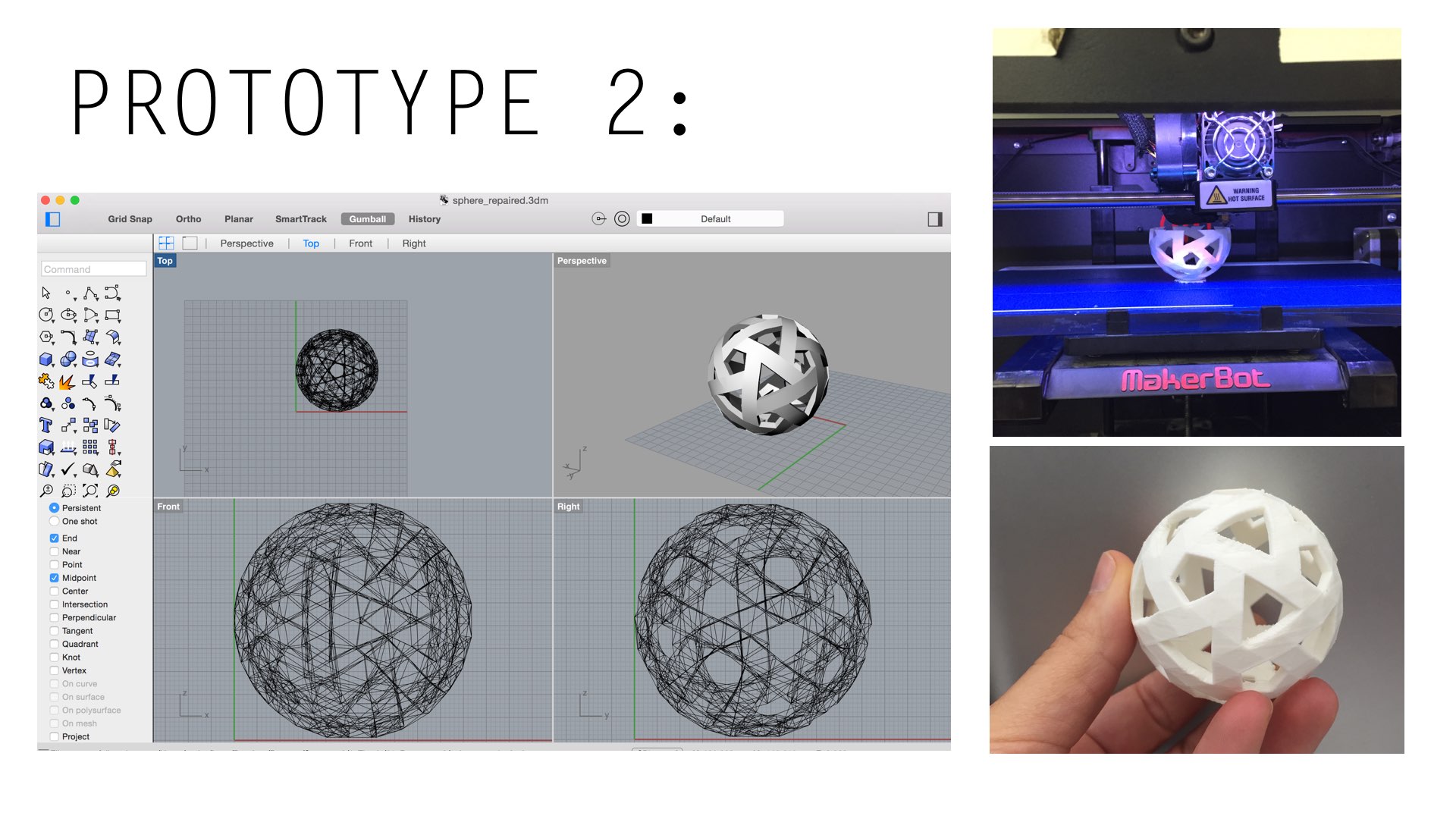
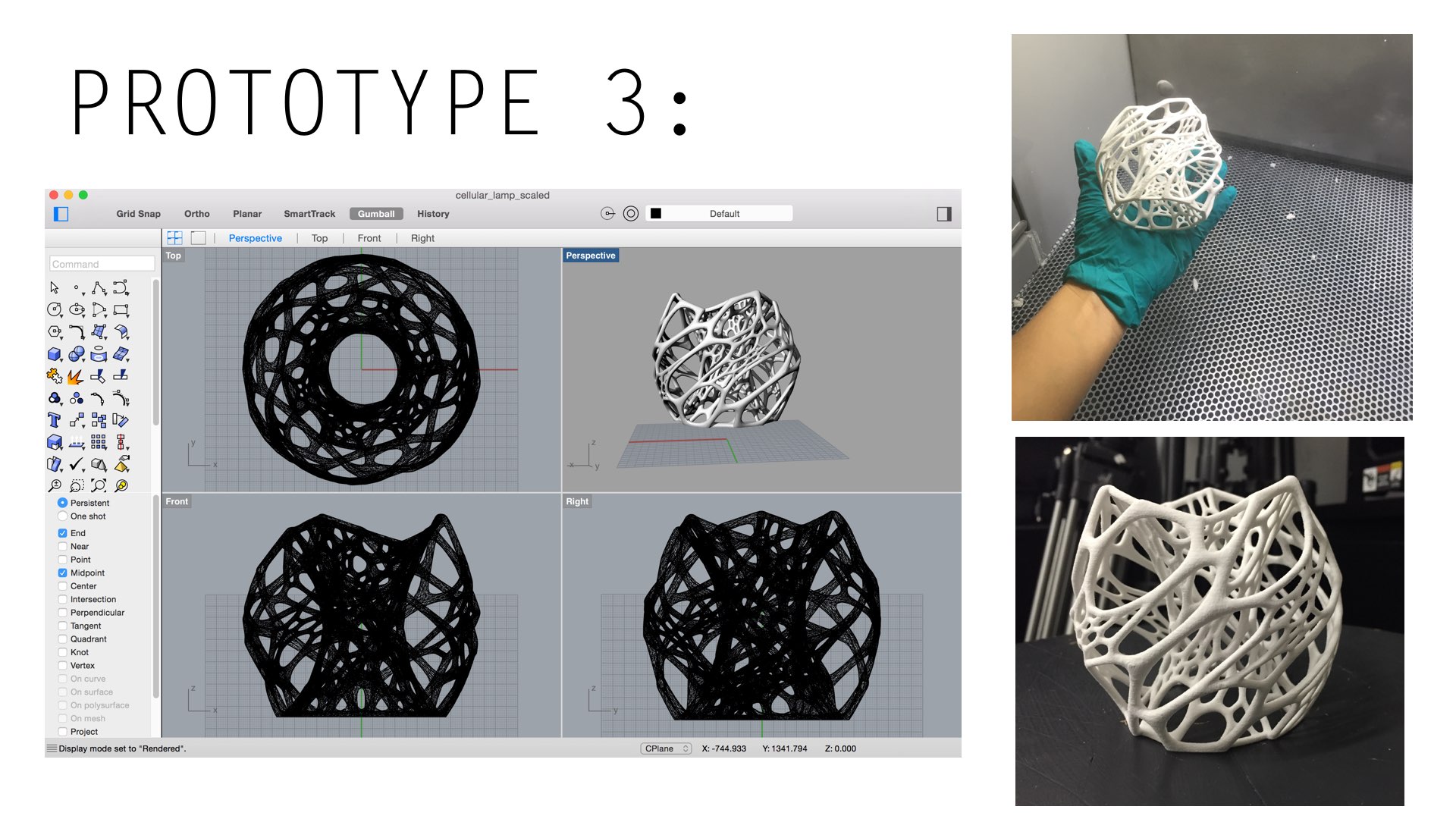
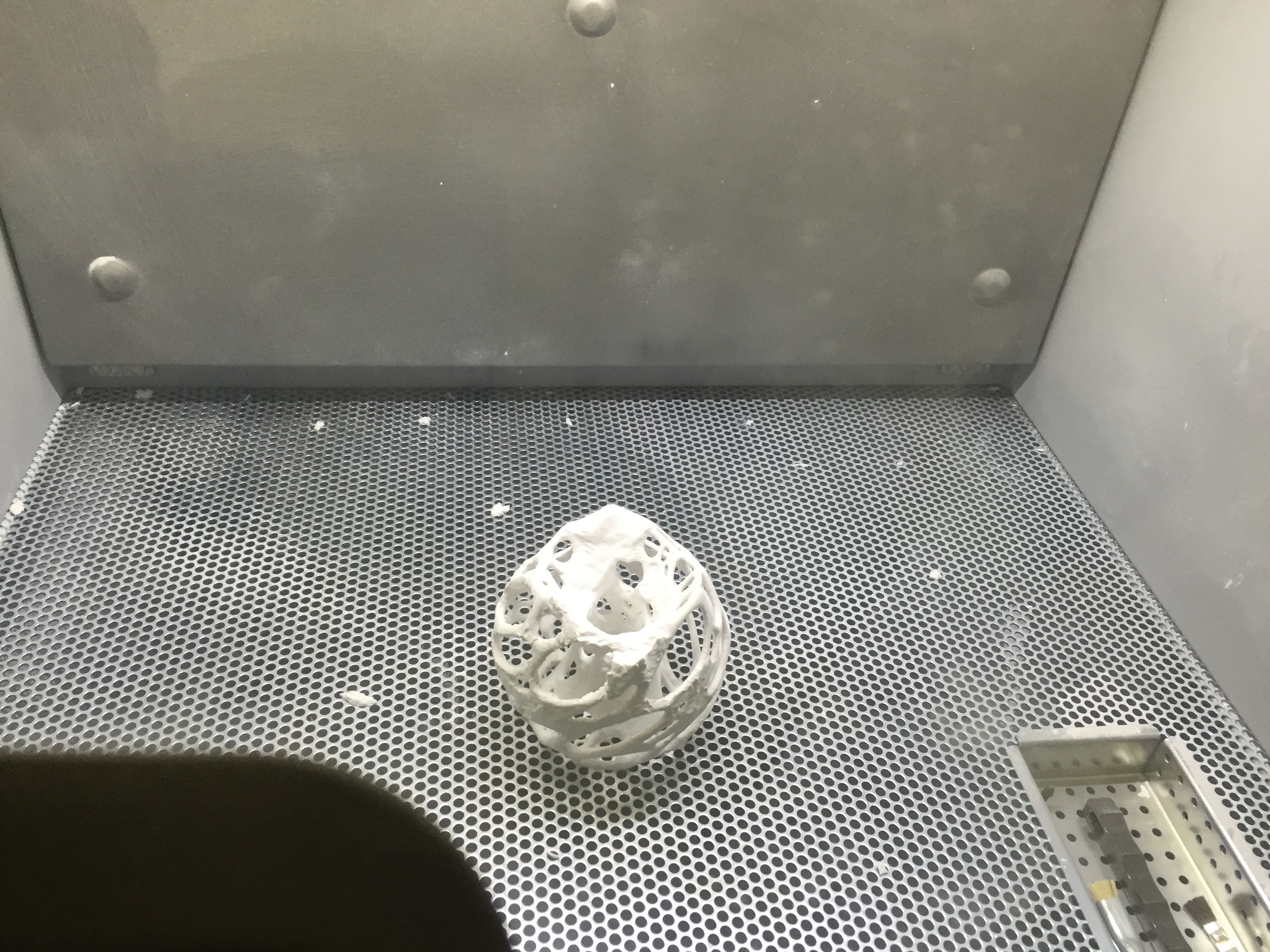
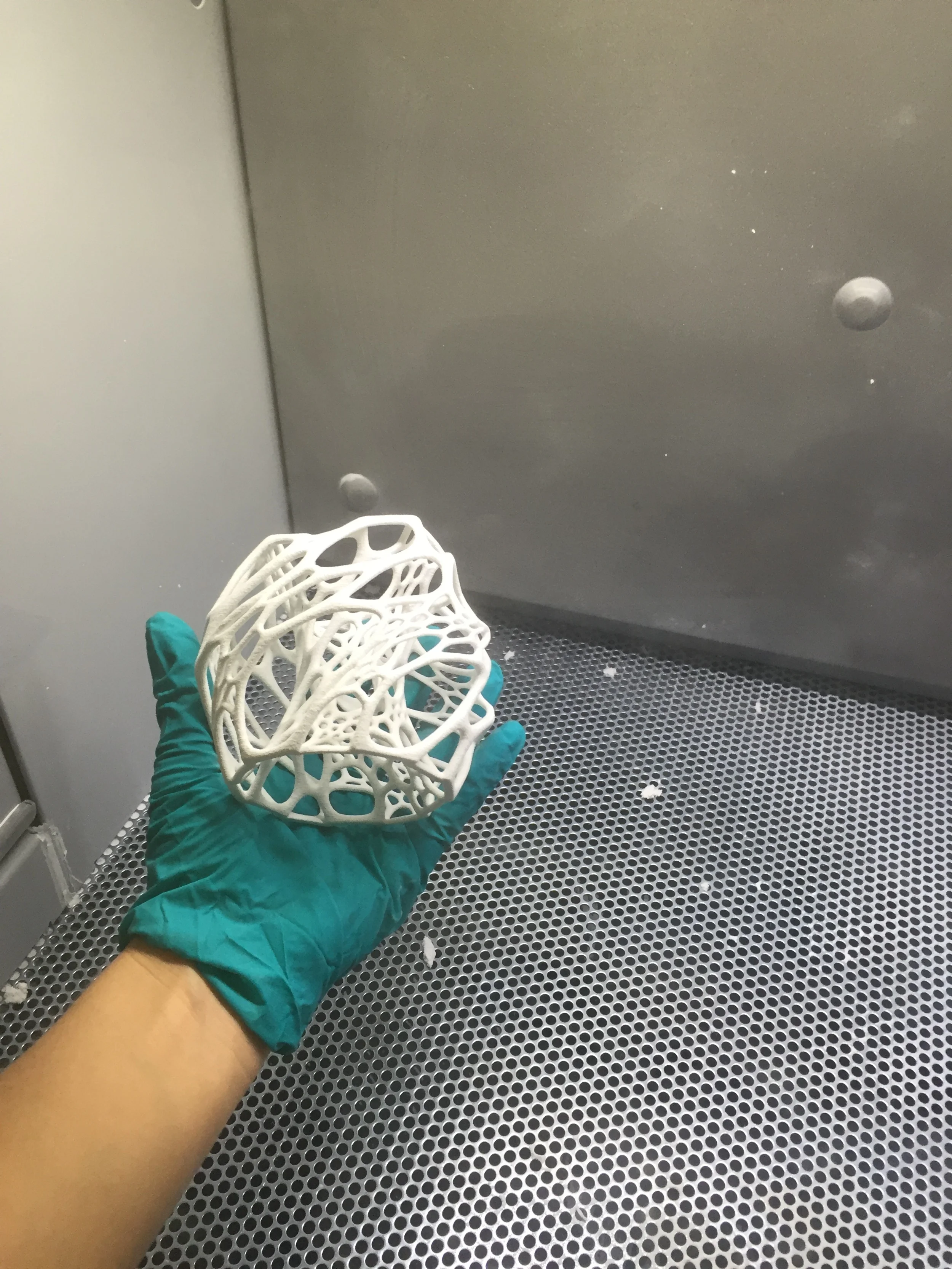
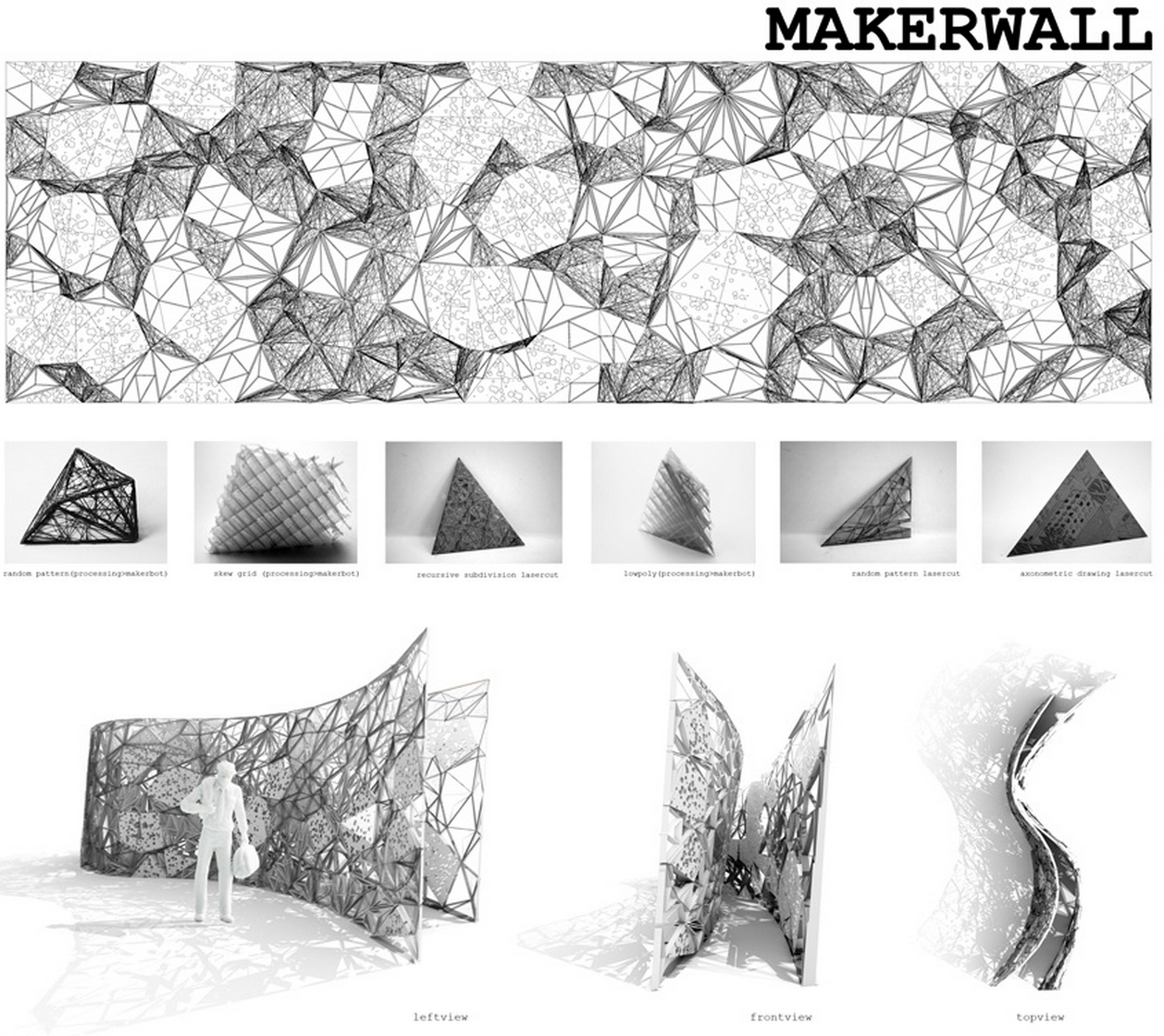
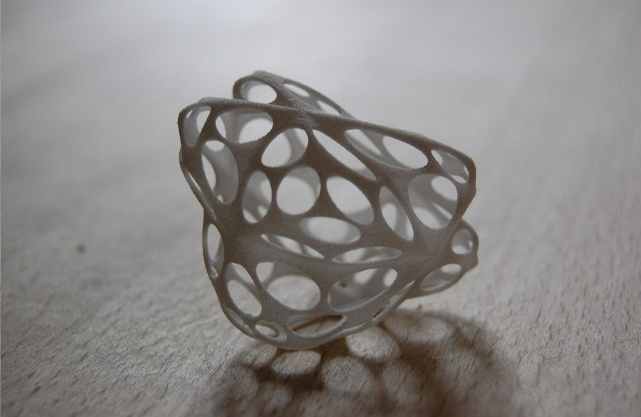
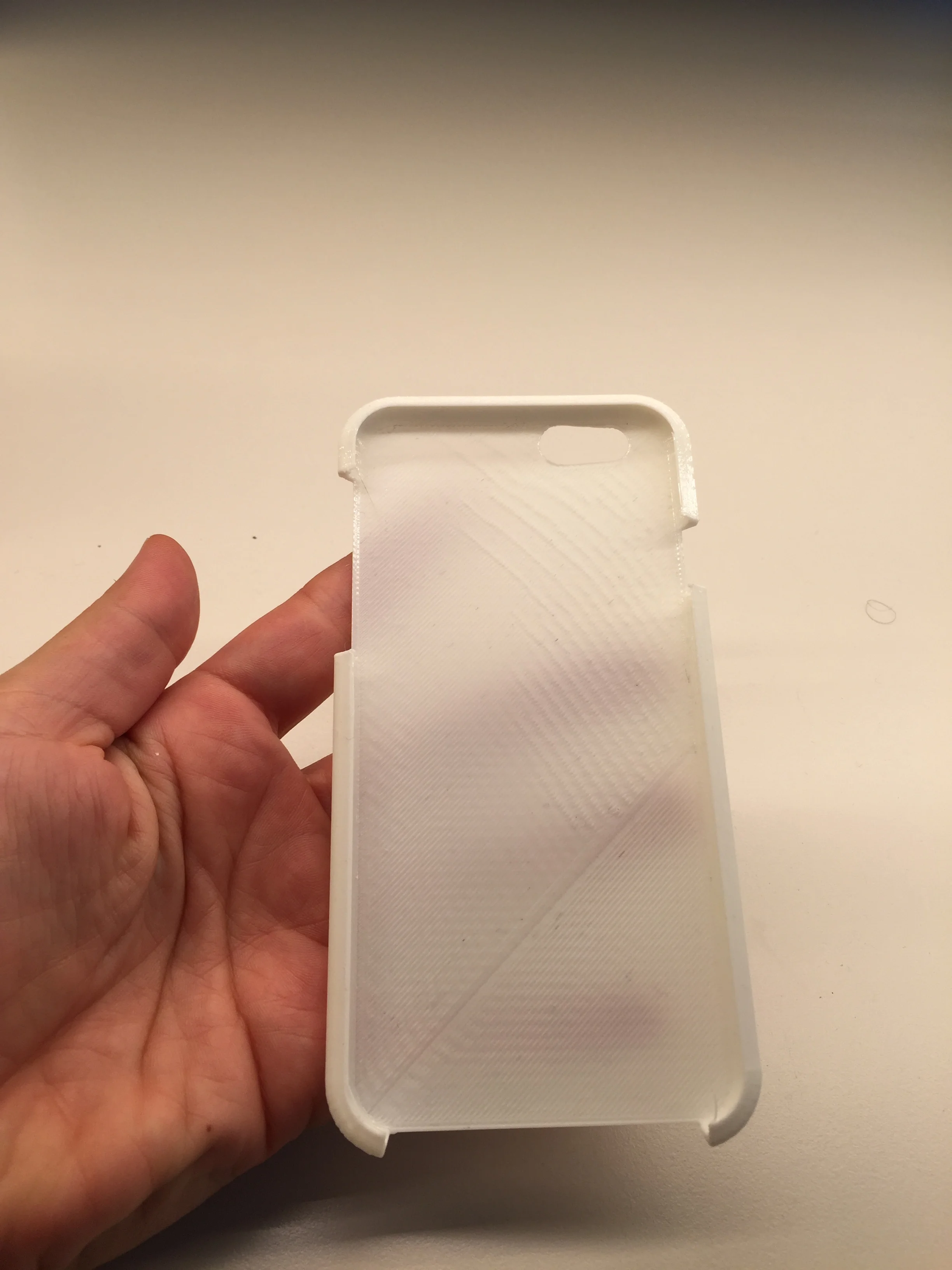
I wanted to explore the process of digital fabrication further. In my second prototype I experimented with the MakerBot using simple forms. For the third prototype I used the 3D Powder Printer (Projet660). I explored more complex shapes in Rhino and looked at algorithmically generating forms.
Reference for 3D models.


Experimenting in Digital Fabrication and 3D Printing:




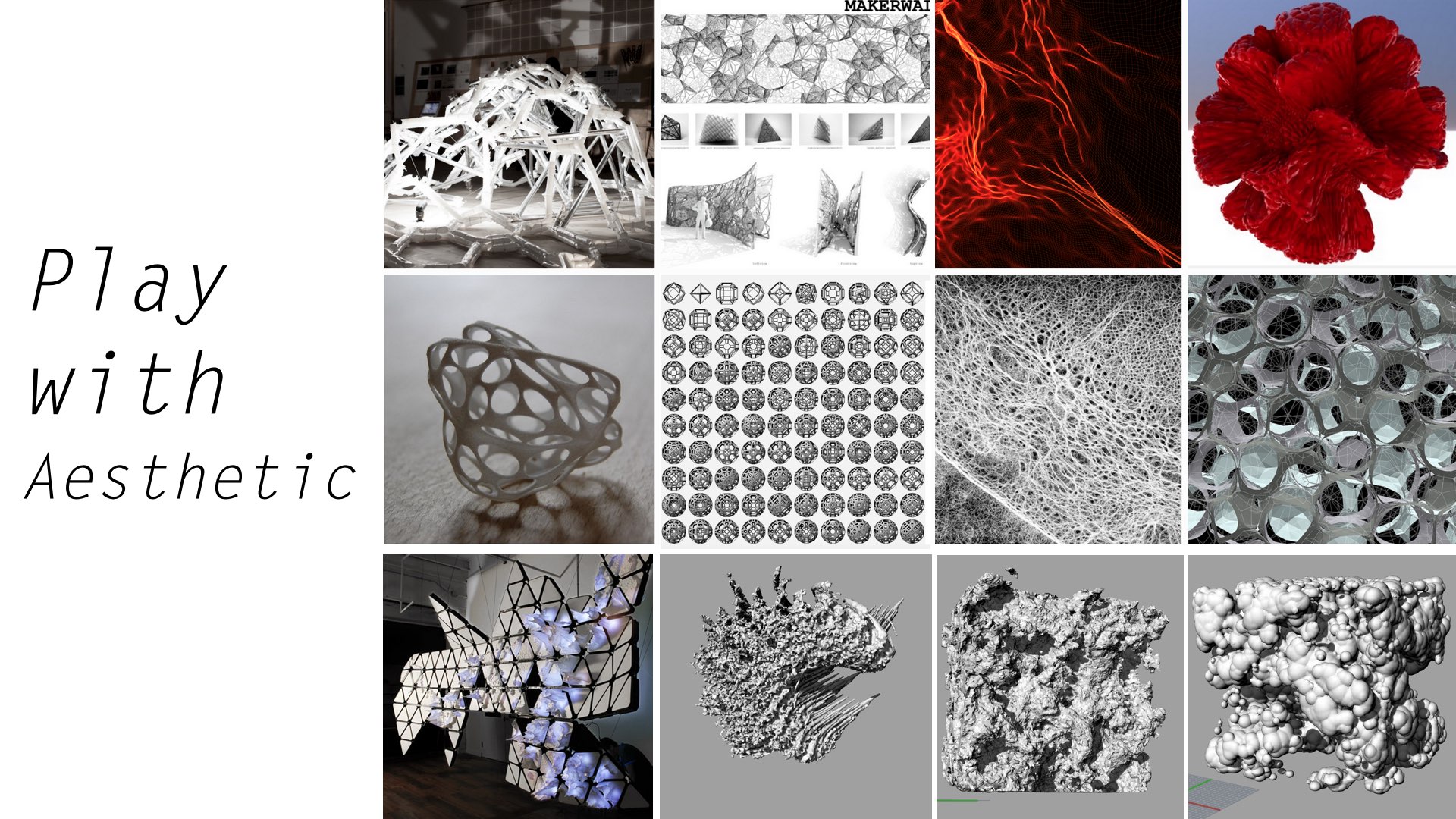
Inspiration:





References:
Aesthetics:
What is the formal basis of your project? (Note: formal here means of or pertaining to the form, what something looks like, feels like, its aesthetics.)
How are you dealing with materials, color, form, shape, composition, aesthetics?
What would you like your piece to “feel” like (whatever you define “feel” to be here).
What aesthetic precedents have informed your project?
How do the aesthetics underscore the overall concept of the work?
Methodological:
How will you go about making your project?
What methodologies or processes will you employ?
How will you collect & manipulate data and media? Source or modify materials?
How does the way in which the project is created or executed underscore its concept?
Rhino Experiments: Twist an Object




Thesis Writing II
What are some adjectives around how the project will make its audience feel?
I want the audience to feel awe: awe at the sheer scale of the sculpture and awe at the notion that we are entering a new era when living systems are as much a part of our environments as they are with humanity itself. The audience should feel connected and unified to all of space and time—a connection to the unknown. The project should elicit feelings of fluidity and movement. The audience should conjure adjectives like geometrical, mathematical, biological (inspired by nature), fractal, patterned, and cellular-automata-like.
What problem are you trying to solve (if design-oriented)? What are you trying express or convey (if art-focused)?
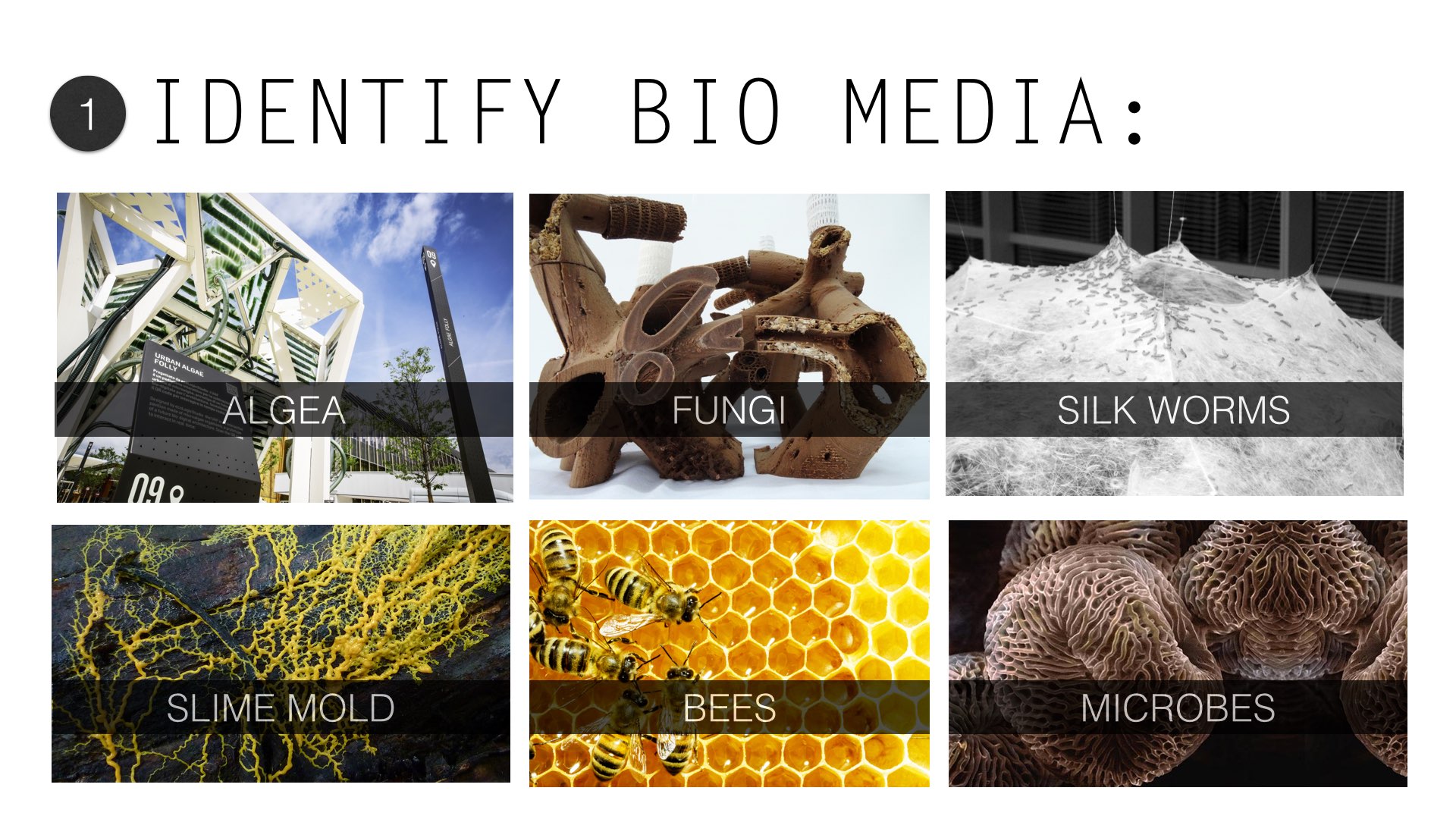
This project is both an art project and a design project. The ultimate problem being addressed is how we can incorporate living systems into our design practice. In the age of the anthropocene, I will argue, it is imperative to be working symbiotically with the “natural” world around the “artificial” one. This project may be a research endeavor to explore one particular living system or a series of smaller experiments using multiple living organisms. The project will seek to show (1) how we can leverage technology and mathematics to model organic systems to better understand how they function, (2) how we can “merge digital and biological fabrication to deliver a holistic and sustainable design approach”[1] and (3) how we can use specific living organisms (silk worms, algae, bacteria, fungi) to grow rather than build our environment.
This project will also have an art focus. Aesthetically the project will lean heavily on the work of Buckminster Fuller, Francois Roche, Alisa Andrasek, and Nervous System. The form of the sculpture will be rooted in geometrical symmetries and playful extrapolations from natural phenomenon. Conceptually, the project will also seek to express the notion that we are living in a fractal multi-verse—all a part of an endless and repetitive pattern. Once we grok[2] this concept, we understand that we are, at the same time, both a part of the whole and of the nothingness. We will understand that to incorporate living systems into our environments is to incorporate ourselves with all that ever was, is, and will be.
[1] Oxman, et.al. Silk Pavilion: A Case Study in Fibre-Based Digital Fabrication
[2] Grok means to understand so thoroughly that the observer becomes a part of the observed—to merge, blend, intermarry, lose identity in group experience. Concept taken from Robert Heinlein’s Stranger in a Strange Land.
Prototype II: Experiments in Modelling
Domain Refined:
1. Architecture
- Building at the large-scale
- Relating space to culture/philosophy/geopolitics – the future of society
- Building in the age of the anthropocene
2. Digital Fabrication
- 3D modeling
- Parametric Design
- Computational Simulations
- Robotic building
3. Biological Fabrication
- Materials investigations
- Living systems (silk worms, fungi, algea)
Synthesis:
I am studying digital and biological fabrication because I want to find out how to build at the architectural scale using alternatives materials and computational techniques in order to understand better methods of living in the age of the anthropocene.
Note from the 2015 Acadia Conference:
“Computational Ecologies: Design in the Anthropocene, seeks to expand the topic of environmental discourse beyond purely practical issues of “performance” as a general means of engaging experimental contemporary design that explores aesthetic, conceptual, and even philosophical levels as well. In the context of such work, the discipline of architecture, conceived as both a technological and a cultural endeavor, becomes immersed in a much broader geophilosophical debate regarding the future of society and by extension the built environment in the age of the Anthropocene.”
Questions:
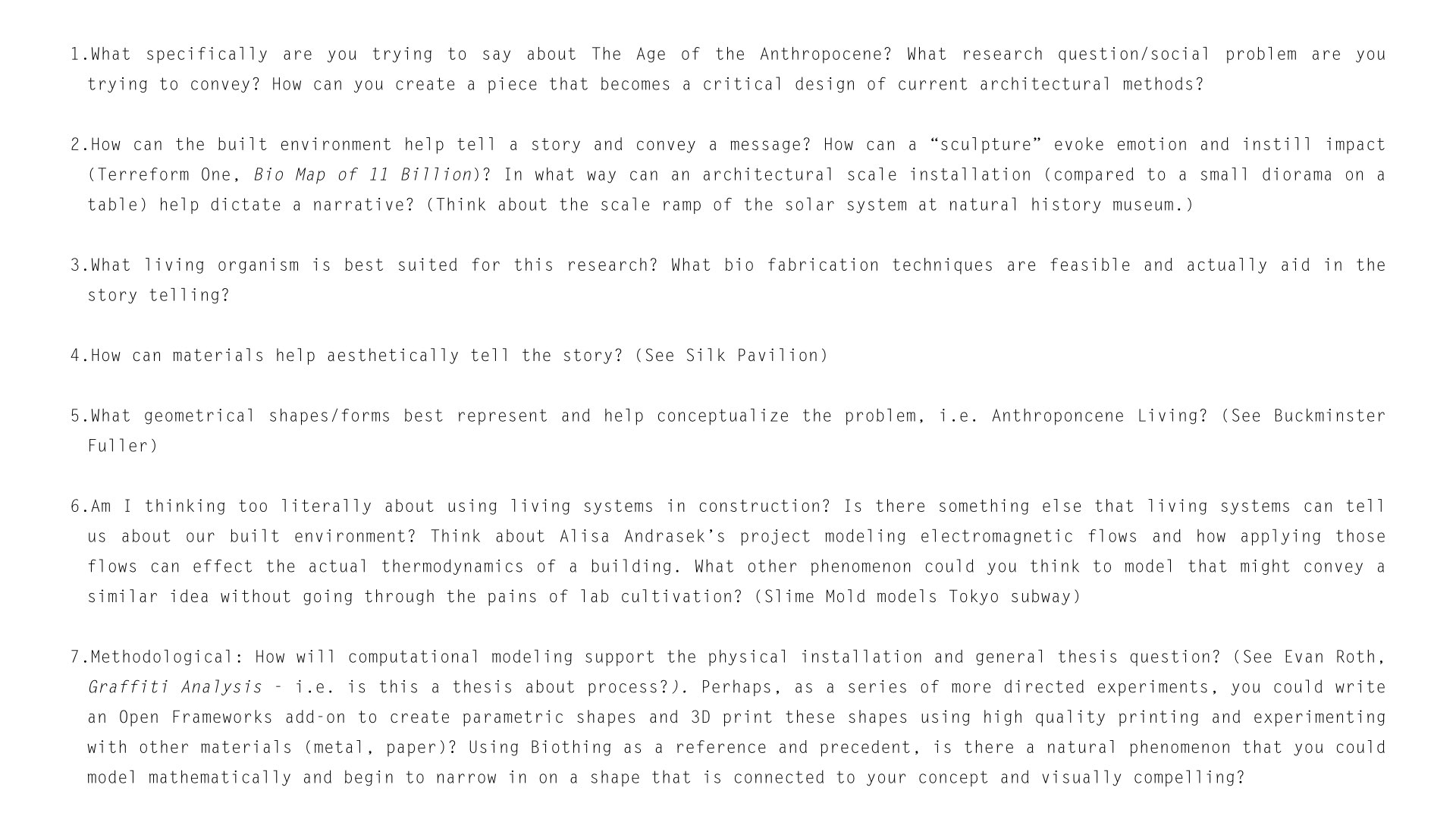
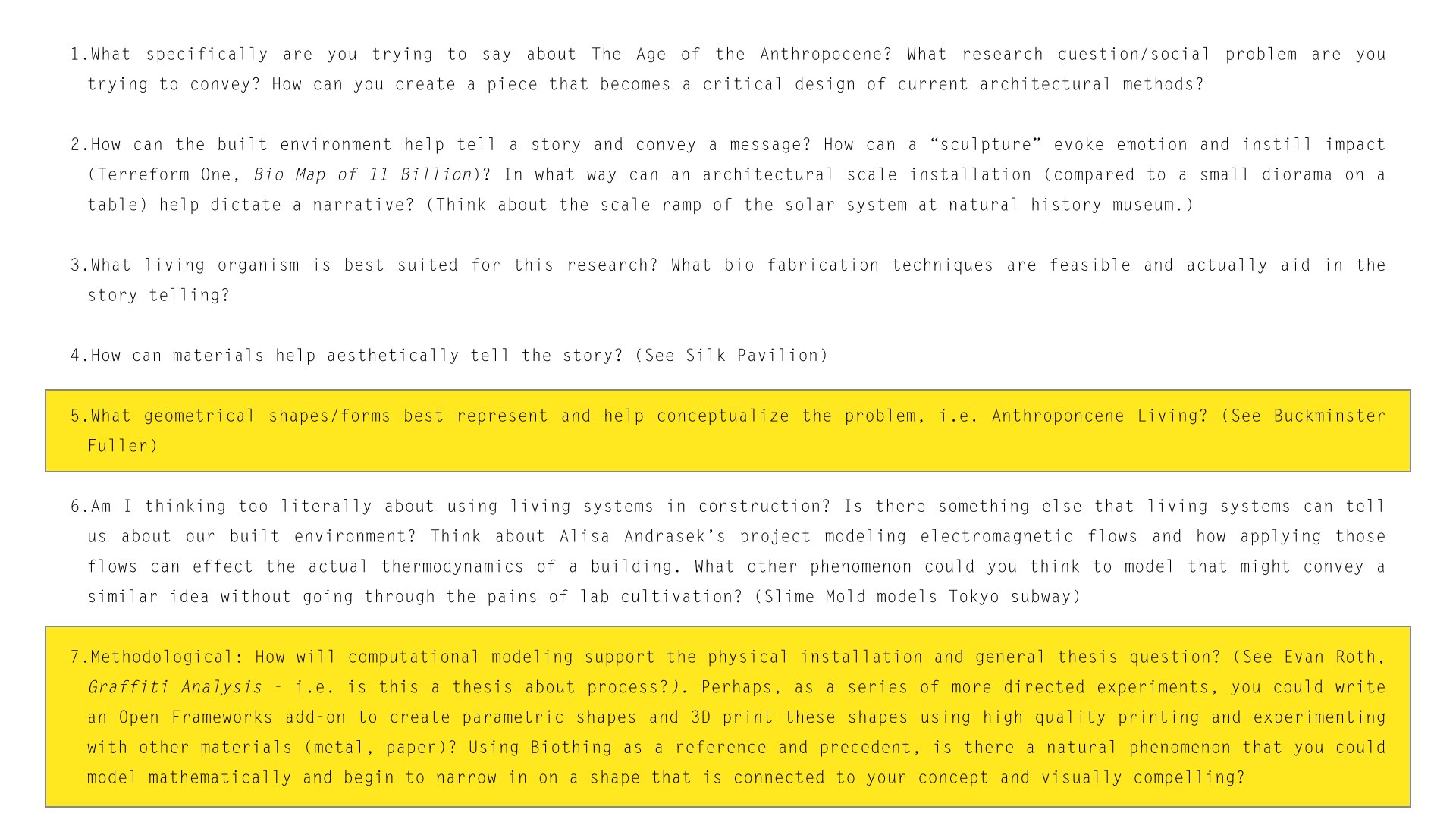
1. What living organism is best suited for this research? Will using silk worms be feasible? Where will I do it? If I use Silk Worms, how will the project differ from Silk Worm Pavilion? Are there other living organisms/systems that are better suited for the project, like bacteria? How could bacteria be implemented as a building material?
2. Are you thinking too literally about using living systems in building? Is there something else that living systems can tell us about our built environment? Think about Alisa Andrasek’s project modeling electromagnetic flows and how applying those flows can effect the actual thermodynamics of a building. What other phenomenon could you think to model that might convey a similar idea without going through the pains of lab cultivation?
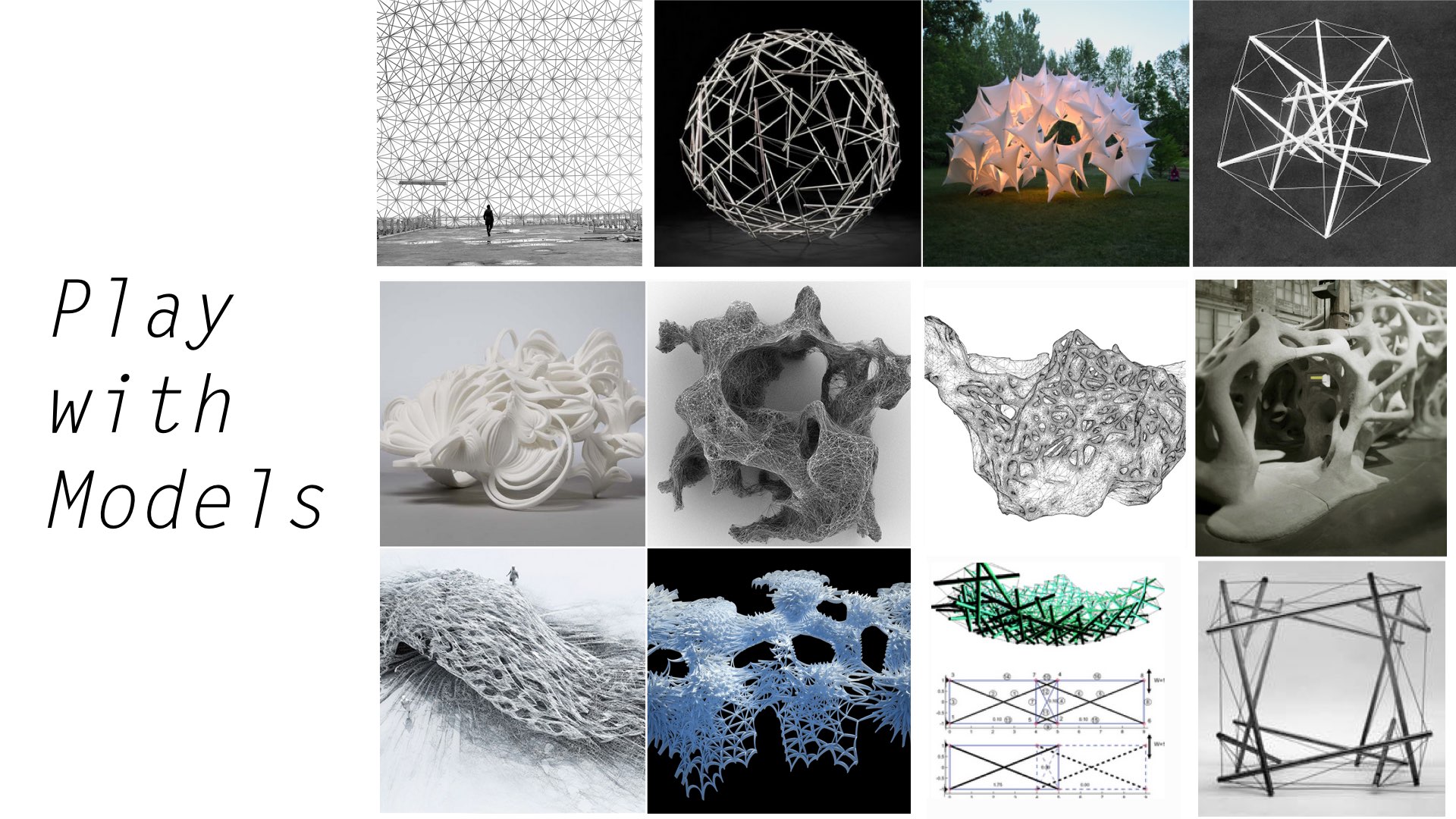
3. What geometry is going to best relay your concept? Can you write an Open Frameworks add-on that helps you to create parametric shapes and could help you narrow in on a shape that works? Perhaps, as a series of more directed experiments, you could write a software and 3D print these shapes using high quality printing and experimenting with other materials (metal, paper)? Using Biothing as a reference and precedent, is ther a natural phenomenon that you could model mathematically and begin to narrow in on a shape that is connected to your concept (fractal universe) and visually compelling?
4. Building at the large scale will be challenging. What space will you use? How will you be able to accomplish this component? Can you research how other people install/construct large scale works?
5. What specifically are you trying to say about The Age of the Anthropocene? What research question/social problem are you trying to convey? How can you create a piece that becomes a critical design? Looking at Hypnosis Room, how can the built environment help tell a story and convey a message? How can a “sculpture” evoke emotion and instill impact?
Central Characteristics/Adjectives:
Geometrical – Mathematical
Biological – Inspired by nature – Natural systems
Fluid – Flowing – Moving while still
Cellular Automata
Fractal – Patterned
For prototype II I wanted to continue to play with form and to begin to bring those forms to life digitally. I am beginning now to explore digital fabrication and the process of making physical objects through computational modeling. I wanted to hone in a bit more on the geometrical aesthetic. I also wanted to experiment with modeling geometries and work a bit with Rhino/3D modeling software to try 3D printing.
Experiment I: Parabolic model // OpenFrameworks


Experiment II: Spherical model // OpenFrameworks

Experiment III: Geodesic Dome // Rhinoceros

Experiment IV: Rotegrity Sphere // OpenFrameworks

Rotegrity Sphere in Rhinoceros (courtesy of Terreform One)

Experiment V: Rotegrity Sphere (Simplified) // Rhinoceros


Inspirations:


Francois Roche // I've Heard About...
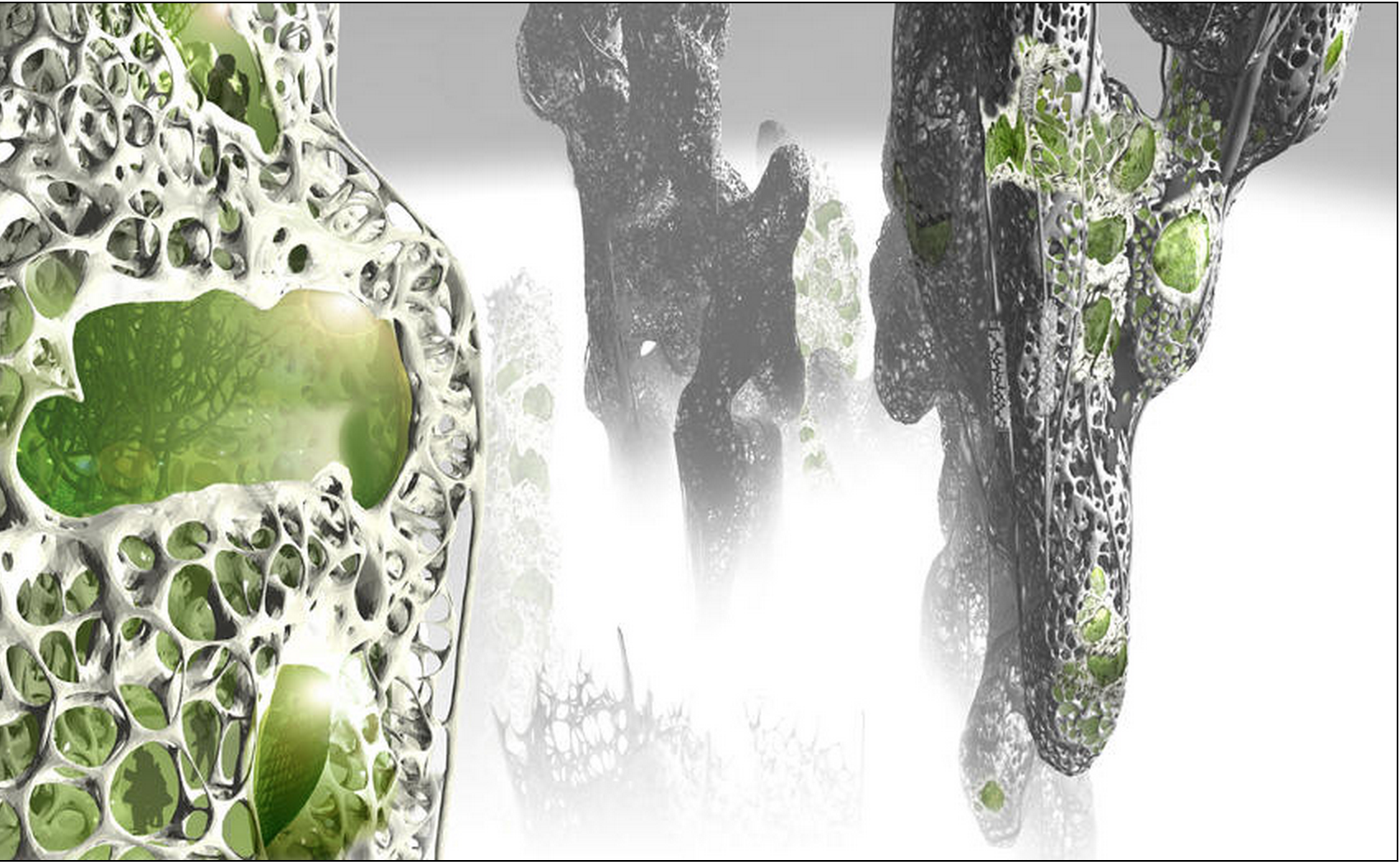

Francois Roche // Hypnosis Room


Alisa Andrasek


Bio Design //\\ Critical Design

Image: Mobile Service Stations, Extrapolation Factory

Image: Vivorium, alischachtschneider.com
Image: Synthetic Kingdom, daisyginsberg.com
Interviews:
Elliot Montgomery, Extrapolation Factory
Ali Schachtschneider, GenSpace
Readings:
- Bio Design: Nature + Science + Creativity
- Bio Design essay provided by William Meyer (download here)
- Simon Understanding the Natural and Artificial Worlds
- Synthetic Aesthetics: Investigating Synthetic Biology's Designs on Nature
- Toward's a Critical Design
- Next Nature
References:
- Anthony Dunne's Design Noir
- Dunne & Raby's Critical Design FAQ
- James Auger's Speculative Design paper
- MOMA's Design and Violence
- Simon Grand Method Toolbox
- Julien Bleaker Design Fiction
- Bruce Sterling essay on The New Aesthetic
- Amy Congdon - Bio Design and Speculation
Terms:
“BioDesign is the integration of design with biological systems, often to achieve better ecological performance. In contrast to design that mimics nature or draws on biology for inspiration, BioDesign incorporates living organisms into design as building blocks, material sources, energy generators, digital storage systems and air purifiers, just to name a few possibilities” (Meyers).
“Critical Design uses speculative design proposals to challenge narrow assumptions, preconceptions and givens about the role products play in everyday life” (Dunne).
Earlier this week, I watched a documentary about Buckminster Fuller called Thinking Out Loud. Fuller was truly an innovative thinker who was constantly pushing the boundaries of our imaginations to invent better ways of living. One such example was the Fuller Home—his answer to how to improve the home building industry. He wanted to reimagine the way homes were manufactured and wanted to make them “accessible, light-weight, easy to construct,” and circular rather than angular. Fuller imagined delivering these homes by air and dropping them right into place on one’s land. While today we do see his geodesic domes almost everywhere, we are still living in homes that are manufactured in the same way they have been for almost 100 years. However, one technological innovation that in the 20th century Buckminster Fuller could never have imagined has recently appeared that may just disrupt the way we live and even the way we understand ourselves: In a recent YouTube video from China building manufacturers showed a series of homes that were made using a giant 3D printer.
Print the Legend is a documentary showcasing the rise of the desktop 3D printing industry (Makerbot, FormLabs). With crowd funding (Kickstarter) and a ripe venture capital community, the industry is becoming flush with cash and ready to skyrocket, to put 3D printers in the homes of everyone in America. 3D printers are now in fact accessible to virtually anyone; a quick Goggle search showed that you could even buy one in Walmart for $800. The invention of the Internet and the personal computer radically changed the trajectory of human kind and the way we experience our world (Internet of Things, Smart Phones). So it remains to be seen how the personal 3D printer change our lives in the next 10 years.
Scientists, specifically in the biomedical industry, have long been experimenting with 3D printed biomaterials, but how far away are we from being able to 3D print biomaterials in the privacy of our own homes? Will we even be able to 3D print our homes? And if so, will those homes be grown using biomaterials that can auto-generate on the scaffolding from which they are created? Will we be able to print human parts using desktop 3D printers? What are the implications of growing environments and, even, growing humans?
Print The Legend briefly touches on the implications of 3D printing by telling the story of Cody Wilson who 3D prints guns and gun parts. While Wilson is a very controversial character, in my mind he is playing an important role by forcing people to think about the implications of this technology. He is not a critical designer, but taken as a case study, his “movement” could certainly be reframed into a design project à la Speculative Everything.
This week I had a conversation with Elliot Montegomery, a former student of Dunne and Raby at the Royal College of Art and now head of a Design Futures Studio, Extrapolation Factory. We discussed the important role of Critical Design and how perhaps, when it comes to Bio Design—where we incorporate living systems into our product—Critical Design becomes all the more important. Alexandra Daisey Ginsberg’s project, The Synthetic Kingdom, “looks at the consequences of developing and using—or misusing—new life forms for our own ends” (Meyers, pg. 168). In her project she categorizes new forms of life called Synthetica, which are “designed and modified organisms” (Synthetic Aesthetics, pg. 54). In this new era of Bio Design—where humans more than ever become the architects of the world—how should critical designers help to shape the way we use and understand our technologies? In our world of synthetic biology and 3D printers, is it now time to move past the era of Critical Designer and into the era of Critical Engineer?
Speculation:
3D printed biomaterials are commonplace and will radically change the way we think about what is grown. Even architects who are already thinking about the grown environment will be reimagining what it means to use biomaterials. Citizen science and bio-hacking will take on a whole new meaning. How will the next generation of technologies like programmable matter and 4D printing impact our world?
Get Out of the Building
This week I explored the city to find inspiration:
MUSEUM OF MATH



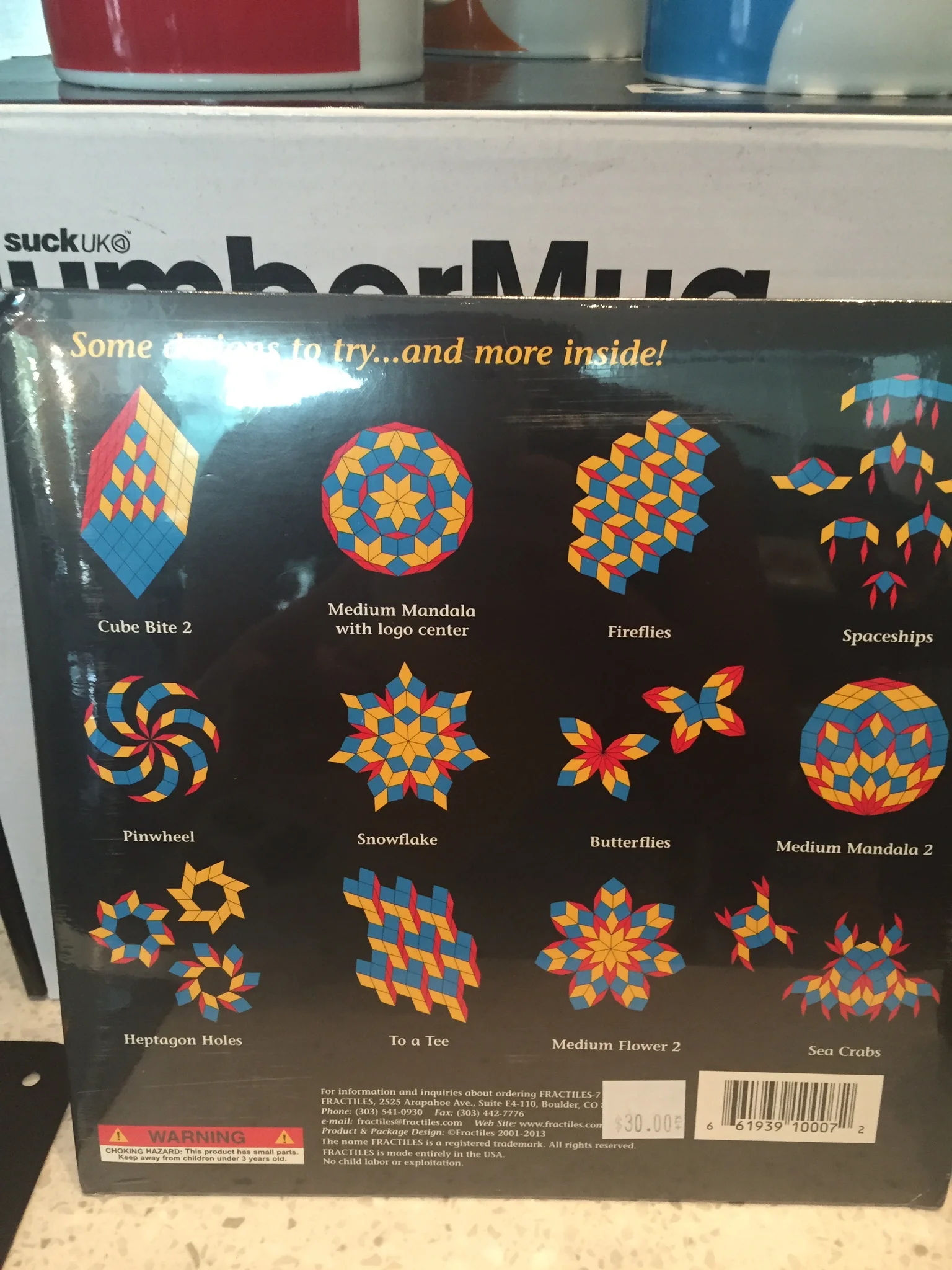
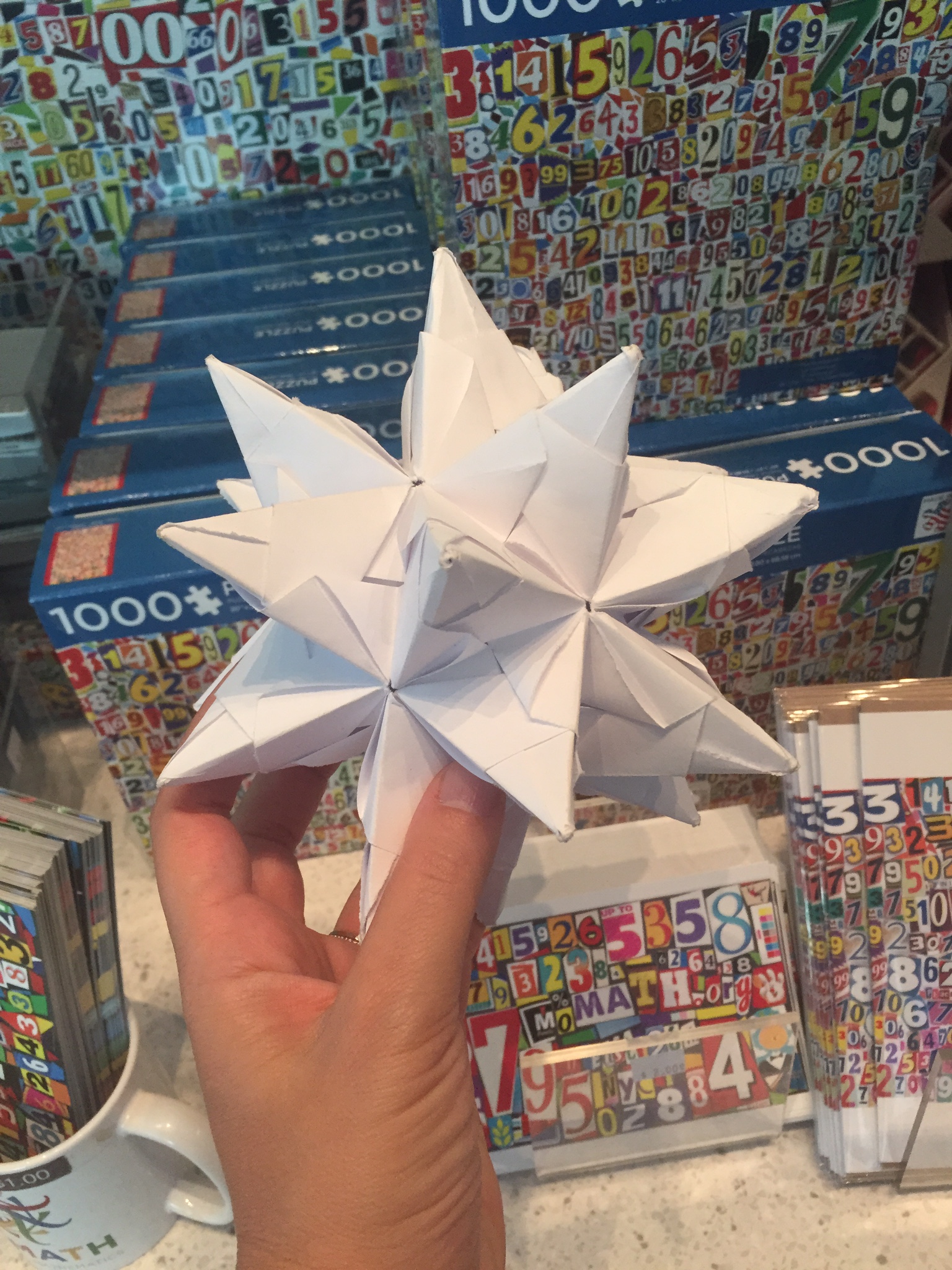
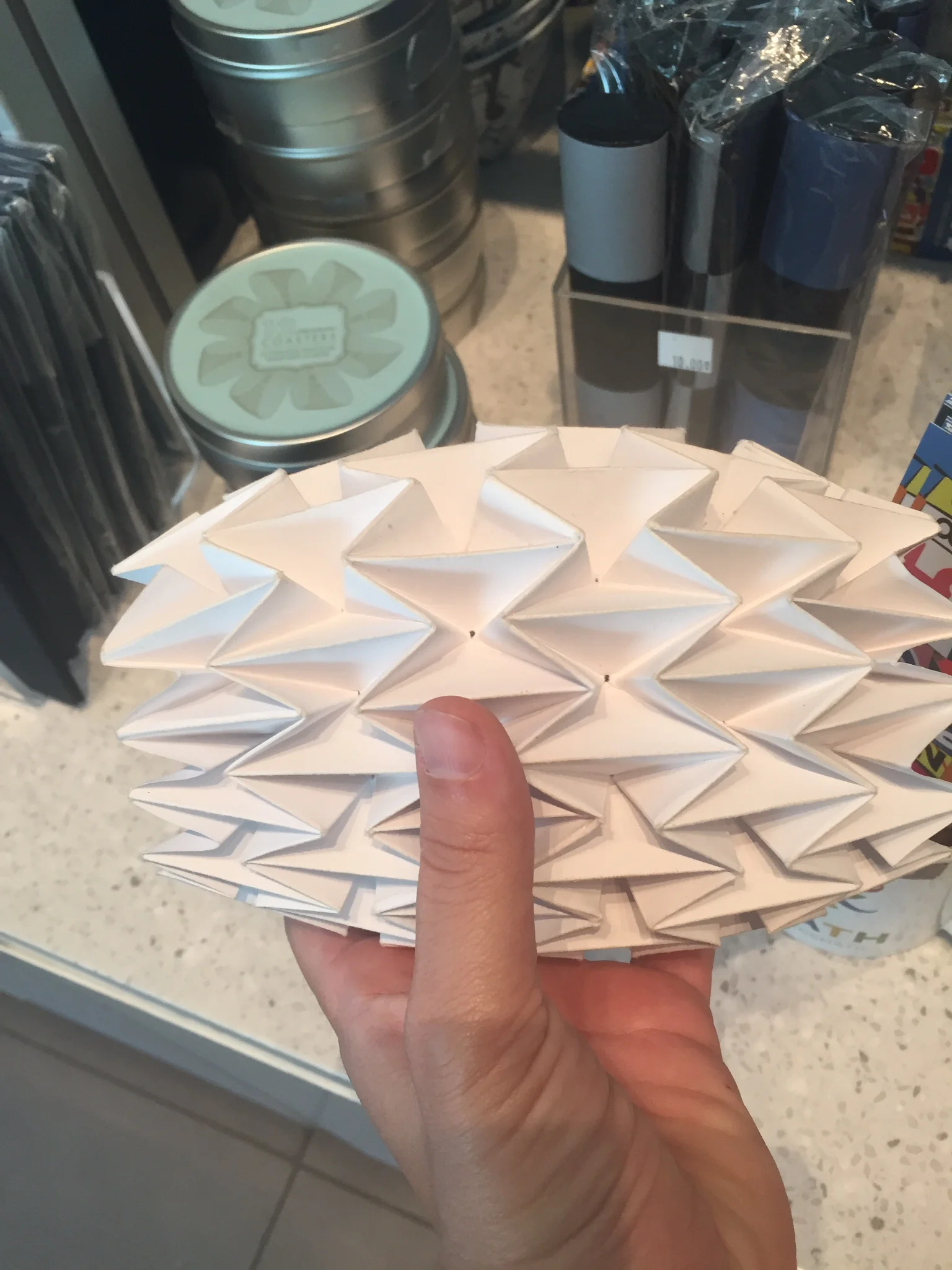
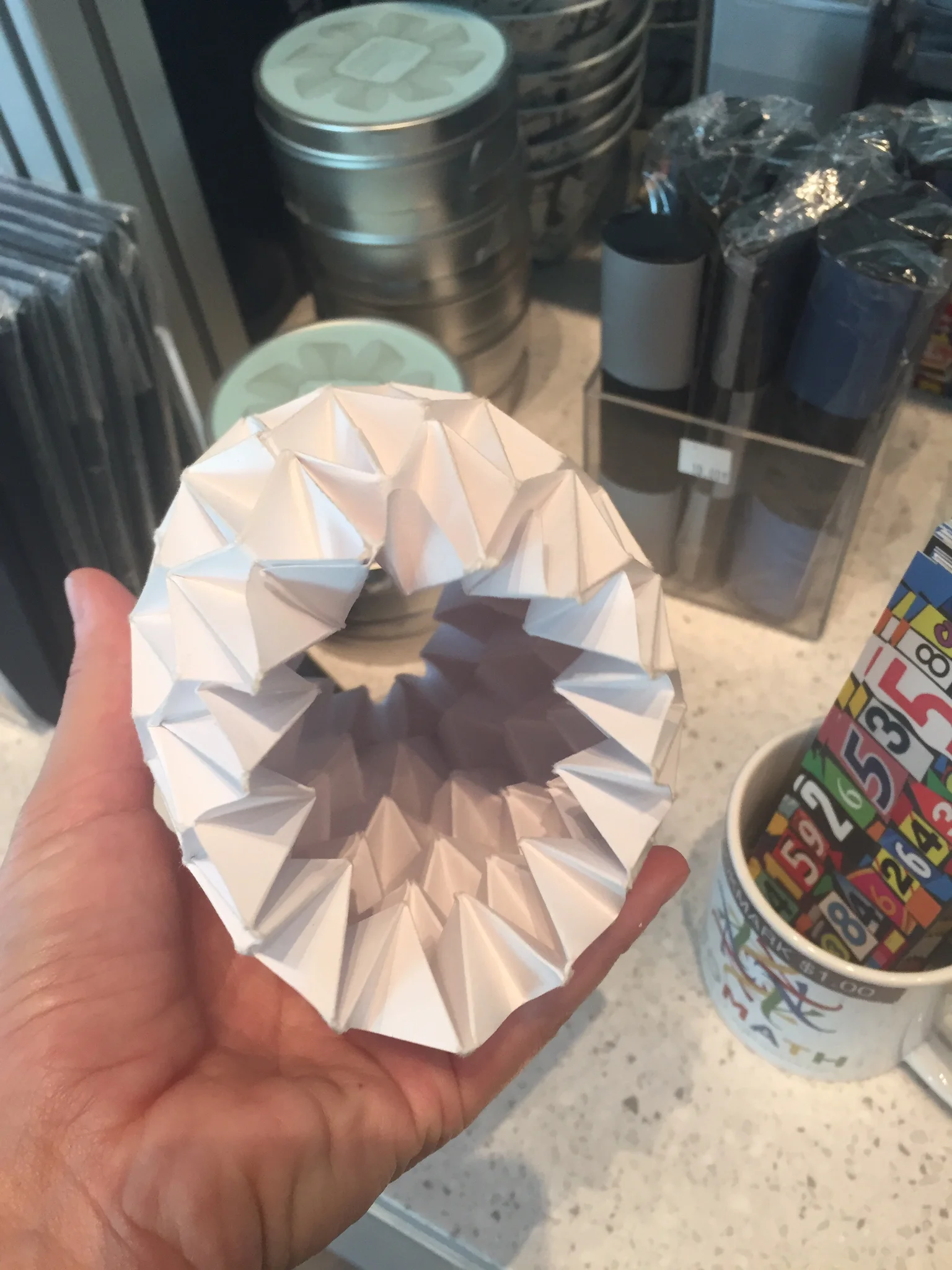
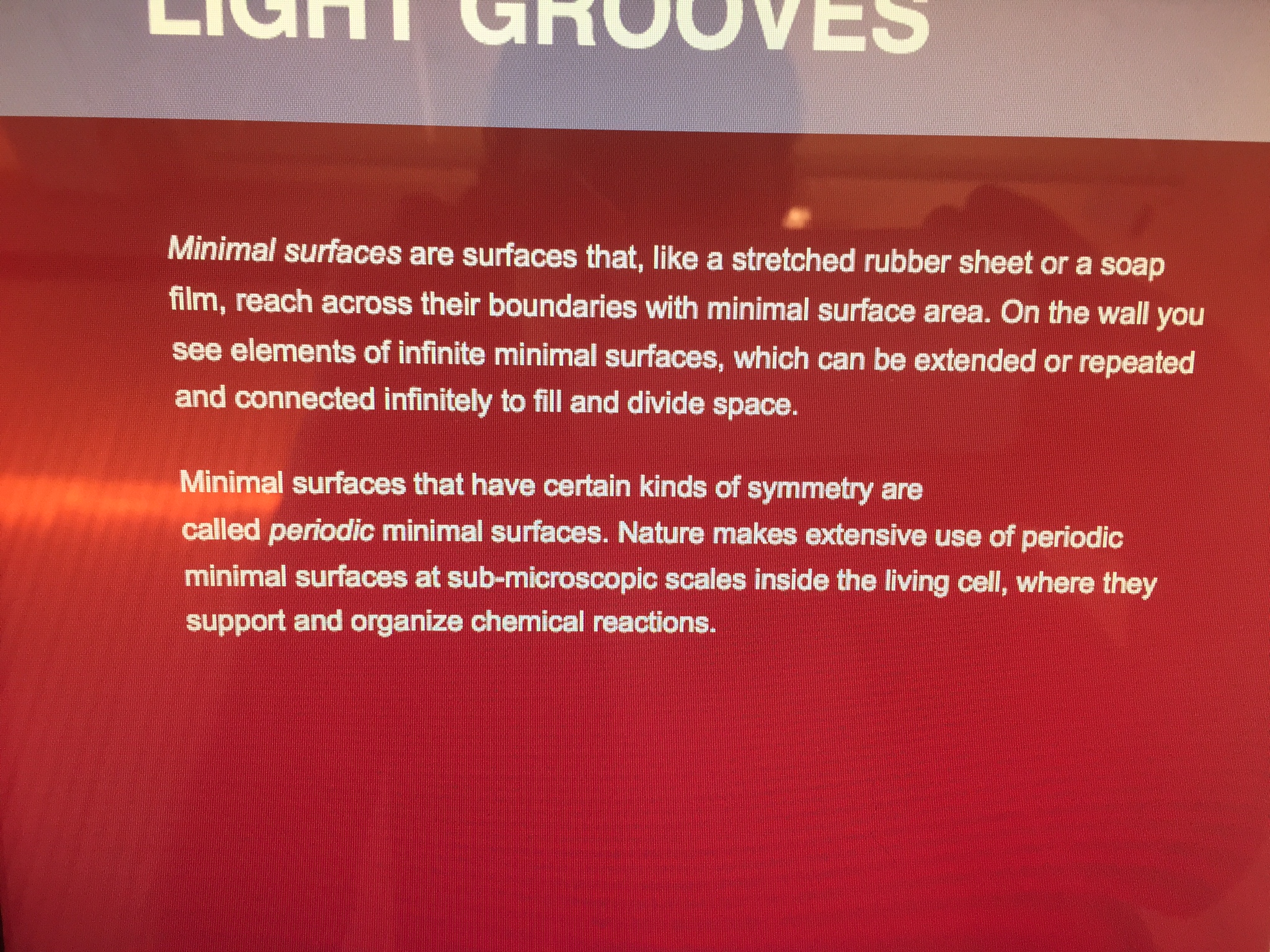


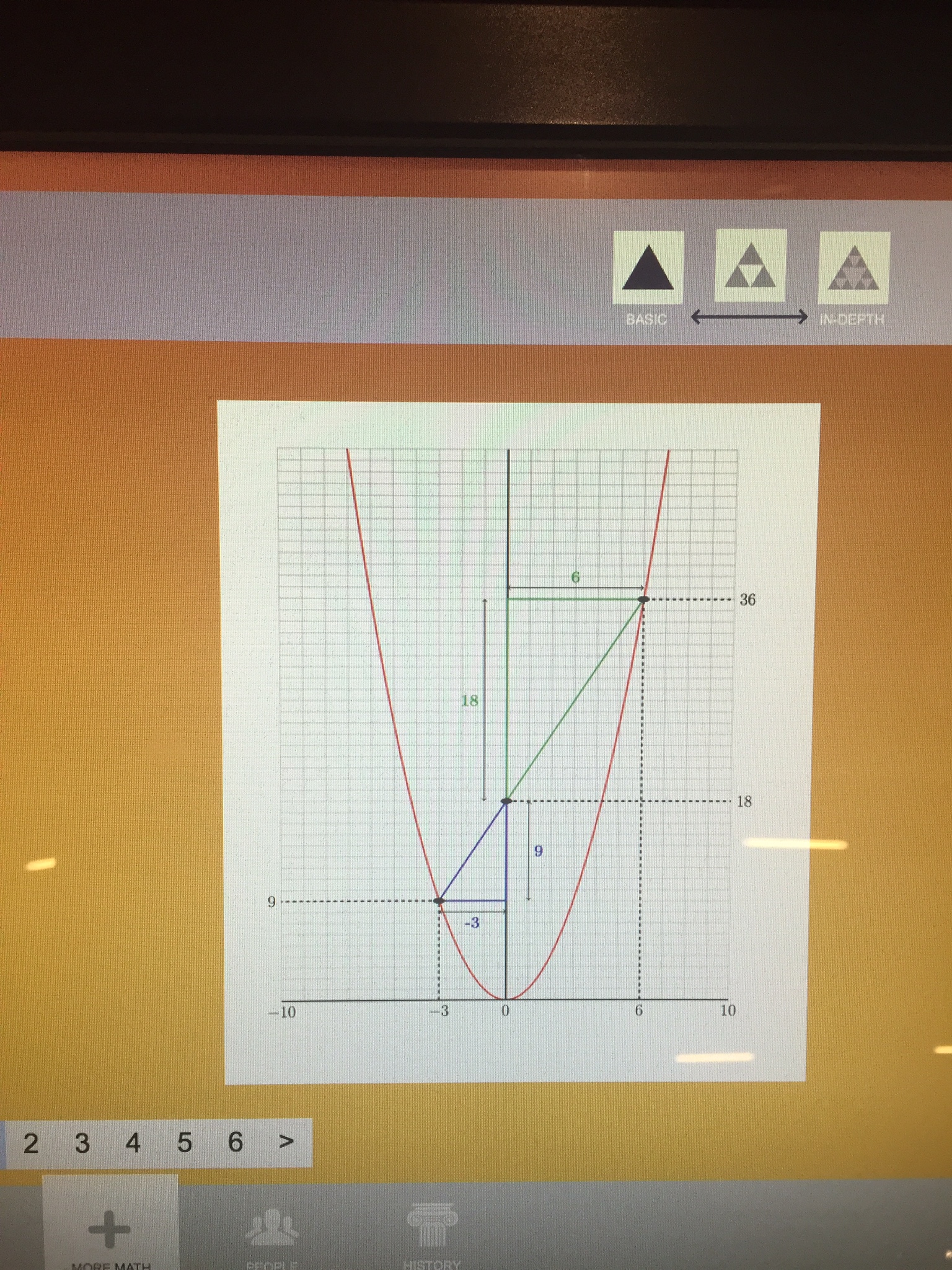

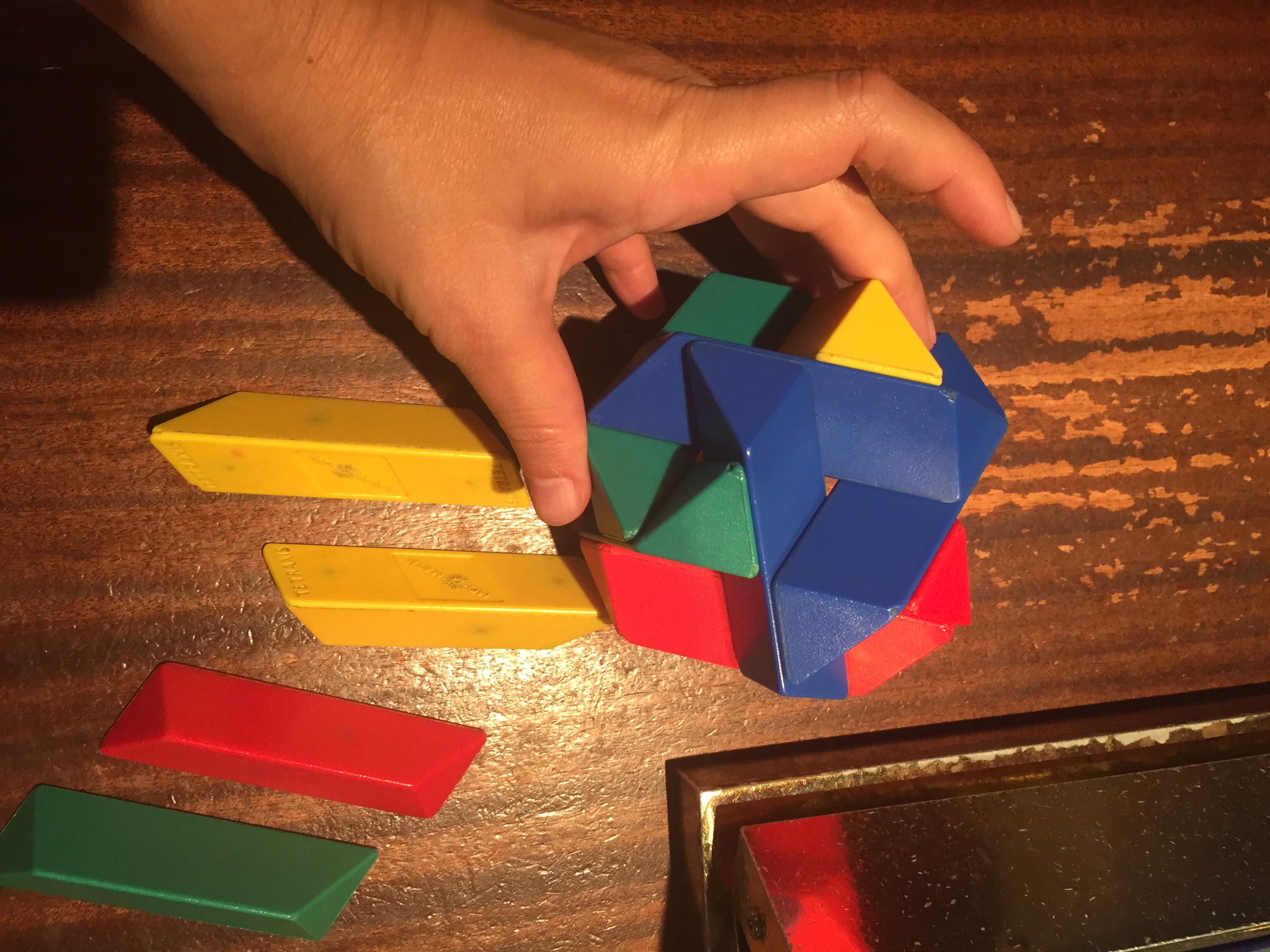


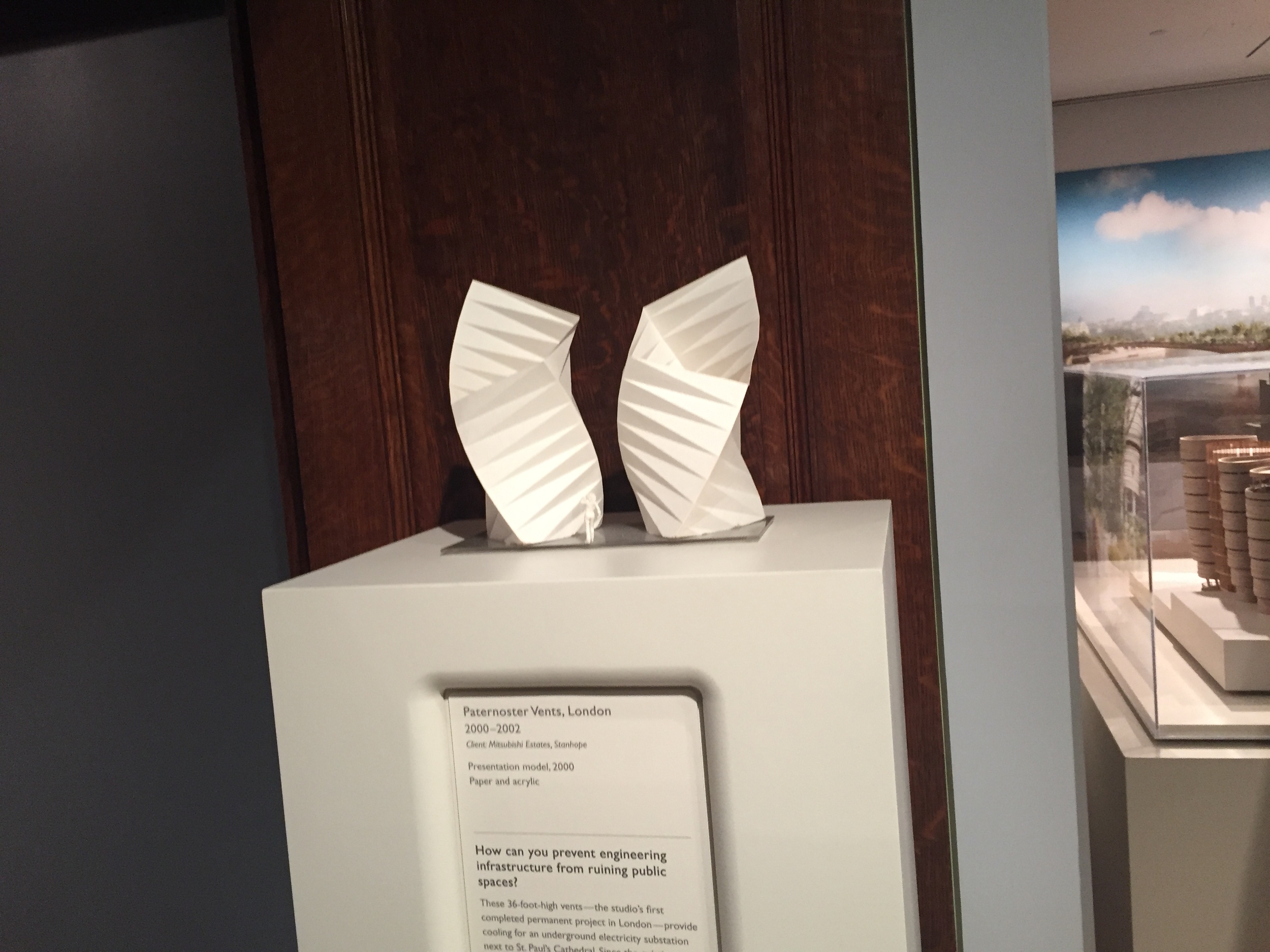



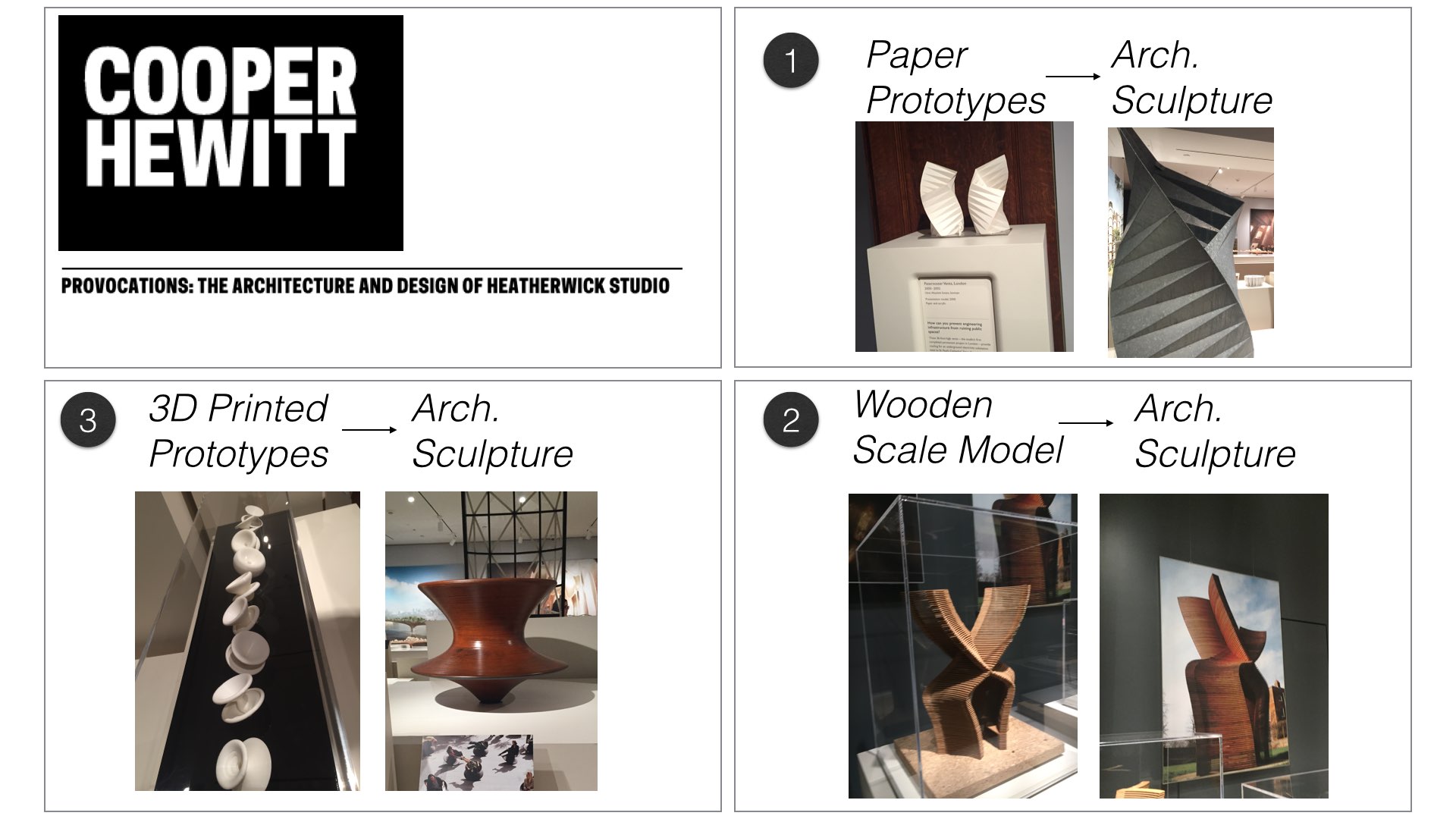
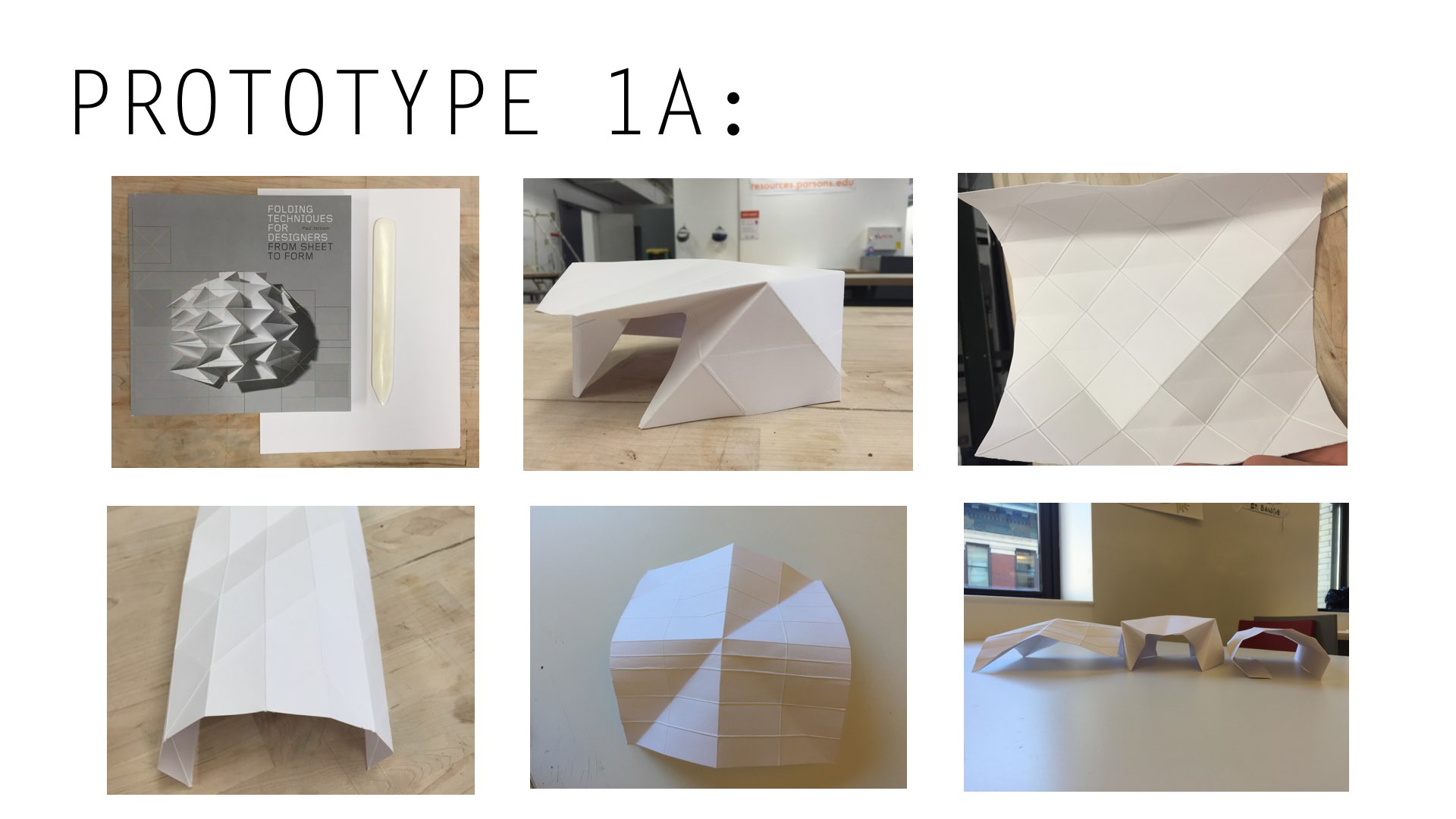
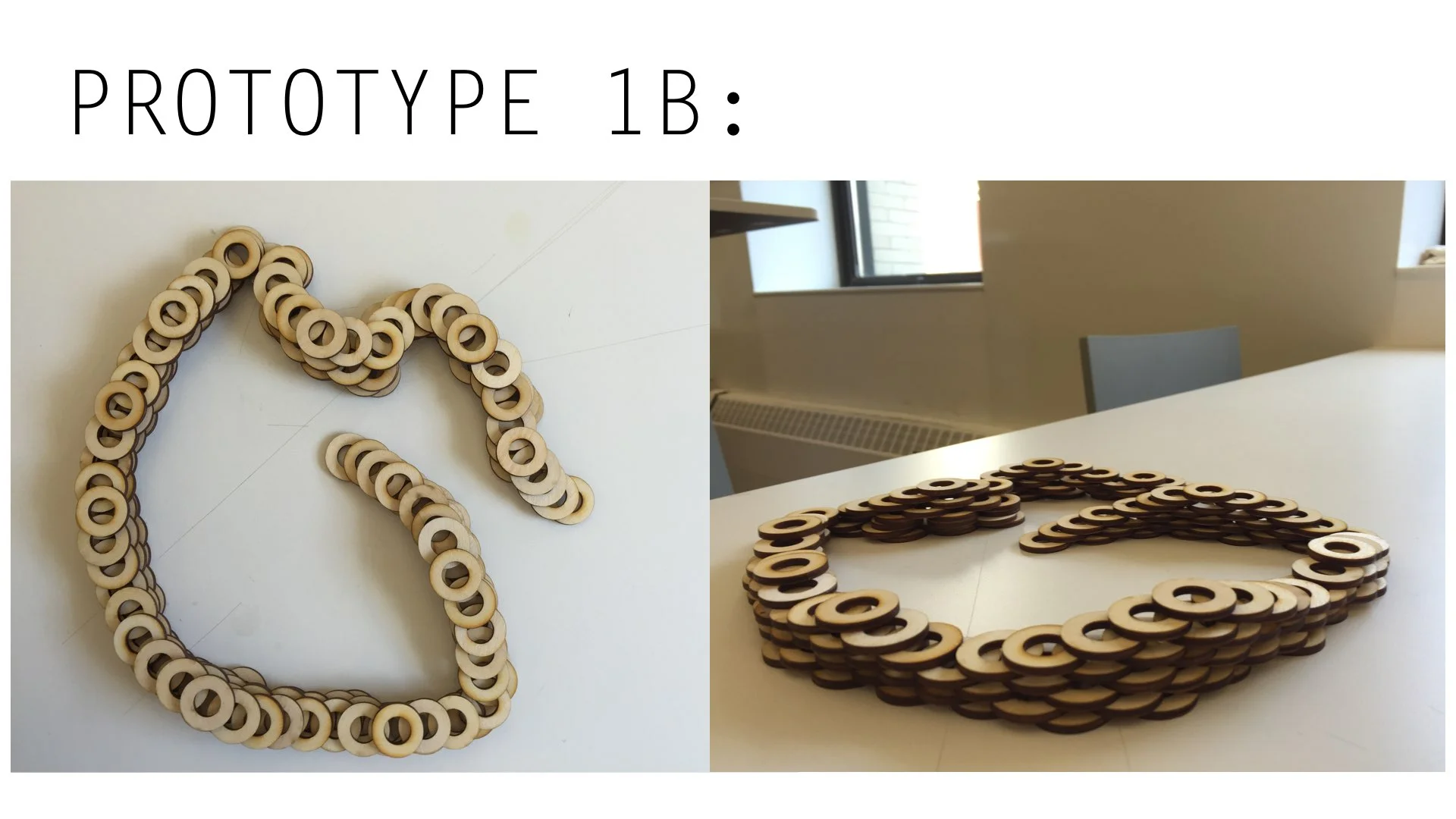
I was very inspired by my visits to both the Cooper Hewitt and the Museum of Math. I think that aesthetically, they both express similar attributes. From the images above you can see that there is a common theme of geometry as aesthetic. For me, I have always been attracted to math because of the forms that are expressed through the language of mathematics. Even the language itself is aesthetically pleasing to me - the curves of an integral sign and the edges of a sigma. The projects at the architecture exhibit take these mathematical forms and bring them to life in real world, physical forms. This to me is incredibly interesting - that something so small like an equation can be realized into an awe-inspiring scale. Architecture, for me, is a way that these small mathematical properties, angles, and formulae can be transformed into something that makes a person look up and realize their insignificance or "smallness". I also was very interested how the Cooper Hewitt and the MoMath exhibits showed the process of creating by using 3D printing and paper prototypes. I don't know exactly where my thesis is heading, but seeing these two museums made me realize that I am going in the right direction. Someone out there speaks my language and soon enough I will be able to articulate my concept with both language and physical form.
SCULPTURES AT SCALE


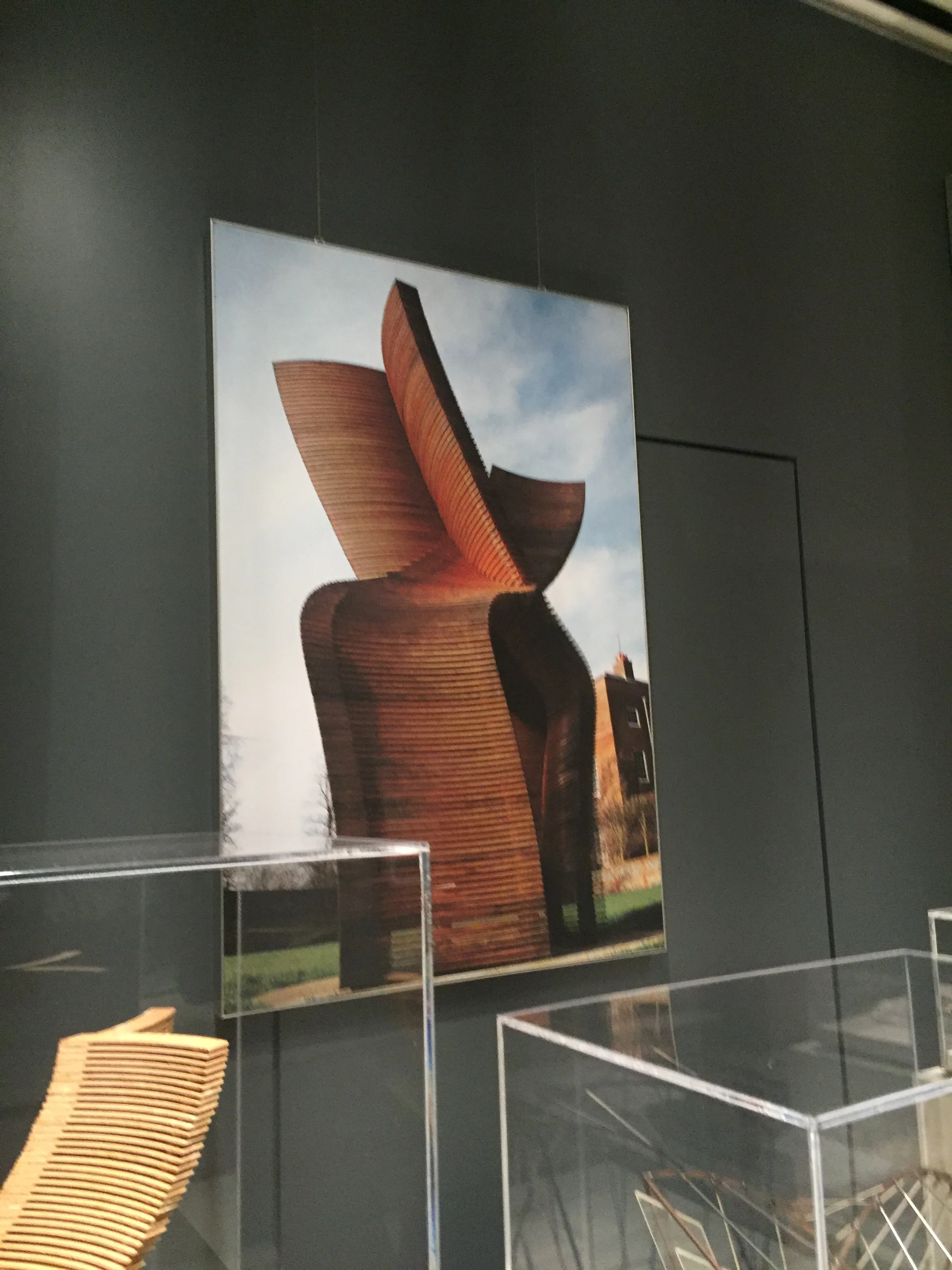
I also ran into this architectural sculpture in the lobby of The New School. It appeals to me both aesthetically because of its wave like pattern. I also like that it is made from natural materials which appear to be some kind of paper or very pliable wood material. This made me think about prototyping and how to incorporate simple materials.

Courtesy of Kynd
Algorithmic Drawing
#ifdef GL_ES
precision mediump float;
#endif

#define PI 3.14159265359

uniform float u_time;
uniform vec2 u_resolution;

float F(float x, float p, float w){
    return (smoothstep(p-w*.5,p,x) + smoothstep(p+w*.5,p,x))-1.0;
}

// Made a function to model the mathematical functions outlined
//in Kynd's flikr page here:
//https://www.flickr.com/photos/kynd/9546075099/
float Curve (float constant, float x, float power){

    return constant - pow(abs(sin(PI * x / 2.0)),power);
}

void main() {
    vec2 st = gl_FragCoord.xy/u_resolution.xy;
    vec3 color = vec3(0.);

    vec2 p = vec2(cos(u_time*0.5),0.)*.5+.5;

    float x = p.x;

    //Here we define the inputs into Curve Function:
    p.y = Curve(1.0, -1.0+2.0*x, 0.5);

    float pct = F(st.x,p.x,.1);
    pct *= F(st.y,p.y,.1);

    color = vec3(step(.5, pct), 0.0, 0.0);
    gl_FragColor = vec4(color,1.0);
}